
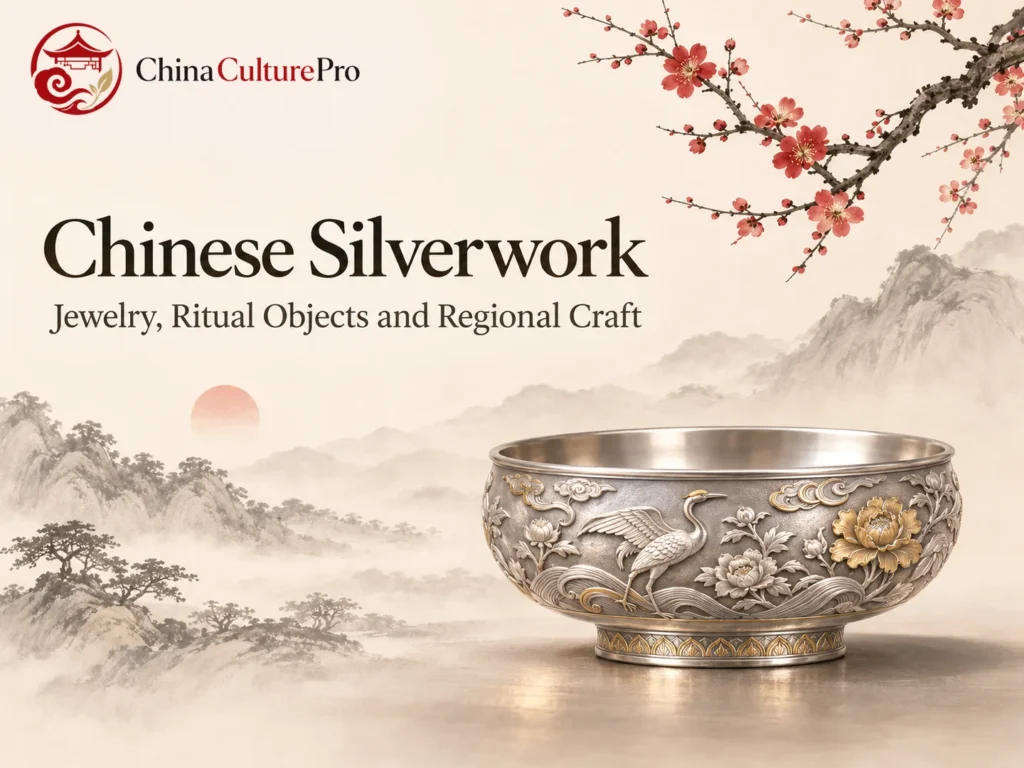

Quick Answer: What Is Chinese Silverwork?
Chinese silverwork encompasses ornaments, vessels and ceremonial objects made using silver. Makers can shape sheet metal, work its surface or assemble patterned wire. The finished object may also include another material or a gilded finish.[1][4][5]
- Techniques: Hammering can shape the metal, while chasing and wire work add different kinds of detail.
- Regional craft: Local workshops make different forms for dress, households and ceremonies.
- Object records: Read the metal, finish, manufacture and use separately.
A bright surface by itself gives limited information about the material or the object’s role.
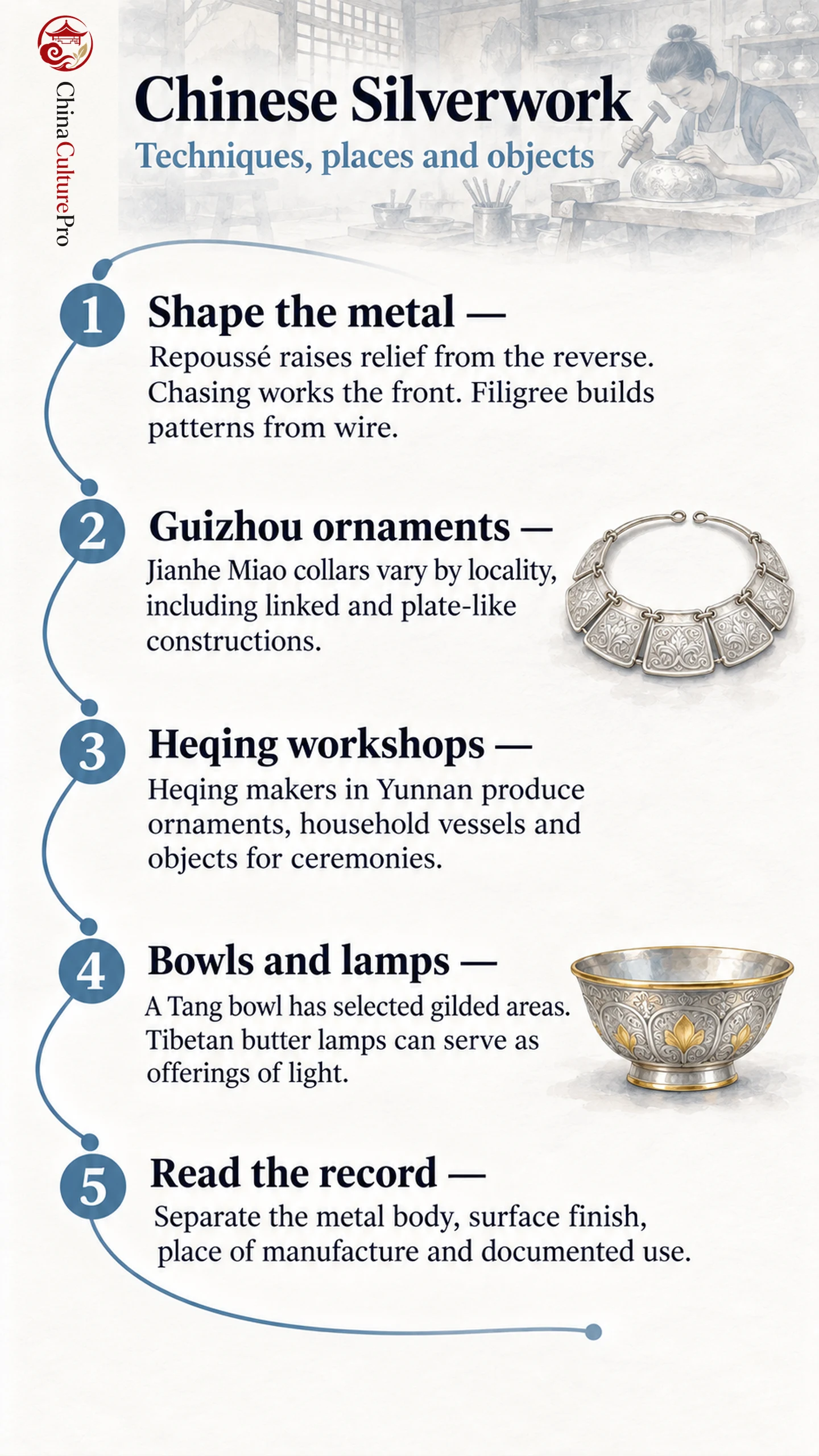
A raised leaf on a silver bowl and a loop on an ornate collar catch light in different ways. To understand the craft, look at how the metal is shaped and joined, then consider the place and purpose recorded for the object.
What Hammering, Chasing and Wire Work Do
Shaping establishes a vessel’s overall form. Relief, fine surface detail and worked wire can then give different parts of the object their patterns.[1]
| Technique | What happens to the metal |
|---|---|
| Repoussé | Working sheet metal from the reverse raises a design toward the front. Look for relief whose shapes follow the worked sheet.[1] |
| Chasing | Small tools work the front surface by tapping or pressing. The detail is formed by moving the metal without cutting it away.[1] |
| Filigree | Fine wire is twisted and arranged into patterns. The pattern can be supported by a base or form a sufficiently strong openwork structure.[1] |
A single maker may move between shaping, joining and surface decoration. The choice depends on the object’s construction and on the intended design, part of the workshop knowledge behind Chinese traditional crafts.
Miao Silver Ornaments in Guizhou
Miao (苗族, Miáozú) silver ornaments in Guizhou include collars, head ornaments, bracelets and pieces assembled from smaller worked elements. The selection and arrangement of ornaments form part of dress. The meaning of an ensemble depends on its locality and occasion.[2][3]
The inventory entry for Jianhe (剑河, Jiànhé) county distinguishes collars made in linked, twisted patterns in Gedong (革东, Gédōng) from plate-like collars in Nanzhai (南寨, Nánzhài). It also describes silversmiths drawing on motifs in women’s embroidery. These links between materials help explain how a pattern can be remade in wire or sheet.[2]
Heqing Silverwork in Yunnan
Heqing (鹤庆, Hèqìng) silverwork is associated with Xinhua (新华, Xīnhuá) village in the Dali Bai Autonomous Prefecture of Yunnan. The inventory describes workshops making jewelry, tea and drinking vessels and objects for religious use. Makers combine working sheet metal and arranging wire according to the object’s form.[4]
The Heqing entry records objects intended for several communities. The place where a vessel is made and the community that commissions or uses it can differ. The national list records the Heqing practice as a 2014 extension. This is a distinct example of intangible cultural heritage centered on transmitted craft knowledge.[4]
Silver Vessels for Dining and Devotion
A seventh- or eighth-century bowl combines a silver body with selected areas of gilding. The vessel is 13.7 cm across, with repoussé on its walls. The catalogue describes silver with parcel gilding, which means that selected areas are gilded. Its date places it in the Tang dynasty.[5]
An eighteenth-century Tibetan butter lamp in a collection record shows silver in a devotional context. In Tibetan Buddhist practice, such lamps can serve as offerings of light. The object record supplies the material, period and ritual category. Evidence for a specific ceremony would require further documentation.[6][7]
How to Read a Silver Object’s Record
Read the material and finish fields in museum collection records before assuming a metal’s composition from its color. If a record says “silver with parcel gilding,” the gilding describes part of the surface. A measured alloy composition would require a separate technical record.
Keep production place, documented use and ownership in separate fields. Similar ornament can appear in objects made for different customers, and a workshop location does not identify each owner. The guide to Chinese antiquities provenance explains how records can support or limit those connections.
FAQs About Chinese Silverwork
Is Chinese silverwork always pure silver?
The material depends on the individual piece. A record can distinguish a silver body, applied gilding and other materials. Appearance alone cannot establish the composition.
What is the difference between repoussé and chasing?
Repoussé raises relief by working the metal from the reverse. Chasing works details on the front. Both can be used on one object.
Are Miao silver ornaments the same in every region?
Ornament forms vary by locality. The documented Jianhe collar types show distinct constructions even within one county.
Does a gold-colored area mean the object is solid gold?
A gold-colored area can be gilding on another metal. The Tang bowl’s recorded silver body and parcel gilding illustrate this distinction.
資料來源
[1] Victoria and Albert Museum. A Guide to Metalworking Techniques
[2] China Intangible Cultural Heritage Digital Museum. Miao Silver Ornament Forging Techniques, Jianhe
[3] Bowers Museum. Miao: Masters of Silver
[4] China Intangible Cultural Heritage Digital Museum. Heqing Silver Forging Techniques
[5] The Metropolitan Museum of Art. Bowl, 1974.268.12
[6] Rubin Museum of Himalayan Art. Butter Lamp, C2008.27
[7] Rubin Museum of Himalayan Art. Butter Lamp, L2013.32.2