


Quick Answer: What Is Chinese Onomatopoeia?
Chinese onomatopoeia (象声词, xiàngshēngcí), also called 拟声词 (nǐshēngcí), uses words to imitate sounds.
- Examples: Animal calls, chiming, flowing water and impacts can be represented in words.[1]
- Form: Sound words can be short or repeated; repetition alone does not establish their meaning.[1][6]
- Reading: Identify what is making the sound before choosing an English equivalent.
The examples below use Mandarin readings. A written sound word is not a universal recording of a noise.
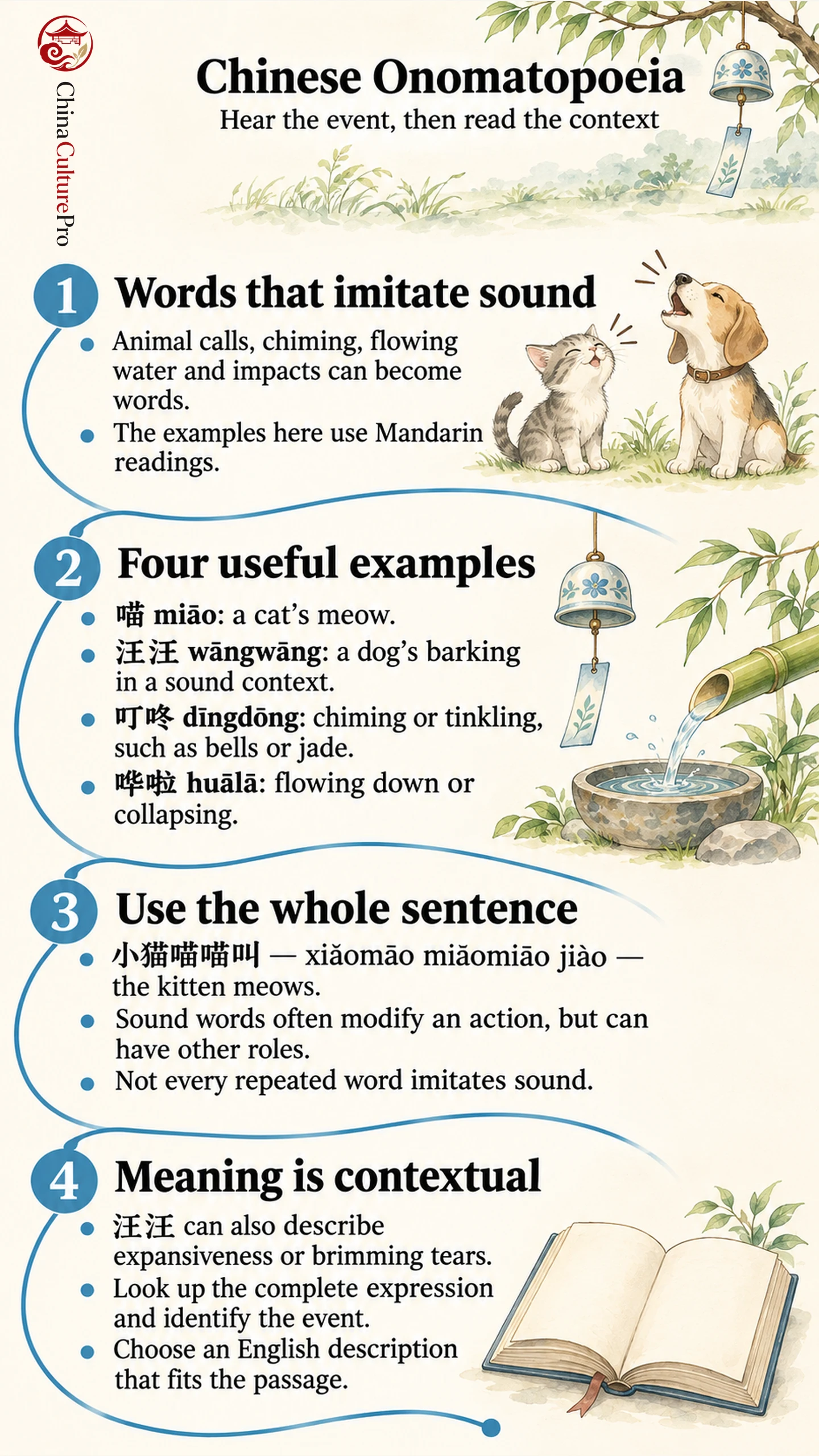
Sound words invite the reader to hear an event rather than merely name it. In a narrative, their meaning depends on the nearby object, action and rhythm. Learning a few examples is useful, but learning how to read their surroundings is more transferable.
Four Mandarin Sound Words in Context
The characters and pinyin below give dictionary readings. English descriptions identify the type of sound, not a fixed translation for every sentence.
| Word and reading | Sound meaning | Context clue |
|---|---|---|
| 喵, miāo | Cat’s meow | A cat calling or vocalizing.[2] |
| 汪汪, wāngwāng | Dog’s barking, in a sound context | A dog and a barking action.[3] |
| 叮咚, dīngdōng | Chiming or tinkling, such as bells or jade | An object striking or ringing.[4] |
| 哗啦, huālā | Sound of flowing down or collapsing | Water or material moving, or something falling apart.[5] |
A dictionary may show traditional 嘩啦 where this table uses simplified 哗啦. The spelling distinction belongs to simplified and traditional characters, not two unrelated sound words. For connected pronunciation, see Chinese tones.
How Sound Words Work in a Sentence
Sound expressions often modify an action, but they can fill other grammatical roles too.[1] For example, 小猫喵喵叫, xiǎomāo miāomiāo jiào, means “the kitten meows”: the repeated sound accompanies the calling action.
Some sound expressions can be set off by quotation marks for visual effect, without quotation marks being obligatory.[1] Read punctuation as part of how the writer presents the sound, not proof that a character is speaking ordinary dialogue.
Repetition, Sensory Language and Other Meanings
Repeated forms can contribute to vivid depiction, yet the wider expressive vocabulary also includes words associated with movement, light or other sensory impressions. Sound imitation is one part of that broader ideophonic field.[6] Do not classify a word as onomatopoeia merely because two characters repeat.
The same spelling may also have meanings unrelated to sound. 汪汪 can describe expansiveness or brimming tears as well as barking.[3] A dog nearby supports the barking reading; a description of someone’s eyes calls for a different interpretation.
Reading and Translating an Unfamiliar Sound Word
Find the event first: what object or creature is present, and what is it doing? Then look up the complete expression in a Chinese dictionary, including any repeated form.
Choose English wording that fits the passage. A descriptive phrase may work better than a sound-for-sound spelling. Preserve whether the event feels brief, repeated or continuing when the context makes that distinction clear.
FAQs About Chinese Onomatopoeia
Are all repeated Chinese words sound words?
No. Reduplication also participates in a broader expressive vocabulary, and appearance alone does not identify sound imitation.[6]
Must a sound word have one English translation?
No. The event and surrounding sentence determine which sound description makes sense; a word such as 哗啦 has more than one documented sound application.[5]
Should pinyin tones always be omitted?
No. The table uses dictionary tone readings. Follow the transcription convention of the source: expressive spoken effects and fixed written expressions need not be handled alike.[1]
資料來源
[1] Yin Binyong. Chinese Romanization: Pronunciation and Orthography, Onomatopoeic Words
[2] Ministry of Education, Taiwan. Revised Mandarin Chinese Dictionary: 喵
[3] Ministry of Education, Taiwan. Revised Mandarin Chinese Dictionary: 汪汪
[4] Ministry of Education, Taiwan. Revised Mandarin Chinese Dictionary: 丁東 and 叮咚
[5] Ministry of Education, Taiwan. Revised Mandarin Chinese Dictionary: 嘩啦
[6] Thomas Van Hoey. Chinese Ideophones and Prototypicality