
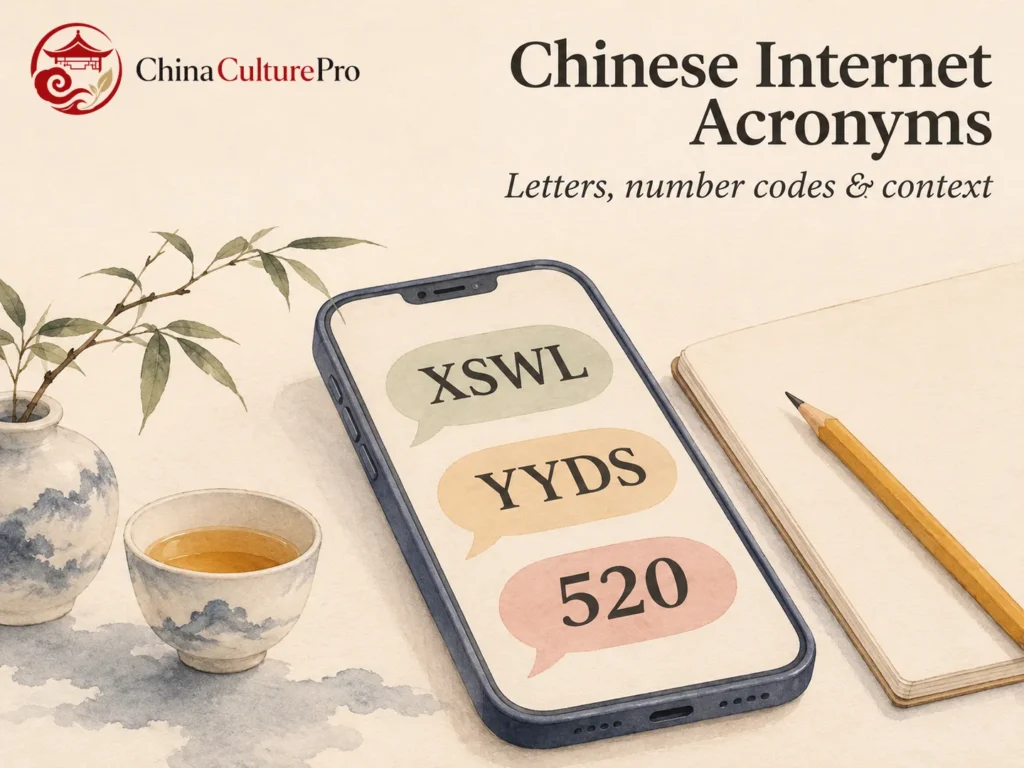

Quick Answer: How Do Chinese Internet Acronyms Work?
Many Chinese internet acronyms shorten Mandarin phrases using the first letters of pinyin (拼音, pīn yīn), the romanization system used to write their pronunciation. Understanding the expanded phrase is only the first part of reading a reply.[3]
- Letters: XSWL (笑死我了, xiào sǐ wǒ le) represents a Chinese laughter expression rather than English words.[1]
- Numbers: A code such as 520 uses a sound association; it is not a set of pinyin initials.[4]
- Context: A short response can express enthusiasm, agreement or distance depending on its surroundings.[2]
The examples below help with recognition. They are not a ranking of what every Chinese speaker currently uses.[5]
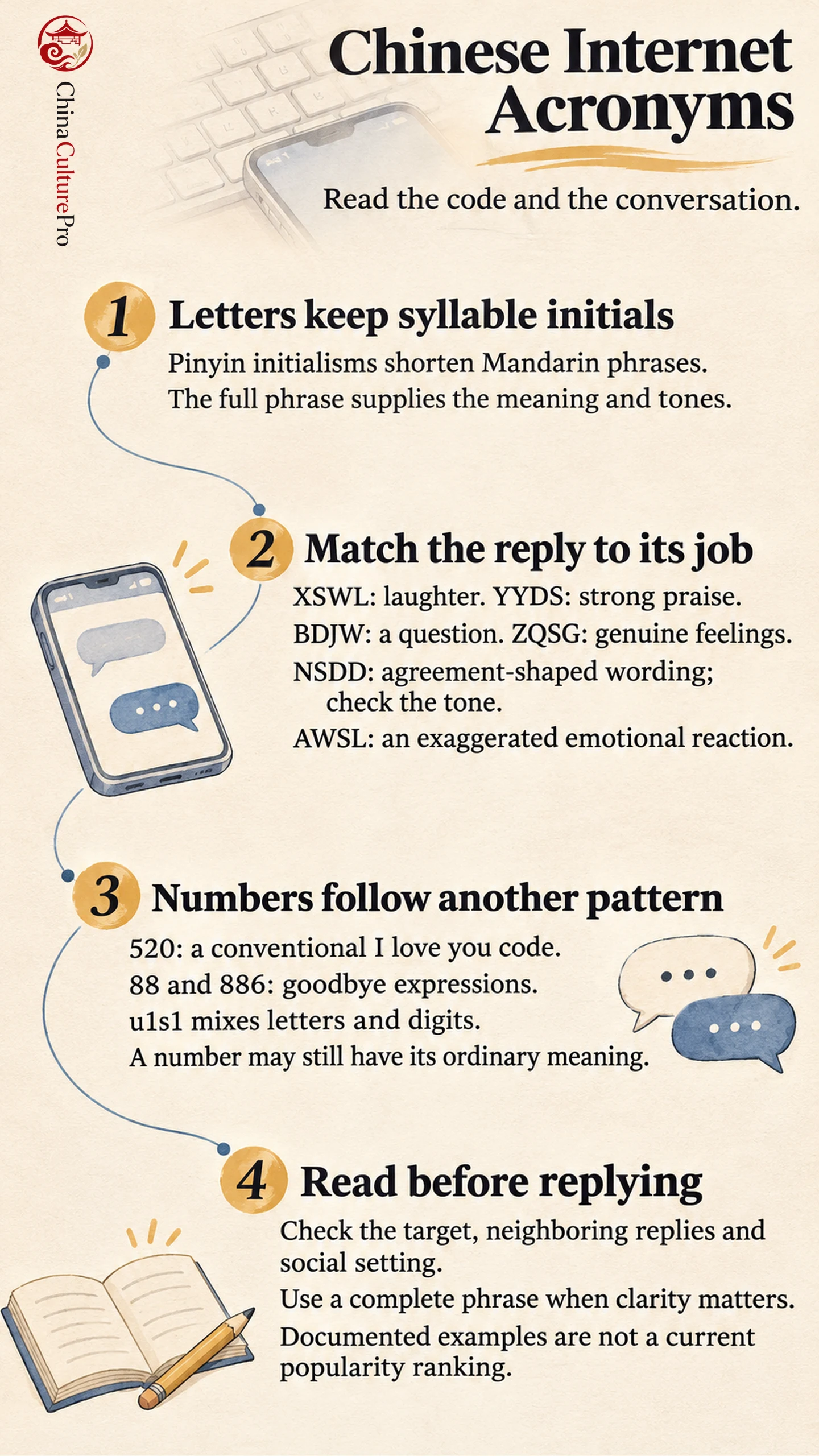
A comment can be easy to copy and difficult to interpret. The useful question is not simply what four letters expand to, but what the writer is doing with them: praising a performance, reacting to a joke, asking something or closing an exchange.
This guide focuses on Mandarin-oriented shorthand. Chinese online writing also belongs to different communities and Chinese language varieties; one decoding pattern should not be treated as a dictionary for all of them.
How Pinyin Initials Become Letter Strings
A pinyin initialism keeps the first written letter of each syllable in a phrase. XSWL takes x, s, w and l from xiào sǐ wǒ le. The letters do not translate the meaning; the expanded Chinese phrase supplies it. [3]
“Acronym” is often used loosely for these forms. More precisely, an initialism is read as separate letters, while an acronym is pronounced as a word. [3]
For pronunciation, expand the phrase and consult the pinyin system; the initials omit the tones.
A Small Glossary for Reading Comments
These documented examples pair the compact form with an expansion and a reading function. Uppercase in the table makes the letter boundaries clear; it is not a claim that every post must use capitals.
| Form and expanded phrase | Reading function |
|---|---|
| XSWL — 笑死我了, xiào sǐ wǒ le | Strong amusement: roughly laughing to death. |
| YYDS — 永远的神, yǒng yuǎn de shén | Emphatic praise for an outstanding person or thing. |
| BDJW — 不懂就问, bù dǒng jiù wèn | An informal lead-in to a question. |
| ZQSG — 真情实感, zhēn qíng shí gǎn | Genuine feelings or emotional investment. |
| NSDD — 你说得对, nǐ shuō de duì | You are right; the exchange determines its tone. |
| AWSL — 啊我死了, ā wǒ sǐ le | An exaggerated response to something overwhelming or adorable. |
NSDD identifies an agreement-shaped reply; judge sincerity from the exchange. AWSL is figurative emotional language rather than a report of physical harm.[2]
As an illustration, a funny clip followed by XSWL is an amusement response. YYDS under an impressive performance is praise. These are reading scenarios, not quotations from a particular user or evidence of how often each form appears.[1][3]
Number Codes and Mixed-Language Shortcuts
Numeric shorthand follows a different logic. Historical internet-language records include 520 for 我爱你, wǒ ài nǐ, meaning I love you; 88 for 拜拜, bài bài, meaning bye-bye; and 886 for 拜拜了, bài bài le, a goodbye expression. These are conventional playful associations rather than exact phonetic transcriptions.[4]
The digits can still have their ordinary meanings. In a calculation or an order number, 520 may simply mean five hundred twenty. Check the setting before replacing a number with a romantic message. The Chinese number-reading guide covers ordinary numerical readings.
Mixed forms can combine letters and digits. For example, u1s1 corresponds to 有一说一, yǒu yī shuō yī, an expression about speaking to the facts. Its letters and numbers jointly cue the phrase; it is not formed solely by taking initials.[2]
English-looking material in Chinese is another category again. English loanwords in Chinese help explain borrowing, whereas a Mandarin pinyin abbreviation may have no English source phrase at all.
How to Check Meaning Before Replying
Use the surrounding conversation to test a possible expansion. Unfamiliar shorthand can obscure rather than clarify a message.[5]
- Check the target: Is the response attached to a joke, a person, a performance or an argument?
- Read the neighboring replies: Look for an explanation, a correction or signs that the exchange has become tense.
- Match the setting: When clarity matters, use the complete phrase rather than unfamiliar shorthand.
Slang can mark shared familiarity and can also exclude readers who do not know the code. Expressions change over time, so recognition of an older example is different from evidence that it is fashionable now.[5]
For a serious apology, a clear sentence is a better starting point than a letter string whose tone you cannot judge. The broader guide to Chinese politeness and apologies addresses that separate social task.
FAQs About Chinese Internet Acronyms
Do Chinese internet acronyms come from English?
Some do, but Mandarin pinyin initialisms do not need an English source. XSWL compresses a Chinese phrase written in romanization, even though its visible form uses Latin letters.[3]
Does NSDD always show sincere agreement?
No. Its expanded wording means you are right, but a brief reply needs its surrounding conversation to establish whether it is warm, flat or dismissive. Do not use the letters alone as proof of attitude.[2]
Are number codes the same as pinyin abbreviations?
No. A code such as 520 relies on an established sound association, while a form such as XSWL selects initial letters. Both shorten online writing, but they are built differently.[4]
資料來源
[1] Shanghai Municipal Government. Must-know Chinese internet slang abbreviations
[2] Yingyue He, UCL. Pragmatic borrowing between English and Chinese: A comparative study of two-way exchanges
[3] Li and Wang. Investigating translanguaging strategies and online self-presentation through internet slang on Douyin (Chinese TikTok)
[4] Ministry of Education, historical archive. 新新人类网络语言魔鬼词典
[5] Cyberspace Administration of China. 网络用语演进,不滥用不恶俗是前提