


Quick Answer: What Are the Main Chinese Fan Types?
A Chinese hand fan is commonly called a shanzi(扇子,shànzi). Familiar names describe different features, so the clearest way to identify one is to separate its structure, outline and material.
- Structure: A folding fan(折扇,zhéshàn)opens and closes around a pivot; a fixed fan keeps its outline.
- Shape: A round fan(团扇,tuánshàn)has a rounded face on a handle, but other fixed outlines also exist.
- Material and use: Leaf, feather, silk, paper and carved-wood descriptions add information about construction and purpose.
These labels overlap.
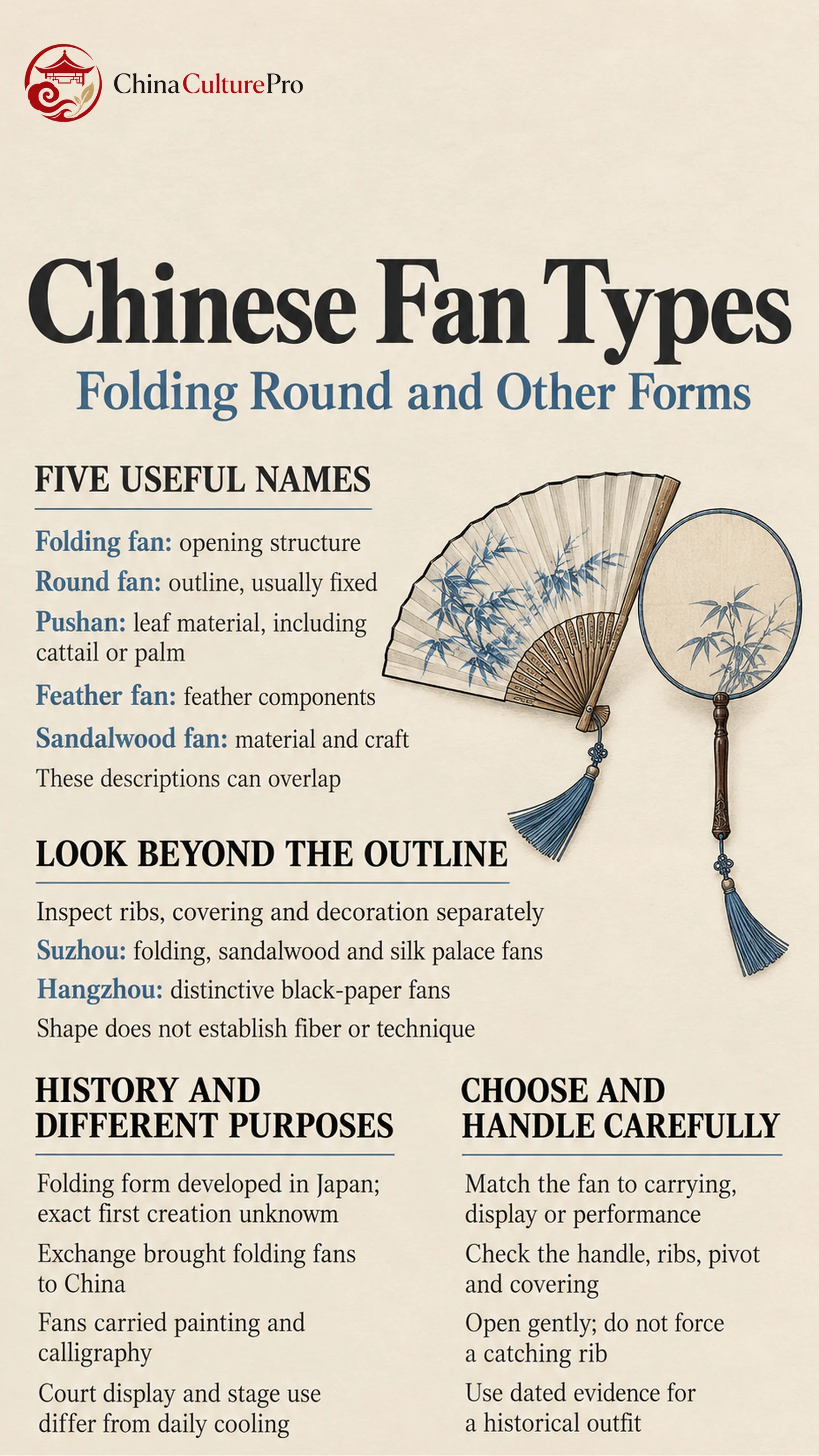
A fan can be folding, silk-covered and painted at the same time; there is no need to place it in only one category.
A fan can fold into a narrow bundle, remain a rigid circle or spread a group of carved slats. The familiar names do not all classify the same feature. Within traditional Chinese clothing, fans also work as carried accessories, practical tools and surfaces for artistic expression.
Five Common Names and What They Describe
Read the opening mechanism first, then the outline and material. The following names are useful recognition terms, rather than five mutually exclusive families.
| 名稱 | 記載內容 | Recognition point |
|---|---|---|
| Folding fan | Opening structure | Pivoted ribs or sticks spread open and close together. Many examples carry a pleated paper or textile leaf, but not all do.[4] |
| Round fan | Outline, usually a fixed form | A rounded face is supported by a handle and commonly a frame. “Round” does not identify the covering material; related fixed fans also have other outlines.[1] |
| Leaf fan: pushan(蒲扇,púshàn) | Plant material | The Chinese term can refer to a fan made from cattail leaves or Chinese fan-palm leaves. It does not mean that every example is made from one identical plant.[2] |
| Feather fan(羽扇,yǔshàn) | The feather components | Feathers form the visible fan surface; the outline and construction need separate description. Feather fans are one of several regional Chinese fan products.[3] |
| Sandalwood fan(檀香扇,tánxiāngshàn) | A material and craft tradition | Suzhou examples developed from folding fans and use sandalwood with decorative working such as carving or painting.[1] |
A carved folding fan offers an important exception to the common paper-leaf image. One Chinese example dated to the late eighteenth or early nineteenth century consists of carved strips linked with silk ribbon. Its catalogue records ivory among its historical materials.[4]
Materials and Regional Craft Traditions
A fan’s frame, covering and decoration can be made differently. Bamboo or wooden ribs may support paper or textile; carving may decorate the ribs, while painting occupies the face. Woven fiber, a whole leaf and an assembled feather surface require different descriptions. Material names do not replace an inspection of how the object is built.
Suzhou fan-making includes folding fans, sandalwood fans and silk palace fans. The latter are not confined to perfect circles: documented shapes include hexagonal, rectangular and elongated forms. Shaping, mounting, carving and other finishing techniques all contribute to the craft.[1] Our folding-fan craft guide explores construction in greater detail.
Hangzhou supplies another distinct example through its black-paper fans and their persimmon-based coating. Regional records also distinguish feather fans associated with Huzhou and palm-leaf fans associated with Xinhui.[3] These are examples of local specialization, not rules that a material can only be worked in one place.
If a fan is sold as silk, check the actual covering rather than assuming a translucent face establishes the fiber. Chinese silk clothing terminology helps separate fiber names from weave and surface treatment. Painted, printed and embroidered decoration are also different techniques, even when they depict similar flowers or birds.
History, Art and Ceremonial Uses
The folding form developed in Japan and circulated to China and the Korean peninsula through gifts and exchange by the end of the tenth century. Its exact first creation is unknown.[5] It became widely popular in China around the Ming period, finding a place in courtly and literati life.[6] Chinese fan history therefore includes both local craft development and exchange across East Asia.
Fans could carry Chinese calligraphy 及 painting, turning a portable object into an artistic surface. The curved, folded face affects composition, and surviving collections include both complete folding fans and separate fan leaves.[6] A fan-shaped painting displayed in an album is not necessarily a complete usable fan.
Court use was broader than a simple gender division. Late-Qing photographs show Empress Dowager Cixi holding both round and folding fans; Qing court fans used several paper and textile surfaces.[7] This specific evidence is enough to reject a rule that women could only carry round fans; it does not establish every woman’s preferences.
Function could also change with scale and setting. Long-handled ceremonial fans served screening and display roles within court ritual.[8] A stage fan may serve a choreographed movement rather than simply cool its holder; Chinese fan dance treats those performance uses separately. Neither a ceremonial implement nor a performance prop should be assumed to function like a small everyday hand fan.
Choosing and Handling a Fan
Choose for the activity. A compact folding fan is convenient to carry; a fixed fan keeps its face exposed and needs space in a bag. A performance prop should match the intended movements, while a display piece may be unsuitable for repeated opening and closing.
For a modern usable fan, inspect the handle, ribs, pivot and covering. Open it gently within its designed range. Stop if a rib catches or the covering pulls away; do not force the fan past that point. Hold a rigid fan by its handle and avoid pressing on a delicate face. These checks concern the individual object, not a guarantee supplied by its traditional name.
When pairing a fan with Hanfu(汉服,hànfú), consider what you need to carry and how sleeves and hanging accessories move around it. The Hanfu wearing guide places accessories after the outfit’s fit checks. For a historical reconstruction, choose a dated reference rather than treating any attractive fan as suitable for every period.
FAQs About Chinese Fan Types
Are round fans always made of silk?
No. The outline and the material are separate questions. Inspect the face and frame; related fixed fan traditions include several coverings and shapes.
Does every folding fan have a paper leaf?
No. Some use textile leaves, and others use linked carved sticks without a continuous paper face. The folding mechanism does not determine one mandatory covering.
Are folding fans for men and round fans for women?
Those associations are not universal rules. Historical evidence includes a woman using both forms. Identify the period, wearer and context rather than assigning a gender from the opening mechanism alone.
Does every fan picture have one fixed meaning?
No. Motifs can carry associations, but an interpretation needs the inscription, setting and intended use. A flower or bird alone does not establish the same message on every fan.
資料來源
[1] China Intangible Cultural Heritage Network. Fan-Making Craftsmanship: Suzhou
[2] Ministry of Education, Taiwan. Concise Mandarin Dictionary: Pushan
[3] China Intangible Cultural Heritage Network. Fan-Making Craftsmanship: Wangxingji Fans
[4] National Gallery of Victoria. Folding Fan, Late Eighteenth to Early Nineteenth Century
[5] Suntory Museum of Art. In the Country of Fans, Japan
[6] Hong Kong Museum of Art. Fantastic Breeze: Selected Fans from the Jingguanlou Collection, Phase II
[7] Zuo Yuanbo; Palace Museum. Interpreting Photographs of the Empress Dowager Cixi
[8] Palace Museum. The Evolution of Fan Functions and Forms: Study Extract