


Quick Answer: What Is a Zhongshan Suit?
The Zhongshan suit (中山装, Zhōngshān zhuāng) is a modern Chinese jacket-and-trousers ensemble associated first with Sun Yat-sen and later, internationally, with Mao Zedong. “Mao suit” is a familiar English name, but it does not mean that Mao invented the garment.
- Shape: A closed-front jacket commonly has a turn-down collar and four front pockets.
- History: Its Republican-era development and use predate the People’s Republic of China.
- Meaning: It acquired political associations through leaders, institutions and widespread everyday wear.
The suit evolved. A familiar later five-button jacket is not a complete specification for every earlier example.[5]
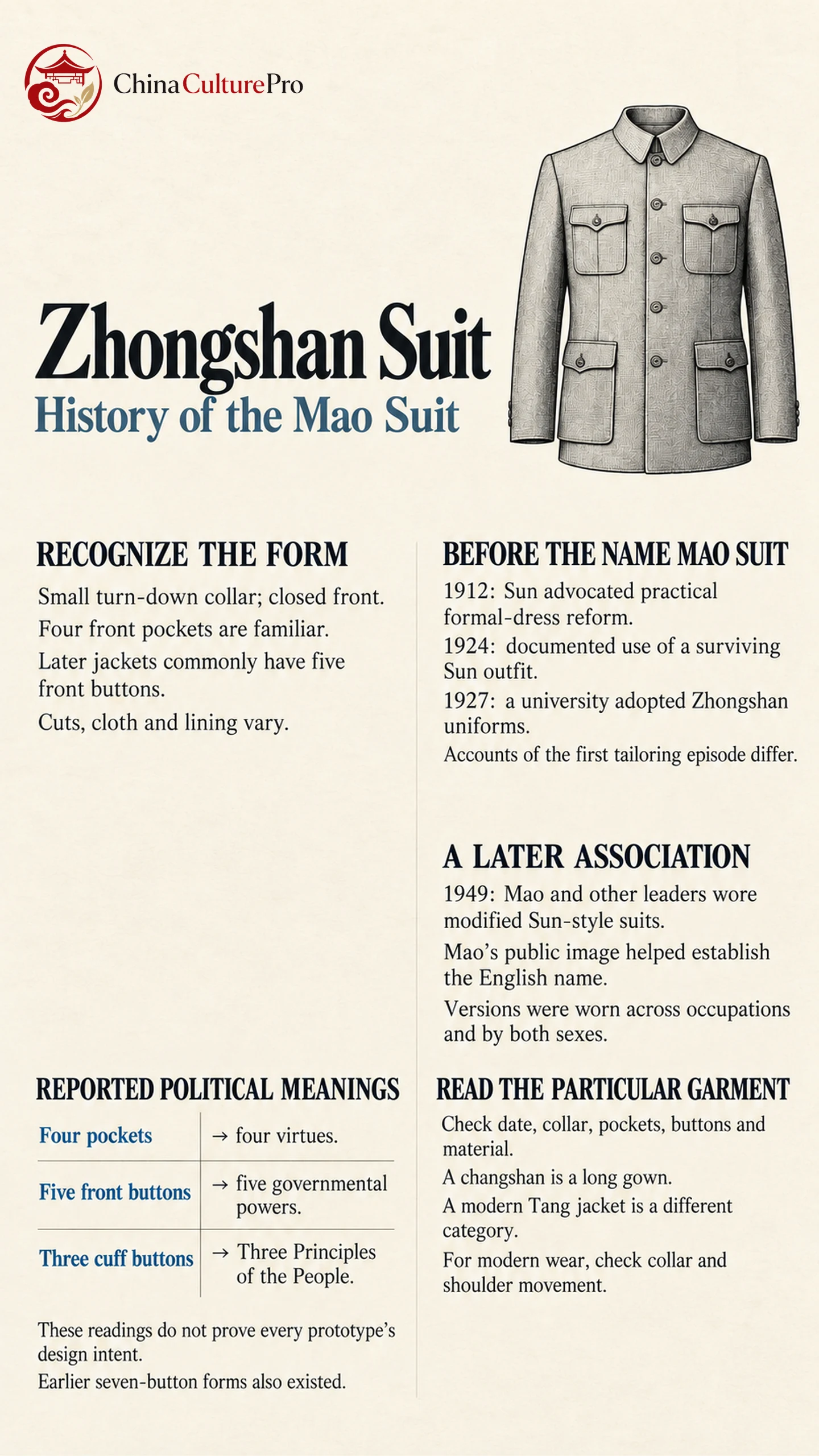
Four pockets and a closed neckline make the jacket easy to recognize, but they do not reveal its whole history. The same clothing family appears in Republican photographs, Mao-era wardrobes and formal imagery. Reading the particular cut and setting helps separate those associations.
Collar, Pockets and the Shape of the Jacket
The familiar later form combines a jacket that buttons high at the neck with a turn-down collar, long sleeves and two pairs of front pockets. Matching trousers complete the ensemble. It differs in silhouette from a lapelled business suit and from a long gown.
A surviving 1970s example makes the details concrete. Its blue cotton jacket has five front buttons, two breast patch pockets with shaped flaps and two larger gusseted pockets at hip level. It is machine sewn and unlined. Those features describe an actual everyday garment, rather than only a ceremonial portrait.[2]
Cut and material still matter. The arrangement of flaps, the shape of the collar and the presence of lining can vary. Within traditional Chinese clothing discussions, the Zhongshan suit belongs to the history of modern dress reform; a closed collar does not make it an ancient robe.
Sun Yat-sen and Republican Dress Reform
The Chinese name commemorates Sun Yat-sen, known as Sun Zhongshan. In 1912 he advocated reforming formal clothing with attention to movement, economy and appearance. Accounts of the first suit differ over the precise tailoring episode: Japanese military or student clothing and garments worn by overseas Chinese both appear in explanations of its development.[3] A single shop legend should therefore not replace the broader process.
A suit preserved from Sun’s own wardrobe supplies firmer evidence than an unsupported invention date. He wore it during important activities late in his life, including meetings in Shanghai in November 1924. Its description emphasizes useful outer pockets, with expanding lower pockets for books or notebooks and flaps to keep contents secure. After his death in 1925, Soong Ching-ling preserved it.[1]
The style spread through institutions as well as personal example. At Sun Yat-sen University, an August 1927 decision specified Zhongshan suits as uniforms for staff and students.[4] Government promotion and the public commemoration of Sun helped make the clothing politically meaningful during Republican China.[3]
These records establish the suit’s life before Mao-era popularization. Garment reform, practical tailoring, political identity and institutional adoption all contributed to its spread.
Why the Name Mao Suit Became Familiar
Mao Zedong’s repeated public association with a later version made “Mao suit” familiar internationally. At the founding ceremony of the People’s Republic on 1 October 1949, Mao and other leaders wore modified Sun Yat-sen-style suits. The older garment family consequently acquired a powerful new place in political imagery.[5] That visual association is part of Mao’s cultural history, rather than evidence that he created the first Zhongshan suit.
During the following decades, versions were worn across occupations and by women as well as men. A blue-grey cotton example dated 1966–1975 has a small turn-down collar, five front buttons and four flapped pockets. It illustrates how an ideologically charged silhouette could also be an ordinary working garment.[5]
This period belongs to a wider modern Chinese cultural history of changing work, institutions and public appearance. Even where clothing looked similar in photographs, the fabric, tailoring and wearer’s circumstances could differ. A jacket’s outline alone does not identify a person’s occupation, political office or individual beliefs.
Pocket and Button Symbolism: Interpretation and Evidence
The suit is often explained through the political ideas attached to its details. These are commonly reported readings, not a reliable way to date an individual jacket or prove the intentions behind every prototype.
| Garment feature | Common political interpretation | Evidence boundary |
|---|---|---|
| Four pockets | The Four Virtues (四维, sìwéi): propriety, righteousness, integrity and a sense of shame. | A symbolic reading exists alongside the pockets’ practical uses. |
| Five front buttons | The Five Powers (五权, wǔquán): executive, legislative, judicial, examination and control powers. | The five-button arrangement is not universal across the style’s development. |
| Three cuff buttons | The Three Principles of the People (三民主义, sānmín zhǔyì): nationalism, democracy and people’s livelihood. | The interpretation does not require every surviving jacket to carry this cuff detail. |
These associations became part of how the garment communicated Republican political ideals.[3] Later accounts explicitly describe symbolic meanings being attached after Sun’s lifetime and note a change from seven to five front buttons.[6] A numerical explanation can illuminate the garment’s cultural reception without establishing an original, unchanging construction rule.
A lower pocket’s capacity is a construction feature; linking four pockets to four virtues is an interpretation. The functional and symbolic explanations can coexist without proving that either accounts for every detail of the suit’s development.
Reading a Zhongshan Suit in Context
For a photograph or museum object, begin with what can actually be observed: collar, center opening, pocket layout, buttons, cloth and accompanying trousers. Then use the date, caption and provenance to place the outfit. Avoid identifying every closed-neck jacket as a uniform from one political period.
The changshan (长衫, chángshān) is a long gown, often worn with a separate short jacket. The modern Tang suit (唐装, tángzhuāng) is another jacket-based category, commonly associated with Chinese-style closures. Neither name is simply interchangeable with a four-pocket Zhongshan jacket.
When choosing a contemporary version, ask about the actual pattern and purpose. Check collar comfort, shoulder movement, pocket placement and how the trousers fit. A historically inspired formal outfit and a reproduction made to match a dated object are different commissions. The broader clothing history helps place those choices without requiring every modern wearer to reproduce an entire historical wardrobe.
FAQs About Zhongshan Suits
Did Mao Zedong invent the Mao suit?
No. The garment developed in connection with Sun Yat-sen and was used during the Republican period. Mao’s prominence helped establish the later English name and a new political association.
Do all Zhongshan jackets have five buttons?
No. Five front buttons are familiar on later examples, but earlier seven-button versions are documented in accounts of the style’s development. Button count alone cannot establish a garment’s identity or date.
Is a Zhongshan suit the same as a Tang suit?
No. A Zhongshan suit is identified through its modern tunic-jacket form, commonly with four pockets and a turn-down collar. Modern Tang jackets belong to a different styling category; a closed neckline alone does not make the two identical.
資料來源
[1] Shanghai Sun Yat-sen Residence Memorial Hall. The Zhongshan Suit Worn by Sun Yat-sen
[2] Powerhouse. Jacket (Zhongshan Fu) from China
[3] Chen Yunqian, Nanjing University. Body Politics: The Birth and Popularity of the Zhongshan Suit
[4] Sun Yat-sen University. 1927: A Century of Sun Yat-sen University
[5] Powerhouse. Blue and Grey Jacket
[6] Beijing Tourism. Chinese Tunic Suit, the Suit of Historic Patriotism