

Quick Answer: What Did a Chinese Emperor Do?
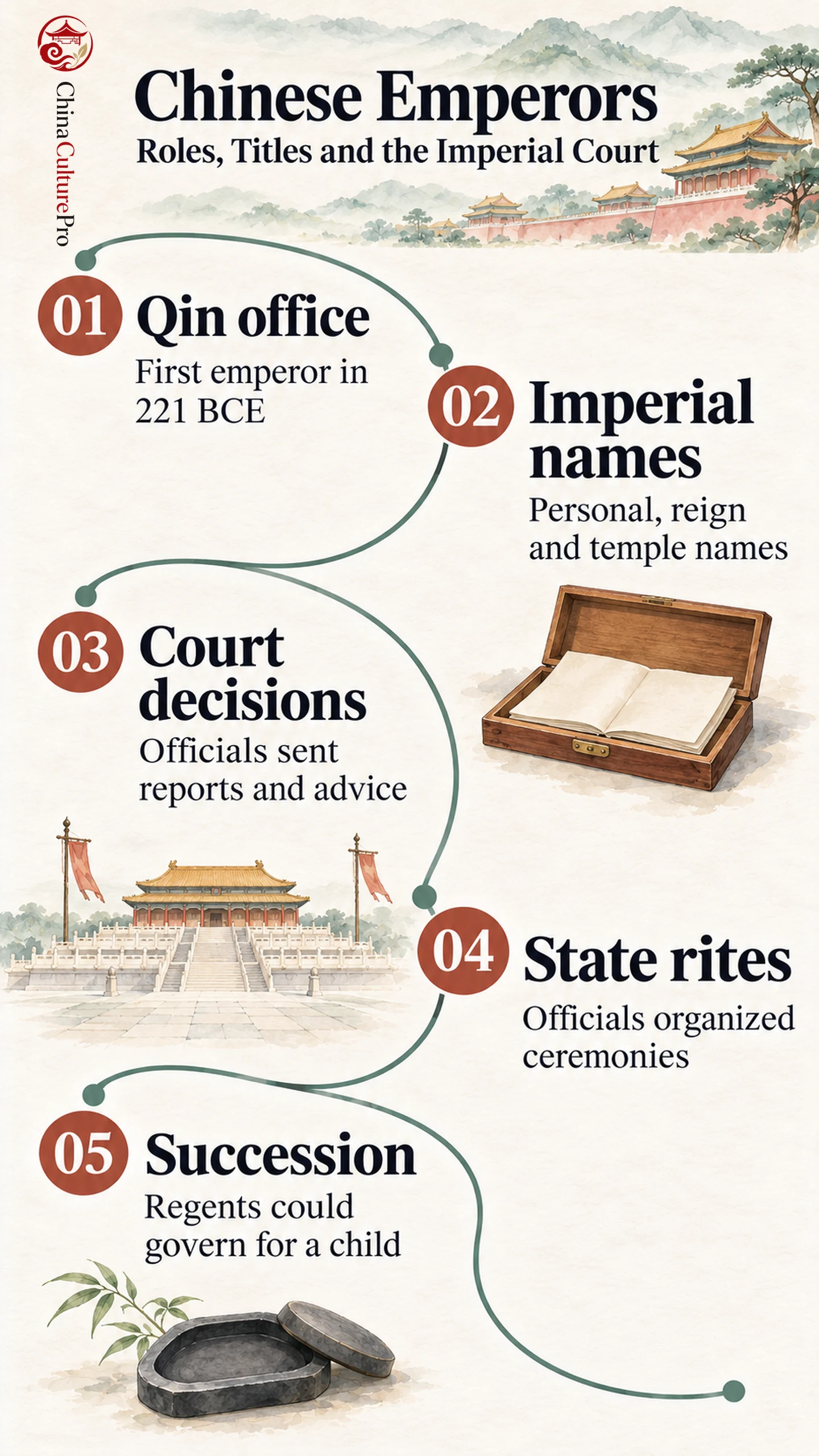
A Chinese emperor (皇帝, huángdì) was the sovereign at the head of an imperial government and its court. The office dates to Qin Shi Huang (秦始皇, Qín Shǐ Huáng), who unified the rival states in 221 BCE. Later emperors received reports, appointed officials and took part in state rituals, with arrangements that changed across dynasties.[1][2][5][6]
- Names: A ruler could have a personal name, one or more era titles and titles granted after death.[3][4]
- Government: Ministers, officials and court offices helped gather information, advise the ruler and implement decisions.[2][5][6]
- Ritual: The emperor’s place in state ceremonies expressed both his authority and his responsibilities.[2]
The ruler’s formal position is a starting point. The records of a particular dynasty show how decisions moved through its court.[5][6]
A Qing official could lock a report in a case and send it to the palace. The emperor could write an answer on the document itself. The case, report and reply make one part of the imperial office tangible. In Chinese history, court government took shape through exchanges like this as well as through the public display of rank.[2][5]
How the Imperial Office Began
The king of Qin took an imperial title after the conquest of the rival states. Qin Shi Huang means First Emperor of Qin. His government appointed officials to run territorial units and sought to standardize coinage, measures and writing. The Qin dynasty thus paired a new title with a government able to issue common standards across conquered territories.[1]
A ruler could also be called the Son of Heaven (天子, Tiānzǐ). This expression conveyed a relationship between the ruler and Heaven, with obligations expressed through state ritual. It is related to the Mandate of Heaven (天命, Tiānmìng), an older political idea that rulers used to explain their authority and duties.[1][2]
How Imperial Names and Titles Worked
The Kangxi (康熙, Kāngxī) Emperor appears under several names in historical records. A date, an ancestral commemoration and a formal honorific can all refer to the same person.[3][4]
| 種類 | Use and example |
|---|---|
| Personal name | The name Xuanye (玄烨, Xuányè) identifies the individual, a member of the Aisin Gioro house. |
| Reign title (年号, niánhào) | Names an era. Kangxi is used to date documents and is also a common way to refer to the ruler in English. |
| Temple name (庙号, miàohào) | Identifies a ruler in ancestral commemoration. This emperor’s temple name was Shengzu (圣祖, Shèngzǔ). |
| Posthumous title (谥号, shìhào) | Honored the dead ruler. Kangxi’s full title was a long sequence of honorifics ending with Ren Huangdi (仁皇帝, Rén Huángdì). |
Some earlier rulers used several era titles in one reign. Ming and Qing rulers generally used one, which helps explain why era titles are common in accounts of those periods. Dates and dynasties still matter when reading Chinese imperial names because similar names and titles can recur.[3][4]
How Decisions Moved Through the Court
Imperial decisions depended on people and documents. In late imperial China, the imperial examinations were one route into official life. Scholar-officials took posts within a larger system that also depended on other officeholders and military personnel. The palace examination stood at the top of the late imperial examination system. Government work then depended on officeholders who could report conditions, advise on policy and carry out decisions.[5][7]
Qing palace memorials (奏折, zòuzhé) illustrate one channel. Designated officials submitted reports on subjects such as local conditions or military affairs. A locked case and a restricted route through the palace helped keep the report confidential. The emperor could add comments and return the document. After the official received the reply, the annotated memorial was returned again to be filed at court.[5]
Consultation was another part of the system. During the Yongzheng Emperor’s campaign against the Zunghars, an inner group of advisers could meet as reports arrived from the front. The group developed into the Grand Council (军机处, Jūnjīchù). This example shows how a ruler’s need for timely advice could change the offices around him.[6]
Ritual Duties and the Imperial Household
Imperial court life also involved ceremonies whose procedures were maintained by officials. At Beijing’s Temple of Heaven, the emperor carried out sacrifices in his capacity as Son of Heaven. Officials organized the ceremony and directed the performance of its rites. In the sequence of prostrations, a high-ranking official could even give the emperor the cues for when to kneel and rise. Their work joined an assertion of imperial standing to an established set of duties.[2]
Daily operations involved other roles. The archives of the Forbidden City help researchers study household finances, guards, eunuchs and palace staff, and the places of empresses and consorts. These records help distinguish the imperial household from the offices responsible for government, even where their activities shared a palace.[8]
Succession and the End of the Imperial Office
A succession could change who exercised power at court. When Xuanye ascended as a child, four senior officials had been designated to act as regents. His accession illustrates the difference between possessing the title and exercising the full responsibilities of the office. In this case, succession put a child on the throne while the named regents helped administer the state.[4]
The Qing ruler Puyi (溥仪, Pǔyí) formally abdicated in February 1912. He continued to live in the Inner Court of the Forbidden City until his expulsion in 1924. His years in residence are a separate part of the palace’s history from the end of regular Qing imperial government.[9]
FAQs About Chinese Emperors
Was Kangxi the emperor’s personal name?
Kangxi was the name of his era. His personal name was Xuanye, and Shengzu was his temple name.
Did the emperor make every decision alone?
The sovereign had formal authority, while ministers and officials supplied reports, offered advice and carried out decisions. The institutional arrangements varied.
Who was China’s last emperor?
Puyi was the last emperor of the Qing dynasty. He formally abdicated in 1912, ending regular Qing imperial government.
資料來源
[1] Smithsonian National Museum of Asian Art. Qin Dynasty
[2] Columbia University, Asia for Educators. The Emperor in the Cosmic Order
[3] David K. Jordan, University of California San Diego. Table of Chinese Imperial Reigns
[4] The Palace Museum. The Kangxi Emperor
[5] National Palace Museum. Palace Memorials
[6] The Palace Museum. Qing Dynasty Political Documents and Materials from the Grand Council of State
[7] Columbia University, Asia for Educators. The Confucian Classics and the Civil Service Examinations
[8] The Palace Museum. Institute of Ming and Qing Archival Research
[9] Encyclopaedia Britannica, republished by China Culture. Puyi