

Quick Answer: What Are Chinese Egg Tarts?
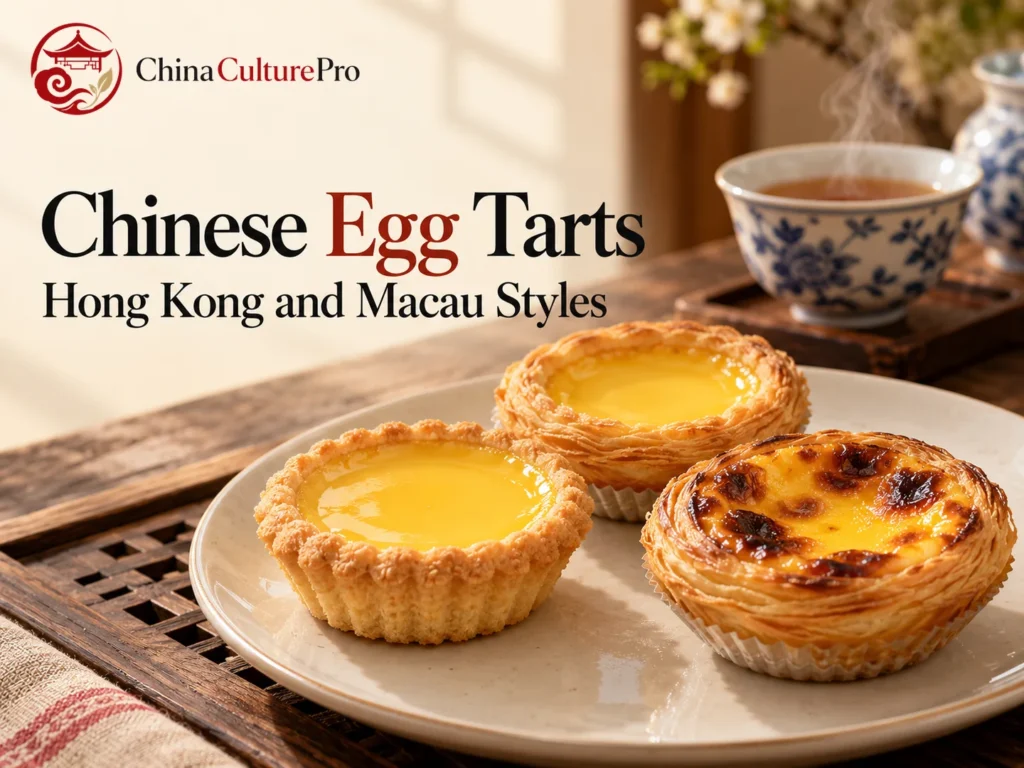
Chinese egg tarts(蛋挞,dàntà)are small pastries filled with sweet egg custard. The familiar Hong Kong style usually has a smooth yellow surface, while Macau’s Portuguese-style egg tarts(葡式蛋挞,púshì dàntà)commonly have dark caramelized patches.
- Hong Kong: Both crumbly cookie-style shells and flaky layered shells are established choices.
- Macau: A layered pastry shell and blistered custard top form the familiar Portuguese-style presentation.
- Setting: Egg tarts appear at bakeries, cafés and some dim sum meals.
These are recognizable styles, not nationwide rules for pastry ingredients, sweetness or exact color.

One bakery tray holds glossy yellow tarts with neat crumbly rims; another has flaky shells and mottled brown tops. The contrast is easy to see, but crust and custard need separate attention. Both fit within traditional Chinese desserts; their names give a useful starting point for choosing a texture.
Hong Kong and Macau Styles at a Glance
Hong Kong egg tarts are often called dan tat in Cantonese menu spelling; dàntà is the Mandarin pinyin. The name identifies the egg tart, not one mandatory kind of shell. Hong Kong’s official tourism material explicitly distinguishes buttery shortcrust from a flaky alternative.[1]
| 上桌形式 | Pastry shell | Custard appearance and eating character |
|---|---|---|
| Hong Kong cookie-style | Shortcrust with a tender, crumbly bite | Usually a smooth yellow surface and soft, lightly sweet custard |
| Hong Kong flaky style | Thin, layered pastry that breaks into flakes | Usually a smooth custard top; crisp layers contrast with the softer center |
| Macau Portuguese-style | Crisp, layered pastry | Browned or blistered patches above a rich custard center |
An original Hong Kong shortcrust preparation uses a cookie-like butter pastry and a silky egg filling.[2] A separate flaky-shell preparation demonstrates why a laminated Hong Kong tart is equally valid.[5]
Macau’s familiar Portuguese-style tart emphasizes its caramelized surface and layered shell.[4] This does not mean every tart sold in Macau has that style, or that a bakery elsewhere cannot make it. Read the named presentation rather than treating a city as an exclusive production boundary.
What the Pastry and Custard Contribute
The shell provides structure around the filling, but its texture changes the whole bite. A cookie-style base tends to crumble as a tender piece, whereas a flaky base separates into layers. “Crisp” therefore does not describe one identical texture across all egg tarts.
In laminated pastry, layers of dough and fat create the structure that opens into flakes during baking. One original Chinese puff-pastry preparation explains how moisture helps separate those layers. It also documents a butter-based version while noting the use of lard in other preparations.[3] A flaky appearance alone does not reveal which fat was used.
The custard is a separate component. Eggs help the liquid filling set; sugar provides sweetness, and dairy ingredients vary by recipe. One published Hong Kong formulation uses evaporated milk.[2] Another uses fresh milk, illustrating why the milk ingredient needs a separate check.[3]
The top is another useful clue. A Hong Kong-style tart commonly aims for a smooth, glassy finish, while the familiar Macau presentation deliberately includes browned patches.[4] Those patches describe a style rather than proving that a tart is burnt. Equally, a darker top cannot establish that a tart has better pastry, fresher ingredients or a particular recipe.
From Bakery Counter to Tea Table
Egg tarts can be a bakery purchase eaten on their own or a small sweet alongside a drink. Hong Kong café culture provides another setting: the tart may accompany an afternoon visit to a cha chaan teng, rather than being reserved for dessert after a formal dinner.[2]
Some dim sum meals include egg tarts among other small dishes.[5] Their place in the meal need not follow one fixed sequence. A tart can be the item someone orders with tea, a sweet contrast to savory plates or a takeaway snack from a bakery counter.
Macau’s version also has a history of local adaptation. A producer’s own account describes an English baker developing his version after encountering Portuguese custard tarts, changing aspects of the method and ingredients.[4] That supports describing a Portuguese connection and a local interpretation, rather than assuming every Macau tart is identical to every tart made in Portugal.
These are everyday bakery and café foods. Different bakeries may specialize in different shells, and an individual recipe cannot define an entire city’s baking.
Choosing an Egg Tart and Checking Ingredients
Choose the texture first: a tender cookie-style shell, delicate flaky layers or the familiar blistered Macau presentation. Then ask about the actual product rather than using surface color as an ingredient list.
- Shell: Check wheat flour and the pastry fat. Butter, lard or other fats affect dietary suitability; a crisp shell does not identify them.
- Custard: Confirm eggs and dairy, including the milk or cream used. A tart without visible milk still may contain it.
- Extras and handling: Ask about flavored fillings, toppings and preparation arrangements relevant to an allergy or strict dietary requirement.
The vegetarian food guide helps distinguish an egg-and-dairy pastry from a vegan product. A classic egg tart contains egg, and some shells also contain animal fat; a separately labeled adaptation requires its own ingredient check.
Use a small plate or paper case to catch flakes and support the soft center. A freshly baked filling may remain hot, so take a small bite before continuing. Expect a cookie shell to crumble and a layered shell to shed flakes.
FAQs About Chinese Egg Tarts
Do Hong Kong egg tarts always have a cookie crust?
No. Both shortcrust cookie-style shells and flaky layered shells are familiar Hong Kong presentations. Ask which pastry the bakery makes.
Is a dark-spotted tart necessarily overbaked?
No. Browned patches are characteristic of the familiar Macau Portuguese-style presentation. Surface color alone cannot judge the quality or ingredients of a particular tart.
Are egg tarts vegan or gluten-free?
Classic egg tarts contain eggs and usually wheat pastry; many also contain dairy. A specially labeled alternative needs its own ingredient and preparation check rather than an assumption based on the name.
資料來源
[1] Hong Kong Tourism Board. Tai Cheong Bakery
[2] Christine Ho. Egg Tarts: Hong Kong Style
[3] KP Kwan. Hong Kong Egg Tarts with Flaky Chinese Puff Pastry
[4] Lord Stow’s Bakery. Portuguese Egg Tart in Macau
[5] Sarah Leung. Hong Kong Egg Tarts