


Quick Answer: How Did Chinese Counting Rods Work?
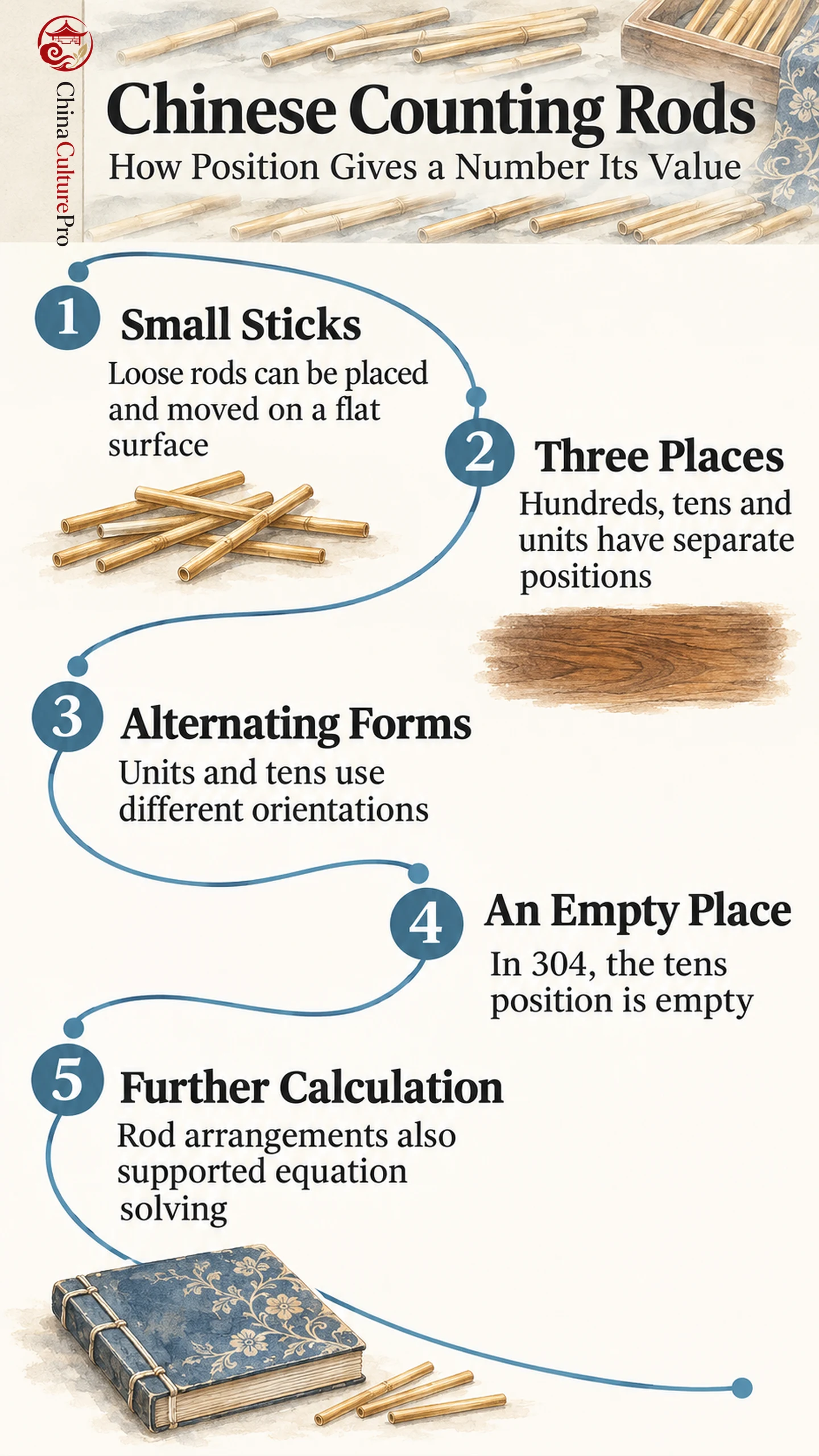
Chinese counting rods (算筹, suànchóu) were small sticks arranged on a flat surface to represent numbers. The value of a group came from its position and the numeral formed by the rods. Calculators moved them to perform operations in a practice known as rod calculation (筹算, chóusuàn).[2][3]
- The units and hundreds places use one orientation, while the tens and thousands use the other.[2][4]
- An empty position can represent zero in a layout with distinct places.[2]
- Excavated rods include Han examples made of lead.[1]
The same rod arrangements can represent different values when they occupy different places.
Three rods can stand for three or three hundred. Their location on the calculating surface tells you which number you are reading.
What Surviving Rods Are Made Of
The National Museum of China records Han lead rods excavated in the eastern area of Xi’an. Their long, flattened shapes preserve evidence of the physical implements. Other sources record rods made with materials such as bamboo and bone.[1]
A display can also reproduce rods to demonstrate a number. Tsinghua University Science Museum identifies its set as a replica. The label distinguishes a present-day teaching object from an ancient implement associated with an excavation.[3]
How to Read Numbers by Position
The rightmost units place uses the vertical forms. Tens use horizontal forms and hundreds return to vertical forms. The alternation helps separate rod groups even when they are near each other. It also keeps a person from confusing adjacent rods with a single wider digit.[4][6]
The same system can appear in a book as written rod numerals. The written marks record an arrangement, while physical rods can be moved to update the result of an operation.[5]
A Simple Example With an Empty Place
To represent 304 in three positions, place three parallel vertical rods in the hundreds position. Leave the tens space empty and put four parallel vertical rods in the units position. Read it as 300 plus zero tens plus 4. The spacing is essential. Four tens would instead use the horizontal form in the middle position.[2][4]
A blank only carries the right meaning if the reader knows that a position is there. The example uses modern digits to explain a historical layout. Related methods helped express decimal fractions 及 negative numbers.
From Ordinary Numbers to Equations
The rods made it possible to move a number as part of a calculation. Procedures in The Nine Chapters include problems solved with arrays of numbers. The later tianyuan method uses positions for coefficients of different powers of an unknown. This is a distinct job from representing the units and tens of a single number.[3]
An abacus gathers the moving elements into a frame. Loose rods leave the layout open, which makes it possible to set up rows or columns for different tasks.
FAQs About Chinese Counting Rods
Why did the rods alternate direction?
The alternating forms made neighboring place values easier to distinguish.[4][6]
Did an empty space mean zero?
On a calculating surface with identified places, a vacant position could represent zero.[2]
Were all rods made of bamboo?
No. Surviving finds and records include lead and bone as well as bamboo rods.[1][3]
資料來源
[1] National Museum of China. Lead counting rods
[2] China Science and Technology Museum. Counting rods exhibit
[3] Tsinghua University Science Museum. Chinese counting rods replica
[4] Chinese Mathematical Society. Contributions of ancient Chinese mathematics: counting rods
[5] Unicode Consortium document archive. Proposal for encoding counting rod numerals
[6] Fudan University, Center for Excavated Texts and Paleography. Research on the form of historical bamboo slips