


Quick Answer: What Order Does a Chinese Address Follow?
A Chinese address (地址, dìzhǐ) normally presents geographical information from larger areas to smaller places, such as city, district, road and street number.[2]
- Chinese postal order: Larger geographical units precede the building or room details and addressee.[1]
- Latin-letter format: The UPU’s China template reverses the geographical order, placing smaller components before larger ones.[1]
- Postcode: Mainland China uses six digits; these identify a postal area rather than a street number.[1]
This guide explains common mainland Chinese address order. For an actual mailing label, follow the destination postal operator’s instructions and the recipient’s verified details.
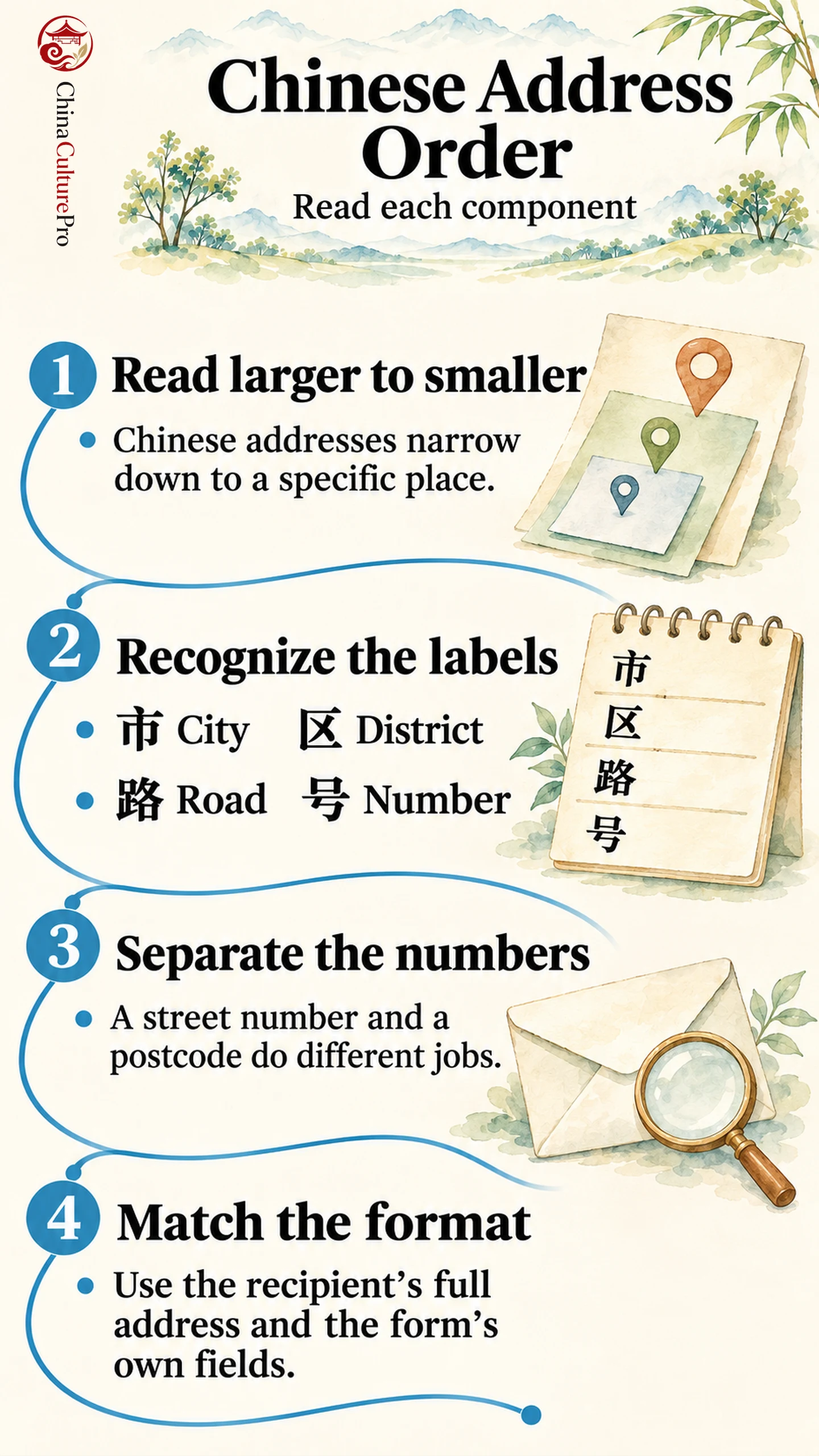
Recognizing component labels makes a long string of Chinese characters easier to parse. Locate the area first, then the road and premises, instead of treating the whole string as one indivisible place name.
Read from the Larger Area to the Specific Place
A common reading path is province or municipality, city where applicable, district or county, street or locality, and then building or room details. Rural and urban addresses can contain different components.[1][2]
| Label and pinyin | 意思 |
|---|---|
| 省, shěng | Province |
| 市, shì | City |
| 区, qū | District |
| 路, lù | Road |
| 号, hào | 編號 |
| 室, shì | Room |
These labels help divide the text. For example, the number before 号 identifies numbered premises, while a number before 室 can identify a room. Keep any supplied building, floor and room details instead of reducing the destination to its street alone.
A Public Beijing Example, Component by Component
A Peking University science center publishes the street portion 北京市海淀区颐和园路5号 and postcode 100871. Its contact page also supplies the English forms below.[3]
| Chinese component | 含義 | 作用 |
|---|---|---|
| 北京市 | 北京 | Municipality/city name |
| 海淀区 | Haidian District | District |
| 颐和园路 | Yiheyuan Road | Road name |
| 5号 | No. 5 | Street number |
| 100871 | 100871 | Postcode |
This is an annotated street portion, not a complete mailing address for every department on the campus. A specific recipient may need an organization name and further building or room details. Use the recipient’s full published address for delivery.
Chinese Order, Latin Letters and Form Fields
For an international Latin-letter address, the UPU’s China examples place the addressee first, followed by the street or premises, then larger geographical units and the country. Chinese-written examples use the opposite geographical direction. The destination country must be recognizable internationally.[1]
Changing script is also different from translating every place name. The public example uses Yiheyuan Road; preserve that published form rather than inventing an English rendering of its Chinese characters.[3] See pinyin 及 Chinese city-name romanization for the naming distinction.
When a form separates city, district, postcode and address lines, enter each component in its matching field. The form’s field order need not reproduce the order of one continuous Chinese address.[2] Recheck that the assembled result still contains the recipient’s required details.
FAQs About Chinese Address Order
Does every address need both a province and a city?
No. Do not invent a missing administrative level. Beijing examples can identify Beijing directly without a separate province name; retain the components of the verified address.[1][3]
Is the postcode the same as the building number?
No. In the public example, 5号 is the street number and 100871 is the postcode. Neither replaces a separate room or department detail when one is required.[3]
Can I translate a road name literally?
Use the recipient’s published English or romanized name when available. In this example, the institution supplies “Yiheyuan Road”; copying that form preserves its own identification of the location.[3]
資料來源
[1] Universal Postal Union. China: postal addressing country sheet
[2] W3C Internationalization. Address formats around the world
[3] Peking University Science Center, Chinese Space Station Telescope. Contact details in Chinese and English