

Quick Answer: What Is Border Town About?
*Border Town* (边城, Biānchéng) is a short novel by Shen Congwen (沈从文, Shěn Cóngwén), first published in 1934. Cuicui (翠翠, Cuìcuì) grows up with her ferryman grandfather near Chadong (茶峒, Chádòng), a river town in western Hunan. Two brothers court her, and her grandfather worries about what will happen to her when he can no longer look after her.[1][2][3]
- The river: The ferry connects the household with the town. Changes in the river also bring people and news in or carry them away.
- The courtship: A formal proposal and a song offer different ways to express what a person wants.
- The story’s question: Cuicui has feelings of her own, but other people have much of the power to act on them.
The quieter scenes of waiting help explain why a song or a few words of news matter so much.[3]
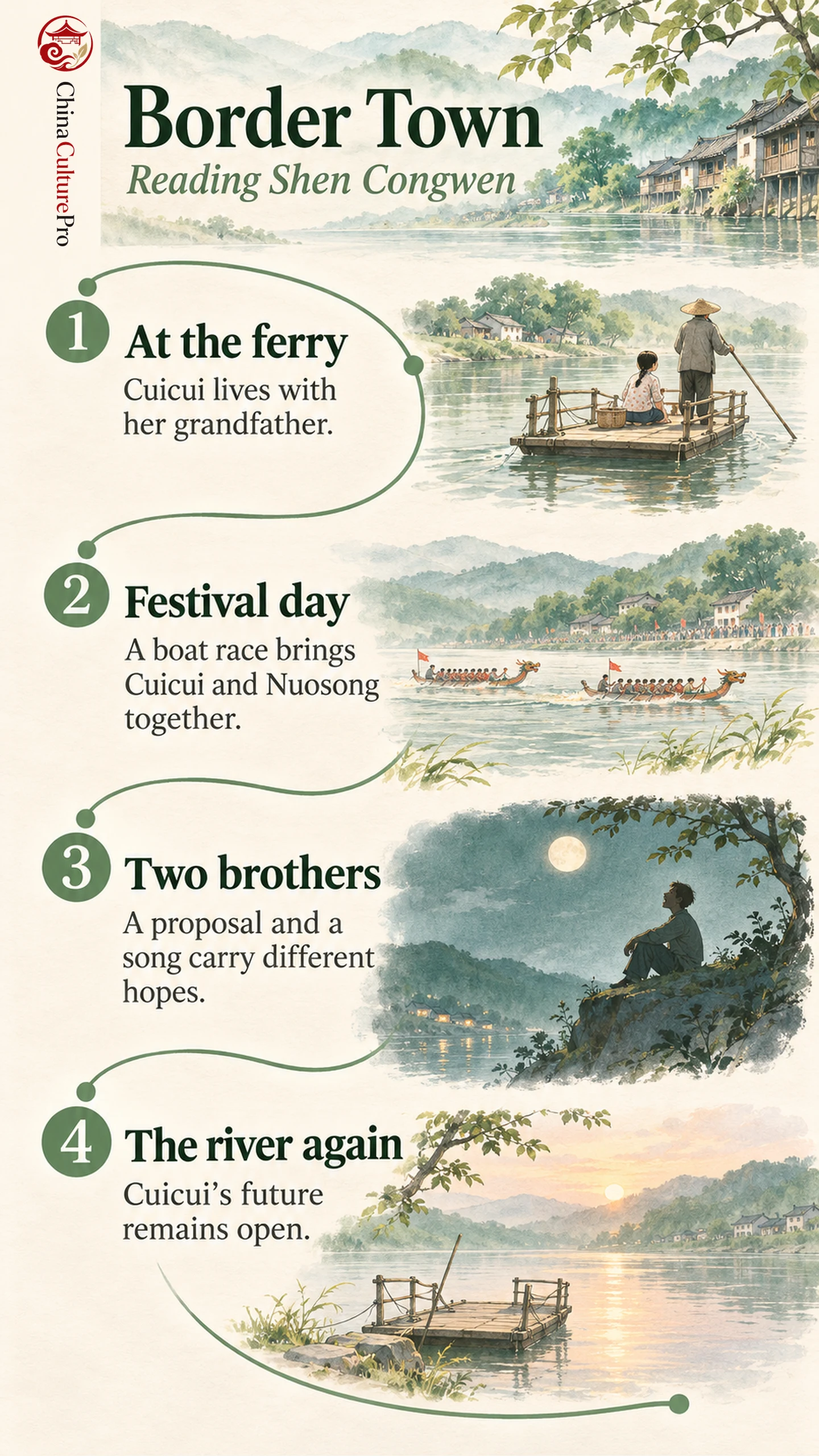
The river can be crossed many times a day. Other distances prove harder for Cuicui and the people who care about her.
Why the Ferry and the Festival Matter
Cuicui’s grandfather operates a ferry. Travelers reach their home because they need to get across the water. The girl can be near the town without sharing all its family ties. When her grandfather thinks about finding her a husband, he is also thinking about who will take care of her after him.[2][3]
The Dragon Boat Festival (端午节, Duānwǔ Jié) gives the story a different kind of gathering by the water. People come to watch the races, and for a time ordinary routines give way to the festival. Cuicui waits for her grandfather and meets a young man whose help she initially misunderstands. In a place that looks familiar to her, she has to work out what a stranger means by the way he speaks.[3]
The Four Characters to Follow
| 人物 | Why they matter |
|---|---|
| Cuicui | She lives near the ferry and comes to favor the younger brother, but others often speak about her wishes before she can express them herself. |
| Her grandfather | He keeps the ferry and tries to secure Cuicui’s future. His attempts to help can make other people’s intentions less clear. |
| Tianbao (天保, Tiānbǎo) | The older brother pursues a match through a more formal route and eventually leaves by boat. |
| Nuosong (傩送, Nuósòng) | The younger brother sings to Cuicui. His singing reaches her indirectly and changes how his brother sees the rivalry. |
The difference between the brothers is easier to follow if you listen for where each approach takes place. A proposal can pass between households. A song can reach Cuicui at night without either person having to say openly what they hope for.[1][3]
What Happens in Border Town?
The festival brings Cuicui and Nuosong into each other’s company. Later, both brothers are interested in marrying her. The older brother goes through intermediaries, while Nuosong sings. Their rivalry touches their relationship with each other and the grandfather’s hopes for Cuicui. She receives parts of what is happening without having the information that would let her sort out everyone’s intentions.[2][3]
The narration gives ordinary gestures time to register. A trip to town or the sound of a voice can carry more weight for Cuicui than the formal steps a suitor takes. What someone means and what another person hears can diverge even when they hope to act with care. That makes the novel’s warmth compatible with its sadness.
What the Open Ending Means
This section reveals the ending. Tianbao leaves and drowns. Nuosong goes away, and Cuicui’s grandfather dies during a storm. She remains at the ferry. The novel leaves open whether Nuosong will return. It keeps the possibility of return beside the possibility that she will have to live without it.[3]
The ferry was her grandfather’s work and is still how other people continue their journeys. At the end Cuicui has to live in a place that keeps serving all three purposes without settling her own future. Su Tong’s The Boat to Redemption also puts questions of belonging on the water. In that novel a boat is a home after a fall from status. Here the ferry is part of the inheritance Cuicui has to carry.
FAQs About Border Town
Where does Border Town take place?
The story is set near Chadong in western Hunan, on the old Hunan–Sichuan frontier. Its title refers to that border setting. Shen’s fictional town is shaped by river trade, ferry travel and local customs.[1][4]
Which English translation of Border Town should I look for?
Jeffrey C. Kinkley’s *Border Town* appeared from Harper Perennial in 2009. Earlier English versions exist, and some editions use a different title, such as *The Frontier City*.[1][2]
資料來源
[1] Jeffrey C. Kinkley. The English translations of Shen Congwen’s Border Town
[2] WorldCat. Border Town, the 2009 Harper Perennial edition
[3] Rocky Mountain Review. Xiao’s study of the ferry, courtship and ending in Border Town
[4] China Today. A Small Town Romance