

Quick Answer: Who Is Bai Ze?
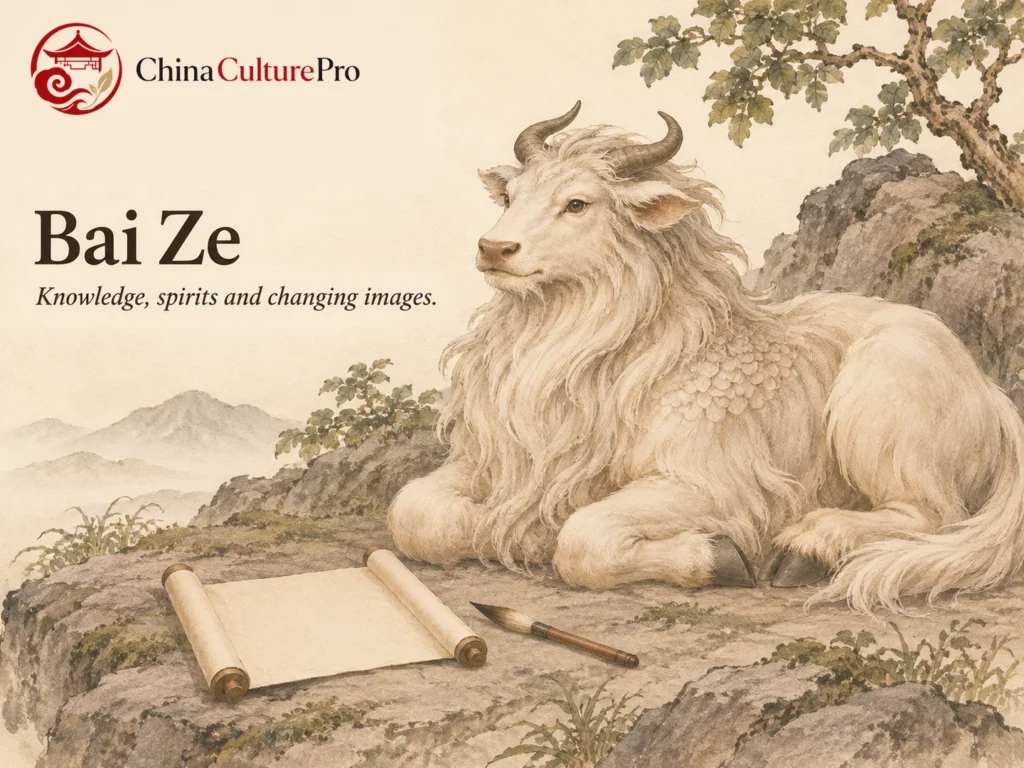
Bai Ze(白泽,Báizé), often translated as “White Marsh,” is a mythical speaking creature associated with knowledge of spirits and strange phenomena. Its importance lies in what it knows and communicates, rather than in one universally fixed animal shape.
- The legend: A ruler receives knowledge of supernatural beings from the creature.
- The texts: Works bearing its name organize accounts of spirits and anomalies.
- The images: Pictures of the beast also acquired protective meanings.
The creature, the books attributed to it and pictures of it are related parts of a tradition. They should not be treated as one surviving original object or as evidence of a real animal.
A speaking beast explains the hidden dangers of the world, while a human listener turns that knowledge into a record. Bai Ze occupies an unusual place in Chinese mythology: its defining gift is understanding. Stories, manuscript fragments and later pictures reveal how that gift could become both written knowledge and a protective image.
The Knowledge Beast and the Yellow Emperor
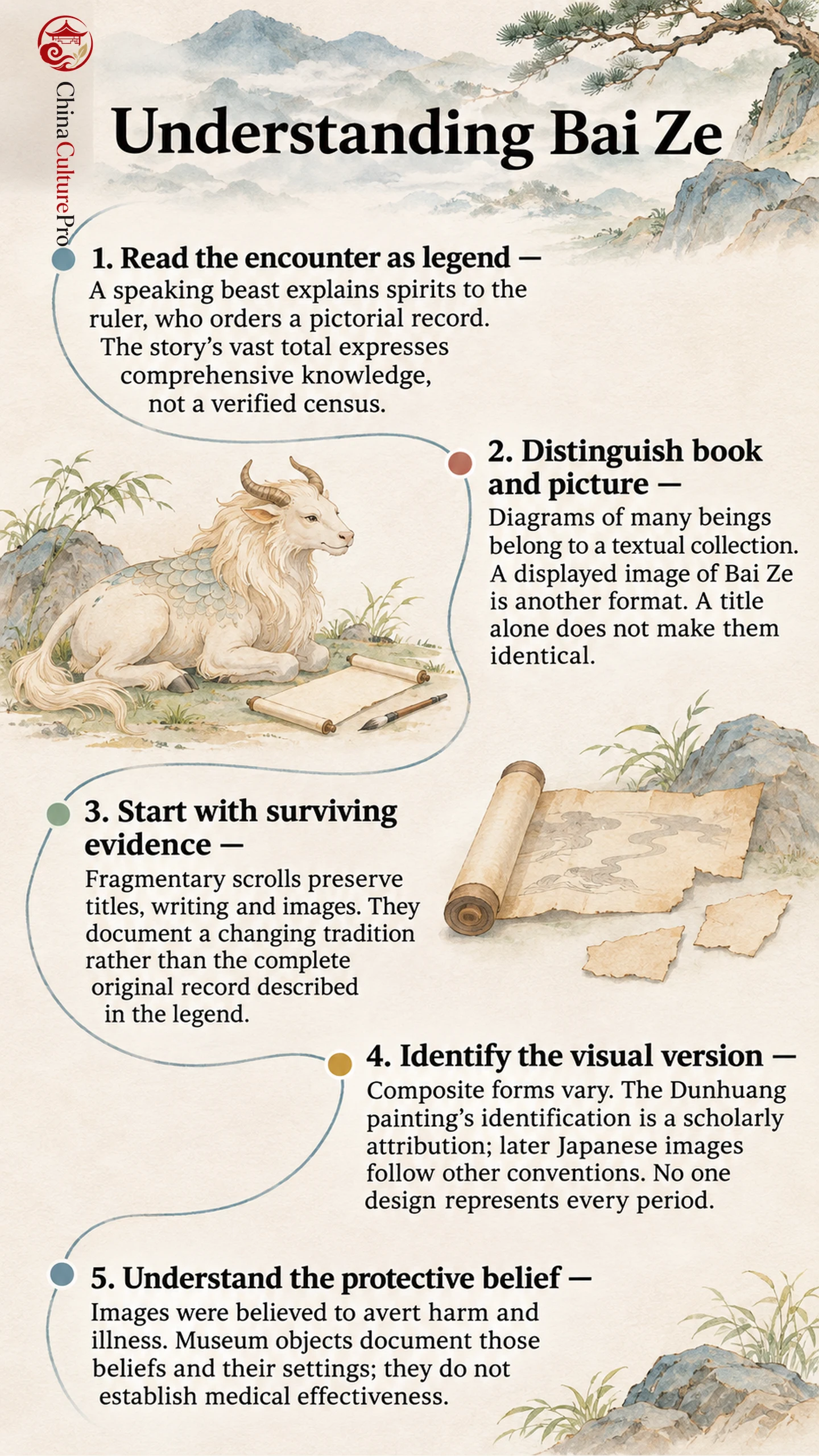
The Yellow Emperor(黄帝,Huángdì)encounters Bai Ze during a journey eastward in a story preserved in the hundredth chapter of a Daoist compilation. At the seashore, he meets a beast capable of speech and asks about spirits and strange transformations. Bai Ze explains them, and the ruler orders the knowledge recorded in pictures.[1]
The account gives an enormous total: 11,520 kinds of supernatural beings. That number belongs to the story’s claim of comprehensive knowledge. It is not a verified count of creatures in nature, nor a count of entries in a complete manuscript available today.
The encounter makes knowledge useful to rulership and human life. The creature is a teacher and informant; the ruler becomes the recipient and organizer of its account. The broader Yellow Emperor tradition contains many such cultural narratives, which need to be read as mythic history rather than eyewitness biography.
A Book of Spirits and an Image of the Beast
Baize tu(白泽图,Báizé tú)can refer to related but different kinds of material. In a public account of his research, Donald Harper distinguishes diagrams of spirits in a book from a picture of Bai Ze itself displayed in a dwelling.[2]
An illustrated entry may show a being described in the text, rather than Bai Ze. A displayed portrait serves another purpose. Check whether the object is a collection of entries or an image of its legendary authority.
Dunhuang Manuscripts and What Survives
Baize jingguai tu(白澤精恠圖,Báizé jīngguài tú)is a title preserved in the Dunhuang manuscript tradition. The Bibliothèque nationale de France catalogue identifies Pelliot chinois 2682 under this title and describes a damaged paper scroll assembled from seven sheets.[3] The shelfmark identifies a physical manuscript, rather than the legendary ruler’s original commission.
Sophia Yuan Shi’s research examines P.2682 and S.6261 as medieval evidence connected with the wider Bai Ze textual tradition. Her analysis considers how graphic registers, divination and household protection could overlap in these manuscripts.[4] The surviving material is more complex than a modern encyclopedia listing imaginary animals.
The fragments also require a distinction between attribution and authorship. A text named after a mythical knowledge beast need not have been written by that creature, and a relationship to an older tradition does not establish an unchanged copy of one original book.
The fragments offer concrete evidence: paper, handwriting, arrangement, images and titles. Those features can be examined independently of whether a legendary encounter ever happened.
Why Bai Ze Does Not Have One Fixed Appearance
A fixed modern design cannot represent every period. Harper’s research account discusses his identification of a Dunhuang painting as an image of Bai Ze, reading its composite creature as cow-like, with a lion-like head and scales.[2] This is an attributed scholarly identification, not an ancient label attached to every similar painted beast.
The International Dunhuang Programme describes the same painting as a creature facing a smiling man who writes, with coins between them, and notes its association with Bai Ze among different interpretations.[5] The scene joins animal presence and human recording without giving us a universal anatomical checklist.
Later Japanese images developed their own conventions. Iwate Prefectural Museum describes a four-footed creature with numerous eyes and horns in its catalogue of a protective hanging image.[6]
When comparing pictures, identify the date, place and object before deciding what Bai Ze “must” look like. A composite animal in a medieval painting and a many-eyed later print can belong to the same broad history while making different visual choices.
Protective Images and Their Later Japanese Life
In Japanese, the written name is read hakutaku. Iwate Museum’s hanging image belongs to a tradition in which pictures were believed to avert illness or other misfortune. Its accompanying text describes protection associated with carrying the image.[6] The record documents protective belief, rather than medical effectiveness.
An artwork at the Metropolitan Museum offers a different setting. Ishikawa Toyonobu’s mid-eighteenth-century painting places an image of the creature within an alcove behind a woman reading. The museum connects that inset picture and its accompanying text with the encounter legend and protective associations.[7]
The inset picture places the creature within a represented interior, giving protective imagery a setting in human life. Its significance depended on where the picture was placed and how viewers understood it.
The guide to Chinese folk religion provides context for protective symbolism, while Japanese examples show how an inherited figure could develop a distinct local life. Modern illustrations add further interpretations; their chosen appearance should be identified as a contemporary design rather than a recovered original portrait.
FAQs About Bai Ze
Is Bai Ze a real animal?
No. It is a mythological creature associated with supernatural knowledge.
Is Bai Ze always shown with nine eyes?
No. Images vary across periods and regions; a many-eyed type is especially associated with later Japanese traditions.
Did the Yellow Emperor really record 11,520 spirits?
That is a claim within the encounter legend, not a documented historical census.
Are the Dunhuang fragments a complete original book?
No. They preserve fragmentary evidence of a changing textual tradition, not the ruler’s complete legendary record.
資料來源
[1] Zhang Junfang’s Daoist Compilation, Chapter 100, Chinese Text Project Transcription. The Yellow Emperor’s Encounter with Bai Ze
[2] University of Chicago Center for East Asian Studies. Donald Harper on Bai Ze: Books, Images and Research Attribution
[3] Bibliothèque nationale de France Catalogue Metadata, via Biblissima. Pelliot chinois 2682: Title and Physical Description
[4] Sophia Yuan Shi, University of California, Santa Barbara. The Graph of the White Marsh and Its Dunhuang Anomaly, 2022 MA Thesis
[5] International Dunhuang Programme. Dunhuang at Work: Painting Associated with the Protector-Spirit Bai Ze
[6] Iwate Prefectural Museum. Protective Hanging Image of Hakutaku, Catalogue 095834
[7] Metropolitan Museum of Art. Ishikawa Toyonobu’s Courtesan Reading a Letter and Its Inset Hakutaku Image