

Quick Answer: What Is Anhui Hairy Tofu?
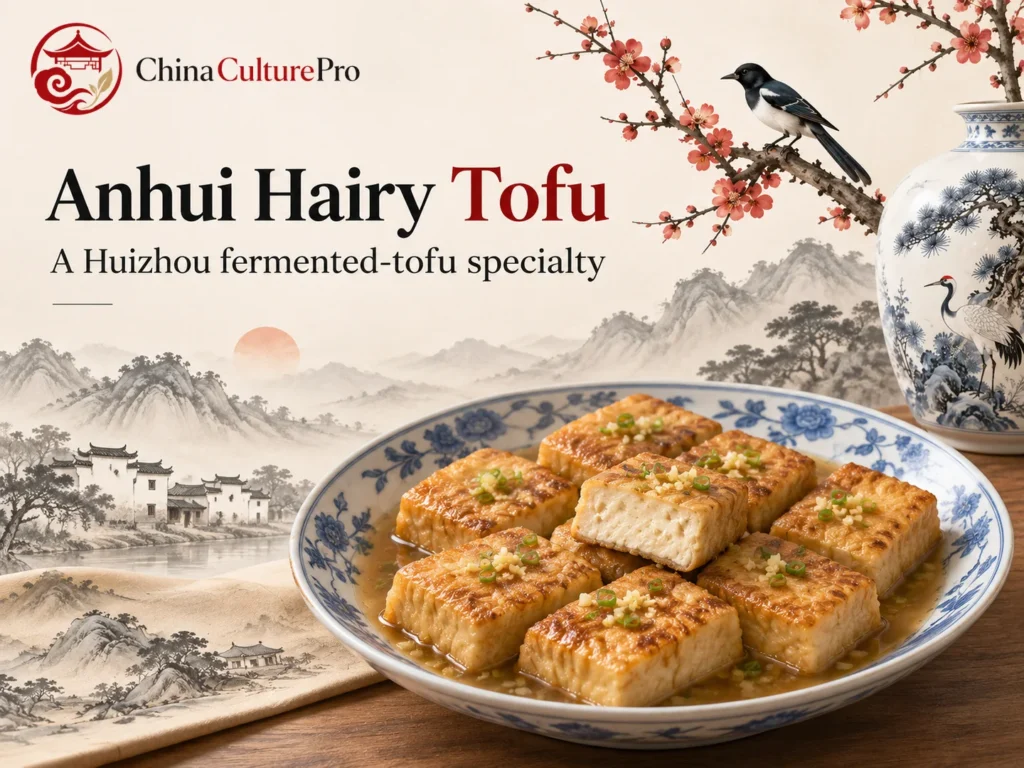
Anhui hairy tofu, mao doufu (毛豆腐, máo dòufu), is deliberately fermented tofu associated with Huizhou in southern Anhui. A white fungal coat develops before cooking; pan-frying turns the surface golden while the interior stays soft.[1][2]
- The “hair” is fungal growth produced during fermentation, not an ingredient added as a garnish.[3][4]
- Local preparations include plain pan-frying, frying followed by braising, and grilling with chili sauce.[2]
- White fuzz alone cannot establish that a product is safe to eat.[7]
The cooking recipe below starts with purchased food-grade mao doufu, not ordinary tofu left to spoil.

Within Hui cuisine (徽菜, huīcài), this dish makes fermentation visible. The soft fermented centre and browned exterior are central to its appeal; the uncooked white coat and finished golden crust represent different stages of the same preparation.[1][2]
Why the Tofu Grows a White Coat
The visible threads are fungal mycelium. Controlled production can use selected mould cultures such as Mucor or Rhizopus, with attention to hygiene, temperature and humidity. This is a managed food process rather than permission to eat any fuzzy block of tofu.[4]
Fermentation changes flavour and texture. Enzymes break down proteins into smaller peptides and free amino acids; research on mao doufu has measured these changes alongside shifts in its bacterial and fungal communities. The community is more complex than one visible mould, and a laboratory finding does not establish health benefits for everyone eating it.[3]
As with other Chinese fermented foods, the intended process matters. You cannot identify a harmless mould by sight alone. Trimming or washing away unexpected mould does not guarantee safety, and ordinary frying cannot reliably destroy mycotoxins. Discard accidentally mouldy ordinary tofu rather than trying to convert it into this dish.[7][8]
Huizhou Cooking Styles and a Local Legend
These are documented ways of serving hairy tofu, not exclusive recipes assigned to separate provinces.
- Pan-fried: Brown both faces and serve with chili sauce, chopped scallion and, in one local preparation, onion. The contrast is a browned exterior and soft centre.[1]
- Pan-fried, then braised: Fry first, then briefly cook with seasonings. This gives the tofu a moist, savoury finish rather than a completely dry crust.[2]
- Grilled: Cook over charcoal and brush with chili sauce. This is another local serving method; it does not turn the food into a different fermented product.[2]
A local story connects the dish with a hungry Zhu Yuanzhang and tofu discovered during a military retreat near Xiuning. It is told as a legend, not evidence of a documented first invention. The distinction between history and traditional storytelling matters here.[1]
Ingredients for One Pan-Fried and Braised Version
Use purchased mao doufu intended for cooking and follow its preparation instructions. This formula makes a stock-braised version:
- Tofu: 500 g hairy tofu, approximately 10 blocks.[5]
- Aromatics and seasoning: 5 g minced scallion; 5 g minced ginger; 25 g soy sauce; 2 g salt; 5 g sugar; 0.5 g MSG.[5]
- Oil and stock: 100 g rapeseed oil for frying; 100 g cooked meat stock for the braise. These are separate quantities.[5]
How to Cook Purchased Hairy Tofu
- Portion the 500 g into about ten blocks if necessary; cut each into three smaller pieces. Follow the maker’s preparation instructions.[5]
- Heat the oil in a skillet without letting it smoke. Fry gently until both faces are golden and the surface wrinkles.[5]
- Add scallion, ginger, MSG, sugar, salt, stock and soy sauce. Simmer about 2 minutes as a guide. For this home version, check the centre reaches 75°C/167°F for 30 seconds; continue cooking if needed and follow any stricter package directions.[5][6]
- Turn the pieces gently in the sauce, transfer to a plate and serve hot.[5]
FAQs About Anhui Hairy Tofu
Is hairy tofu the same as stinky tofu or furu?
They belong to a wider fermented-soybean family but are not interchangeable ingredients. Stinky tofu (臭豆腐, chòu dòufu) has several regional processes and serving styles. Furu (腐乳, fǔrǔ) commonly undergoes further seasoned maturation and is used as a condiment. Compare these with other Chinese tofu types before substituting.[4]
Can I make it by leaving ordinary tofu out?
Do not use that shortcut. Leaving ordinary tofu out does not control which organisms grow, even when the result looks white and fluffy. Buy a food product from a reliable maker; frying does not rescue tofu contaminated by heat-stable toxins.[4][7][8]
Is this recipe vegetarian?
The measured version above contains meat stock, so it is not vegetarian. A plain pan-fried preparation is a different option; check the tofu, sauce and cooking ingredients rather than assuming every version is meat-free.[2][5]
How should I store the product and leftovers?
Before cooking, follow the maker’s storage temperature, use-by date and opening instructions. For the fully cooked dish, refrigerate shallow portions within 2 hours, or 1 hour above 90°F/32°C. Keep at 40°F/4°C or colder and use within 3 days, or sooner if the label requires. Reheat only the portion needed to 75°C/167°F for 30 seconds; do not repeatedly warm and rechill it.[6][8][9]
資料來源
[1] Huangshan Municipal Government. Huizhou Hairy Tofu
[2] Zheng Mengting, Huangshan University. Huizhou’s Hairy Tofu and Its Cooking Styles
[3] Dongqi Li and colleagues. Dynamic Changes in Physicochemical Properties and Microbial Diversity During the Fermentation of Mao-Tofu
[4] Yan Xu and Zhao Qianqian. Can Fermented Mouldy Tofu Be Made at Home? Interview with Li Shuying
[5] Intangible Cultural Heritage Food China. Huizhou Hairy Tofu: Recorded Ingredients and Cooking Method
[6] Centre for Food Safety, Hong Kong. Cooking and Reheating
[7] Centre for Food Safety, Hong Kong. Food Safety Express: Mouldy Food
[8] Centre for Food Safety, Hong Kong. Moulds on Food: Potential Health Risks?
[9] USDA FSIS. How Do I Handle Leftovers Safely?