


Quick Answer: What Is a Kowtow?
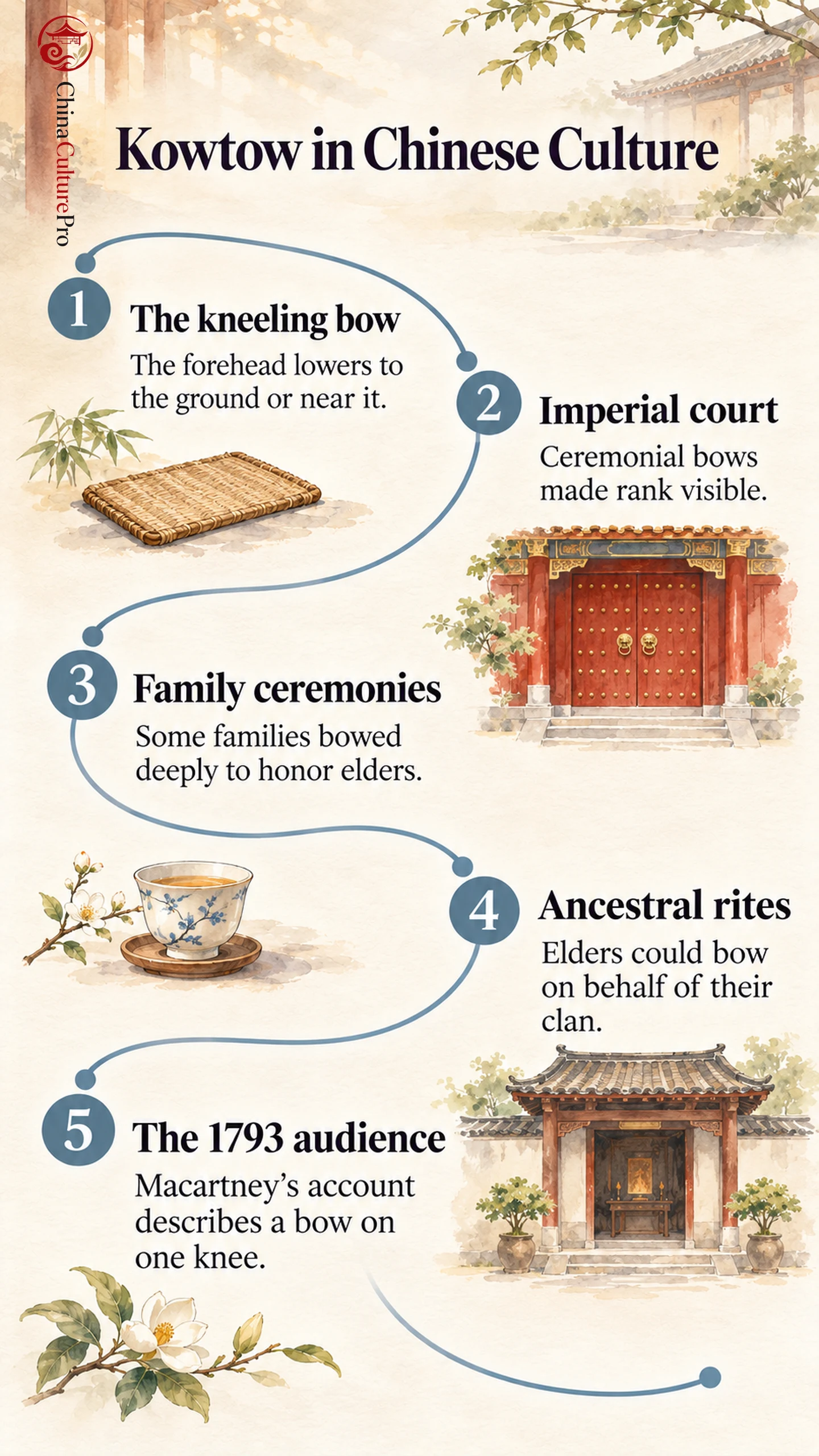
A kowtow (叩头, kòutóu) is a ceremonial kneeling bow in which a person lowers their forehead to the ground or near it. The action could express deep respect, worship or deference, depending on the ceremony.[1][2][6]
- At court: Formal gestures made rank visible during imperial ceremonies.[3]
- In family life: Some families used the gesture to honor parents or senior relatives at ceremonies such as weddings.[3]
- At ancestral rites: A kowtow before an altar can express reverence for the dead.[4]
The number of bows and the meaning of the gesture depend on the occasion. A nod, standing bow or ordinary kneel can express respect without being a kowtow.[2][3][4]
A person kneels before an ancestral altar, leans forward and lowers their head to the floor. The movement resembles a gesture once performed at the Qing court, but who receives it matters. At the altar, the person may be honoring a deceased family member. At court, the same movement could acknowledge rank.[3][4]
What a Kowtow Looked Like
The English word kowtow comes from a Mandarin expression meaning “knock the head.” The related form ketou (磕头, kētóu) also refers to kneeling and lowering the head to touch or approach the ground. In practice, the kneeling posture and the depth of the bow distinguish it from greeting someone while standing.[1][2][6]
Repetition belonged to the ceremony. Historian Henrietta Harrison describes a range of late Qing gestures, from clasping hands when greeting peers to prescribed sequences of kneeling and lowering the head for more formal occasions. Her account draws on a village etiquette manual that illustrates several forms. The wider guide to Chinese greetings and etiquette gives context for forms of respect used between people of different roles and ranks.[3]
Why Court and Family Kowtows Carried Different Meanings
In a formal audience, the way people greeted the emperor made differences in position visible. At a wedding, kneeling before parents or senior relatives could mark respect for elders and a change in family relationships. The movement is similar, but a wedding and an imperial audience recognize different kinds of authority.[3]
An ancestral hall offers another example. Hugh Baker describes three senior elders repeatedly kneeling and bowing before an altar on behalf of their clan. Their seniority gave them the responsibility to perform the rite. The elders were addressing the ancestors in the presence of the living.[4]
What Happened at the 1793 Macartney Audience?
When the Qianlong emperor received the British envoy at Chengde, court etiquette became a question of how two courts would recognize one another. Historian James Hevia reconstructs one version from Lord Macartney’s journal and British drawings. In that version, Macartney went down on one knee and bowed his head before presenting George III’s letter. Hevia notes that the Chinese-language records discussed in his introduction register a poem the emperor wrote for the occasion, leaving a different kind of evidence. The Macartney Embassy is an example of how much could ride on the form a greeting took.[5]
FAQs About the Kowtow
Is kowtowing an everyday Chinese greeting?
Ordinary greetings can take forms such as a spoken greeting or a nod. A kneeling bow belongs to a specific ceremonial setting, and its practice varies among families and communities.[3][4]
What does “kowtow to someone” mean in English?
In figurative English it usually means showing someone undue deference. That critical tone comes from the English expression. It would miss the point of an ancestral ceremony, where the gesture can be an act of remembrance.[4][6]
Источники
[1] Chinese Text Project. Dictionary entry for 叩头
[2] Chinese Text Project. Dictionary entry for 磕头
[3] Henrietta Harrison. The Republican Citizen, in The Making of the Republican Citizen
[4] Hugh Baker. Kowtow, in Ancestral Images: A Hong Kong Collection
[5] James L. Hevia. Introduction to Cherishing Men from Afar
[6] The American Heritage Dictionary. Kowtow