
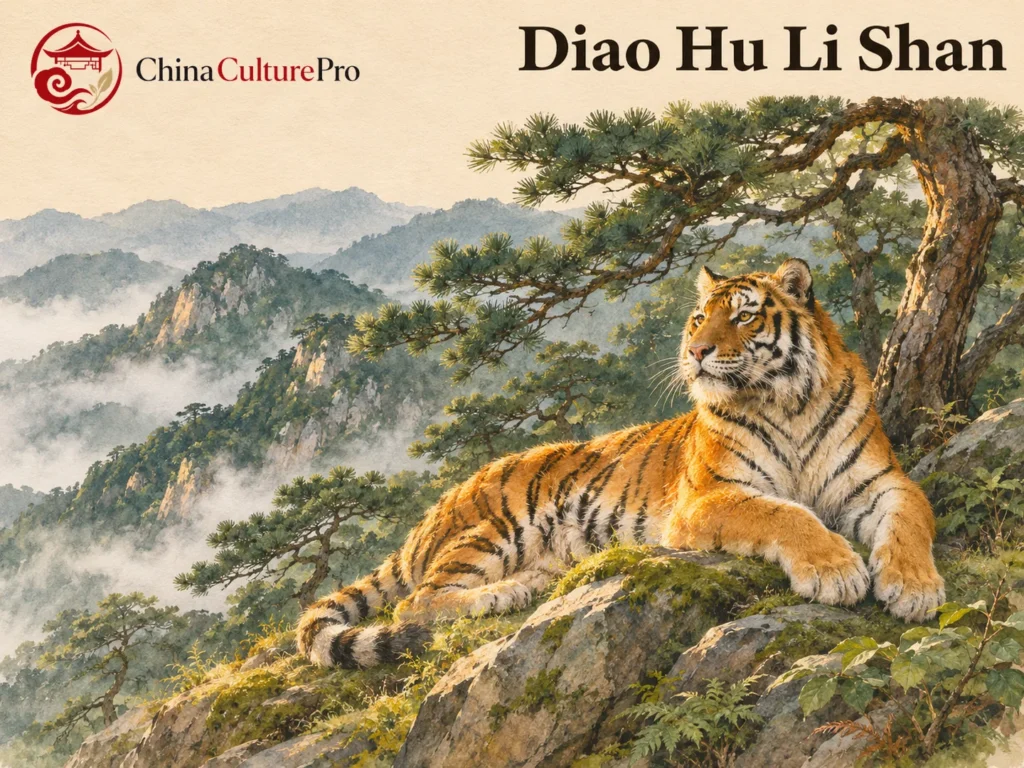

Quick Answer: What Does Diao Hu Li Shan Mean?
Diao Hu Li Shan (调虎离山, diào hǔ lí shān) literally means “draw the tiger away from the mountain.” The tiger represents someone whose presence gives them control of a place or position. The phrase appears in Journey to the West (西游记, Xīyóu Jì) and in the traditional list of Thirty-Six Stratagems (三十六计, Sānshíliù Jì).[1][2][3]
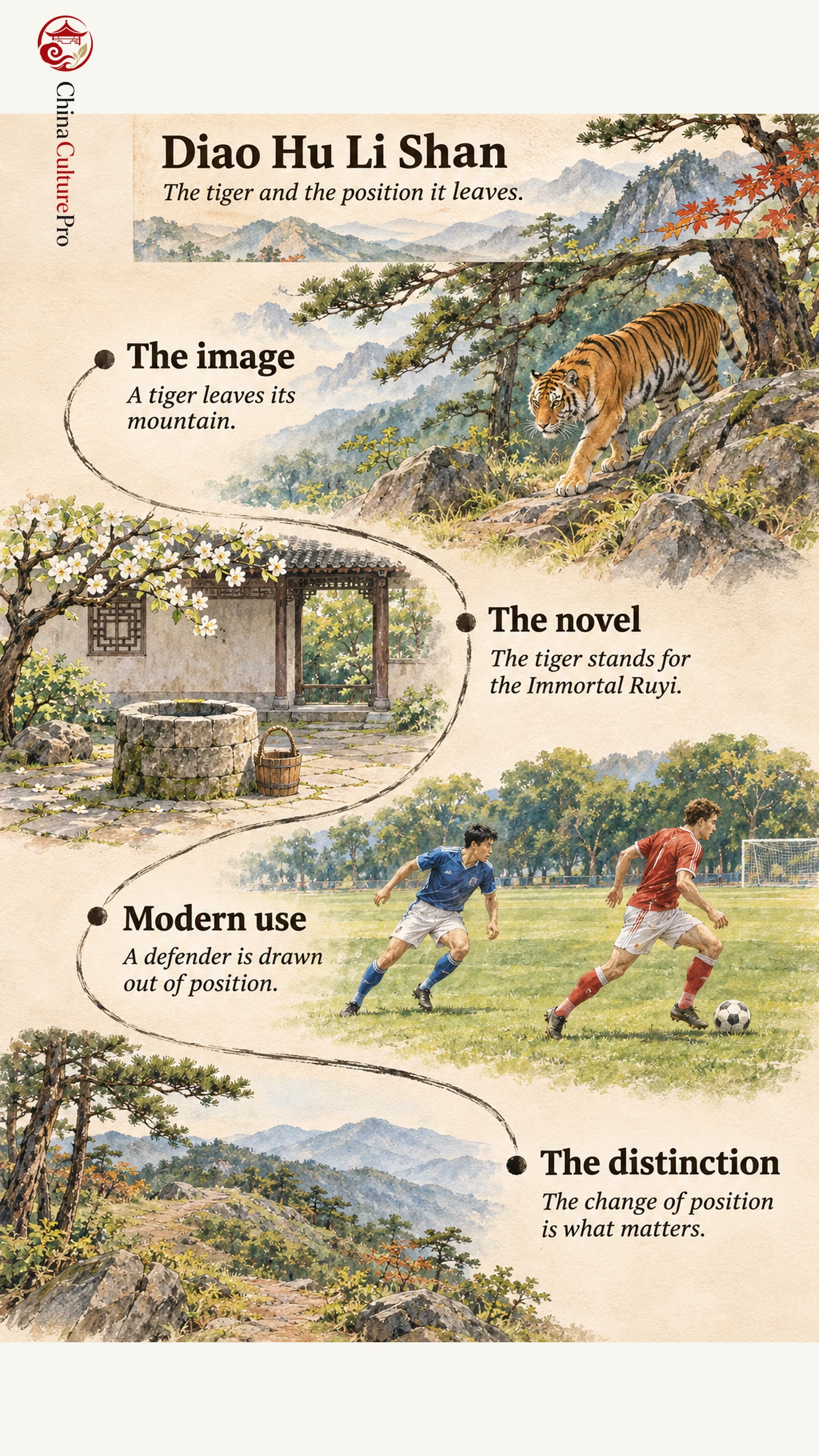
- The image: A tiger leaves the mountain where it has the advantage.[1]
- The meaning: Someone is induced to leave a position that matters.[2]
- The context: The image can describe a move in fiction or sports commentary.[1][2]
The idiom emphasizes the change of position, not just a shift of attention.
The four characters describe a tiger and a mountain, but the tiger in the familiar Journey to the West passage is a figure of speech. The reader has to recognize which character occupies the position represented by the mountain.[1]
The Tiger and Its Mountain
In this expression diào means to draw or move someone away. Hǔ is a tiger, lí means to leave, and shān means mountain. The animal’s territory stands for a place where a person is hard to dislodge or enjoys some advantage.[1][2]
The mountain can stand for a position rather than a physical landscape. An English translator can look for what the person has left behind, such as a position in a game or a role in a fictional scene. If the text only says a character was momentarily distracted, the image of leaving the mountain may be too specific.[1][2]
The Phrase in Journey to the West
Chapter 53 of Journey to the West includes an episode at a guarded well. Sun Wukong explains afterward that the Immortal Ruyi was the “tiger” in his expression. Sha Wujing has drawn the water while Ruyi was away from his position. The phrase sums up the contrast between where Ruyi was needed and where the encounter took him.[1]
The dictionary cites the episode as a possible textual source. The expression also appears among the named entries in the Thirty-Six Stratagems. These are two useful places to recognize it. Neither reference by itself establishes who first coined the four words.[1][3]
How to Use Diao Hu Li Shan in a Sentence
A sports commentator might say 这一幕像是调虎离山,后卫一离开原位,空当就出现了。 The defender’s departure from the original position is what makes the comparison work. An English broadcast might say “the defender was drawn out of position.”[2]
In a literary translation, “lure the tiger away from the mountain” preserves the picture when a character names the expression. A plain account of what happened may only need “draw them away.” The surrounding sentence can supply the consequence of leaving.[1][2]
How It Differs From Sheng Dong Ji Xi
Sheng Dong Ji Xi (声东击西, shēng dōng jī xī) highlights attention drawn in one direction while the action is elsewhere. Diao Hu Li Shan puts the emphasis on the person actually leaving the position. The terms appear separately in the received list, although a story can use both images to describe related aspects of a scene.[1][3]
An Du Chen Cang (暗度陈仓, àn dù Chéncāng) is another distinct entry. It emphasizes what happens out of sight. A useful translation identifies which aspect the narrator cares about: a person drawn away, a distraction or a concealed action.[1][2][3]
FAQs About Diao Hu Li Shan
Is 調 pronounced diào or tiáo here?
Diào is the reading here. It refers to drawing someone away or causing a change in position.[1][2]
Does Diao Hu Li Shan require a real tiger?
No. The tiger stands for someone whose position gives them an advantage. Journey to the West uses the image for the Immortal Ruyi.[1]
Is Diao Hu Li Shan in the Thirty-Six Stratagems?
Yes. It appears as a named entry in the traditional list.[3]
Источники
[1] Taiwan Ministry of Education. Idiom dictionary entry for 調虎離山
[2] Taiwan Ministry of Education. Concise dictionary entry for 調虎離山
[3] Taiwan Ministry of Education. Dictionary entry for 三十六計