
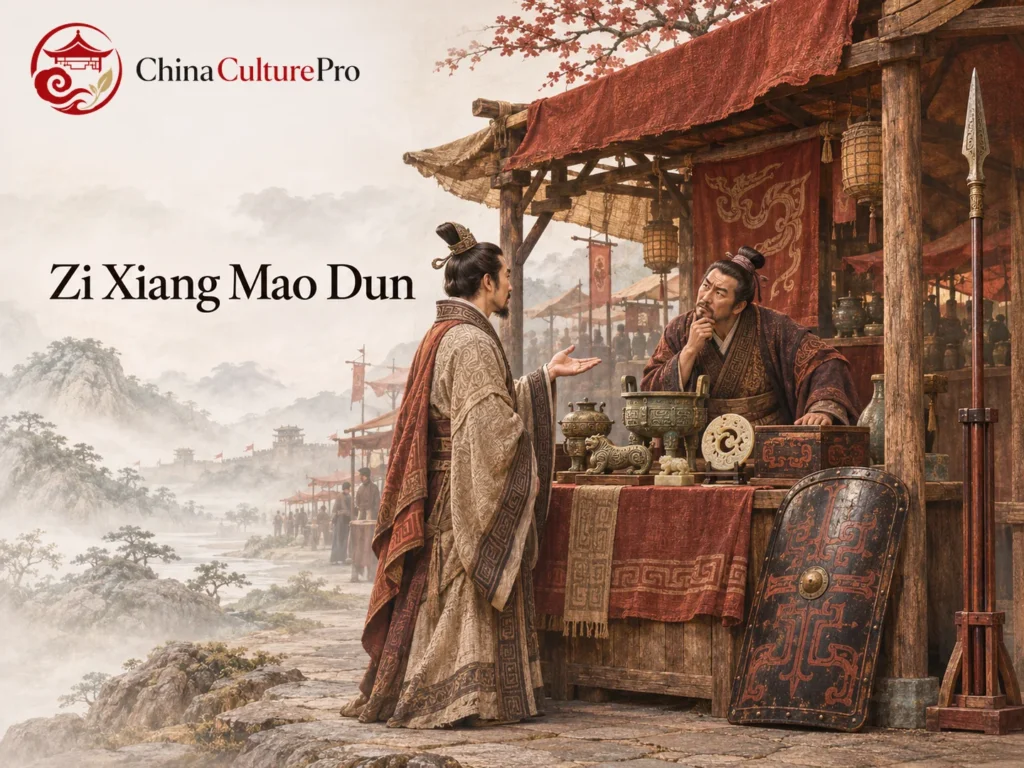

Quick Answer: What Does Zi Xiang Mao Dun Mean?
Zi Xiang Mao Dun (自相矛盾, zì xiāng máo dùn) means “to contradict oneself” or “to be internally inconsistent.” It comes from an episode in the Han Feizi (韩非子, Hán Fēizǐ) where a merchant’s own claims about a spear and a shield cannot both be true.[1][2]
- The image: The merchant says nothing can pierce his shield and his spear can pierce anything.[1]
- The question: A bystander asks what happens when his spear meets his shield.[1]
- The modern sense: Use it when someone’s statements conflict with each other or their conduct conflicts with what they say.[2][3]
The key is that the claims are incompatible under the same conditions. A person who gives two different answers about different situations may have a good reason for doing so.
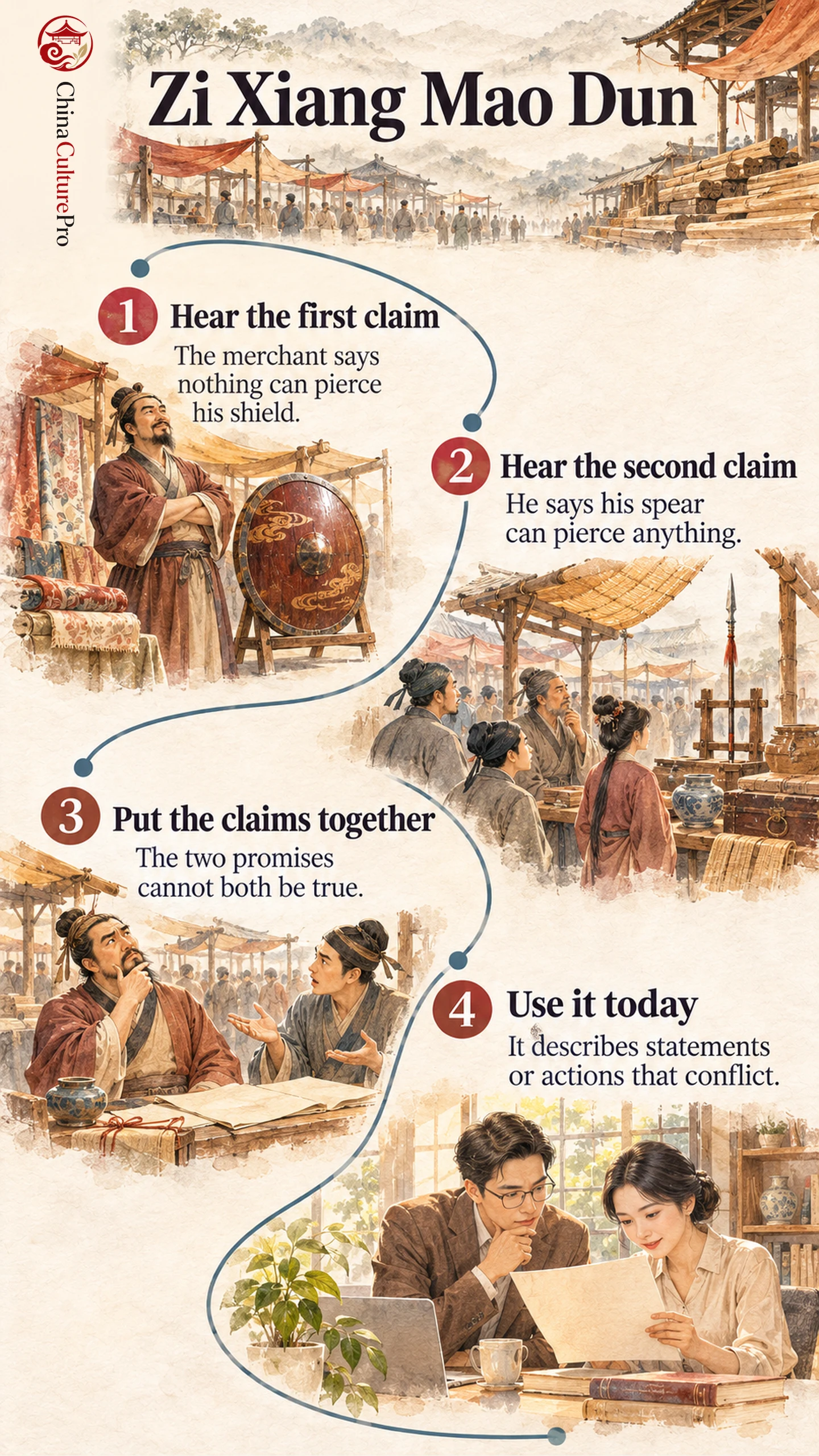
The merchant needs no demonstration to find himself in trouble. Once the bystander puts the two claims together, any answer would undermine one of the promises he has just made.[1]
What makes the merchant’s two claims incompatible
In the first “Objections” chapter, a man of Chu (楚, Chǔ) sells a shield and a spear. He praises the shield as something nothing can pierce. He also praises the spear as something that can pierce anything. A person in the crowd asks what would happen if the spear met the shield. The seller cannot answer.[1][2]
If the shield holds, then the spear has failed against something and the second claim is too strong. If the spear pierces it, then the first claim is false. The bystander exposes the problem by putting the two claims under the same conditions. Both are worded so broadly that they have to apply to the merchant’s own goods. Each claim sounds impressive on its own, but the audience now has reason to question at least one.[1][3]
Why the Han Feizi uses the story to discuss rulers
The chapter tells the story during a debate about two exemplary rulers, Yao (尧, Yáo) and Shun (舜, Shùn). One account praises Shun for personally remedying flaws among farmers, fishers, and potters while Yao governs. The critic asks how there could be failures for Shun to remedy if Yao’s oversight was as perfect as his admirers say.[1]
Put the two descriptions side by side. Shun’s achievement consists in correcting a failure, while the account of Yao leaves no failure to correct. This is the disagreement the critic illustrates with a very ordinary exchange between a seller and a bystander.[1]
How to use Zi Xiang Mao Dun in modern Chinese
In modern Chinese, the phrase can apply to a person, two sentences in a report, or a claim that someone’s conduct undermines. When you use it in a disagreement, it helps to put both statements in the same sentence so the conflict is visible.[2][3]
- Conflicting instructions: 通知前面说报名无需预约,后面又说只有预约的人才能报名,前后自相矛盾。 “The notice says no appointment is needed, then says only people with appointments can register. It contradicts itself.”
- Words against actions: 他口口声声说这件事应该公开讨论,却关闭了讨论区,做法和说法自相矛盾。 “He kept saying there should be an open discussion, then shut the discussion down. His actions contradict his words.”
The examples are original. “The notice contradicts itself” suits the first example. “His words and actions are at odds” suits the second. These direct English phrases usually sound clearer than invoking the spear and shield, unless the listener already knows the source story. Find more examples of story-based expressions in the guide to Chinese chengyu.
FAQs About Zi Xiang Mao Dun
Does the merchant ever test the two objects?
No. The question leaves the seller unable to answer. The contradiction follows from the claims themselves.[1][2]
How is it different from Mao Dun?
Mao Dun (矛盾, máo dùn) can name a contradiction or a conflict more generally. Zi Xiang Mao Dun emphasizes an inconsistency within one person’s statements, behavior, or position.[2][3]
Can you use it when someone changes their mind?
Sometimes. If a person endorses incompatible claims under the same conditions, the phrase fits. Acknowledging a change of mind or responding to new information can explain why two statements differ.[2]
Источники
[1] Wikisource. Han Feizi, Objections One
[2] Министерство образования Тайваня. Dictionary of Chinese Idioms, Zi Xiang Mao Dun
[3] Key Concepts in Chinese Thought and Culture. Paradox of the Spear and the Shield