


Quick Answer: What Does Yi Nuo Qian Jin Mean?
Yi Nuo Qian Jin (一诺千金, yī nuò qiān jīn) literally means “one promise is worth a thousand in gold.” It praises a person whose word can be trusted, or describes a promise the speaker regards as a serious commitment.[1][2]
- The image: Gold supplies a measure of value for something as intangible as a person’s word.[1][2]
- The origin: In the Records of the Grand Historian (史记, Shǐjì), a saying from Chu puts the promise of Ji Bu (季布, Jì Bù) above a large sum of gold.[1][2]
- Modern use: Say it about someone who keeps their word, or use it to emphasize the strength of a pledge.[2][3]
The force of the expression comes from being able to count on what was said. An expensive gift or an impressive-sounding promise calls for different wording if reliability is missing.
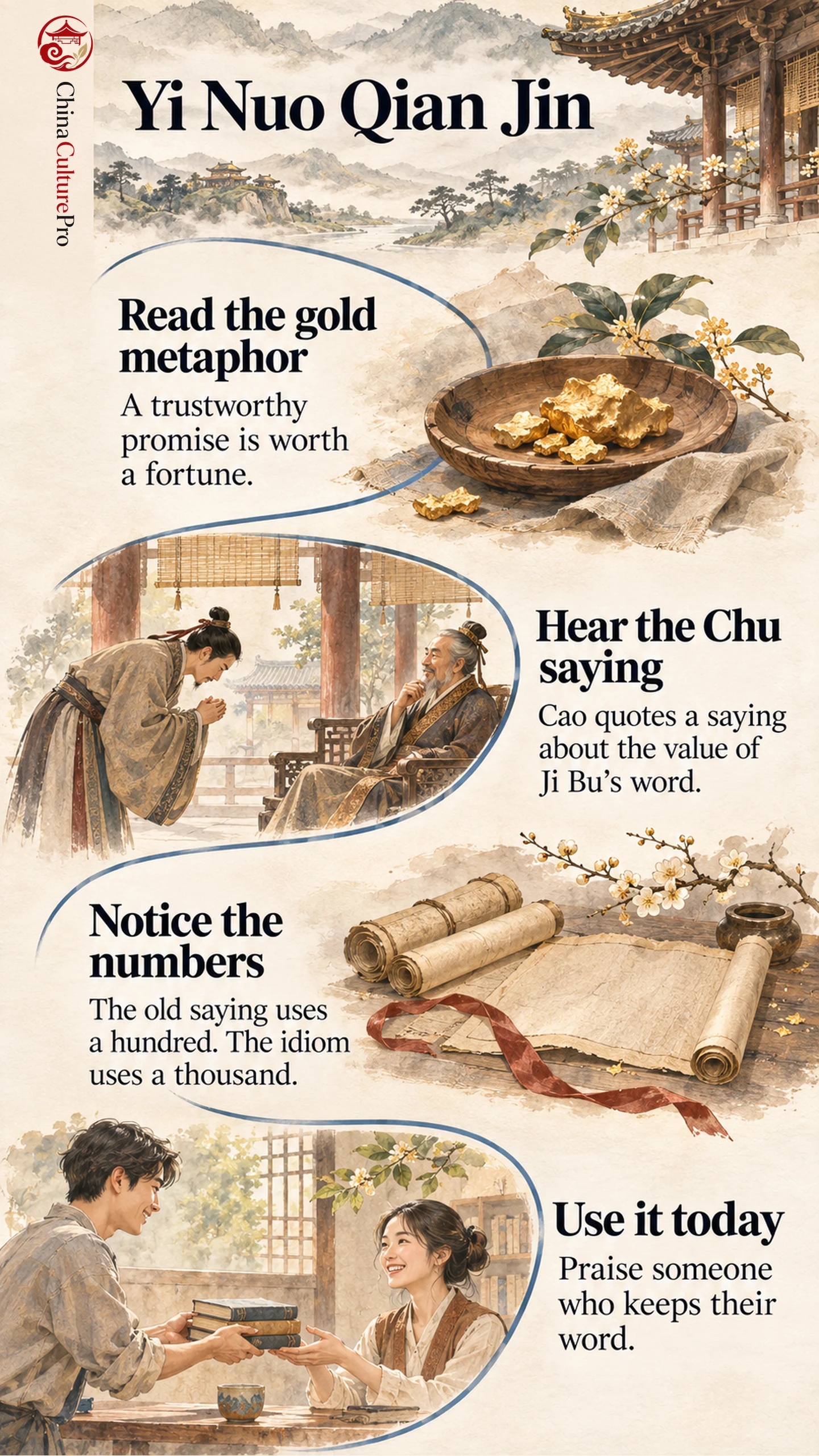
In the story, the person who brings up the saying has something to gain. Ji Bu is reluctant to see him, and the visitor turns a familiar compliment into a reason to hear him out.[1]
How Ji Bu earned a reputation for keeping his word
Ji Bu came from Chu and served as an official in the early Han dynasty. The biography describes a would-be visitor, Cao Qiusheng (曹丘生, Cáo Qiūshēng), whom Ji Bu initially regarded with suspicion. Cao insisted on obtaining a letter of introduction even after he was warned that Ji Bu would dislike the visit. On arriving, he bowed and recalled a saying from Chu that put Ji Bu’s promise above a hundred in gold.[1][2]
Cao went on to say that he had helped spread Ji Bu’s reputation. Ji Bu received him as an honored guest and kept him there for several months. The biographer ends the account by crediting Cao with making that reputation more widely known. Cao is quoting a saying that already circulates, then taking credit for its reach. The episode records a reputation and shows someone using it to change the course of a visit.[1][2]
The later idiom uses a thousand in gold. In a Song-dynasty letter, the writer Yang Wanli (杨万里, Yáng Wànlǐ) uses the four-character form to thank someone. The comparison had become a way to recognize a commitment even without naming Ji Bu.[3]
How to use the expression about a promise
The strongest context for the expression is a promise that gives someone else grounds to act. You can praise the person who kept it and follow the compliment with what they actually did. You can also use the expression for your own pledge, though the tone is then more emphatic than a simple “I promise.”[2][3]
- Praising someone who followed through: 她答应周五前把借来的书还给我,果然一诺千金,周四就送回来了。 “She promised to return the borrowed books by Friday and kept her word. They were back on Thursday.”
- Giving a firm assurance: 你放心,我既然答应亲自来接你,就会做到,一诺千金。 “Don’t worry. I said I’d pick you up myself, and I will. You have my word.”
In the first example, 果然 signals that the person lived up to expectations. In the second, what the speaker will do comes before the idiom. Naming the action gives the promise a concrete object. For more ways in which a historical anecdote becomes an everyday expression, see the guide to Chinese chengyu.
How to translate Yi Nuo Qian Jin into English
“She keeps her word” works when the Chinese describes a dependable habit. “He made good on his promise” suits a report about one completed action. “You have my word” fits a speaker who is making or reaffirming a commitment. The choice depends on whether the sentence is about reputation, follow-through, or assurance.[2][3]
Keep “a promise worth a thousand in gold” when explaining the origin or translating a passage where the gold imagery matters. In ordinary dialogue, a short expression about someone’s word carries the meaning more naturally. “Worth its weight in gold” preserves the sense of value but can also describe a tool or a favor, so name the promise if the context leaves any doubt.[2][3]
FAQs About Yi Nuo Qian Jin
Does the original proverb say a hundred or a thousand?
The saying quoted in Ji Bu’s biography uses a hundred. The established four-character idiom uses 千, “a thousand.” Both compare the value of a promise with gold.[1][2][3]
Which tone does the first syllable take?
The dictionary form begins with yī. In connected speech before the fourth-tone nuò, it is commonly read yí, giving yí nuò qiān jīn.[2]
Is Qian Jin Yi Nuo another form of the same saying?
Yes. Qian Jin Yi Nuo (千金一诺, qiān jīn yī nuò) is a recorded variant that puts the gold first. It also describes a pledge that can be trusted.[3]
Источники
[1] Wikisource. Records of the Grand Historian, annotated volume 100
[2] Министерство образования Тайваня. Dictionary of Chinese Idioms, Yi Nuo Qian Jin
[3] Taiwan Ministry of Education. Revised Mandarin Chinese Dictionary, Yi Nuo Qian Jin