


Quick Answer: Who Was Han Yu?
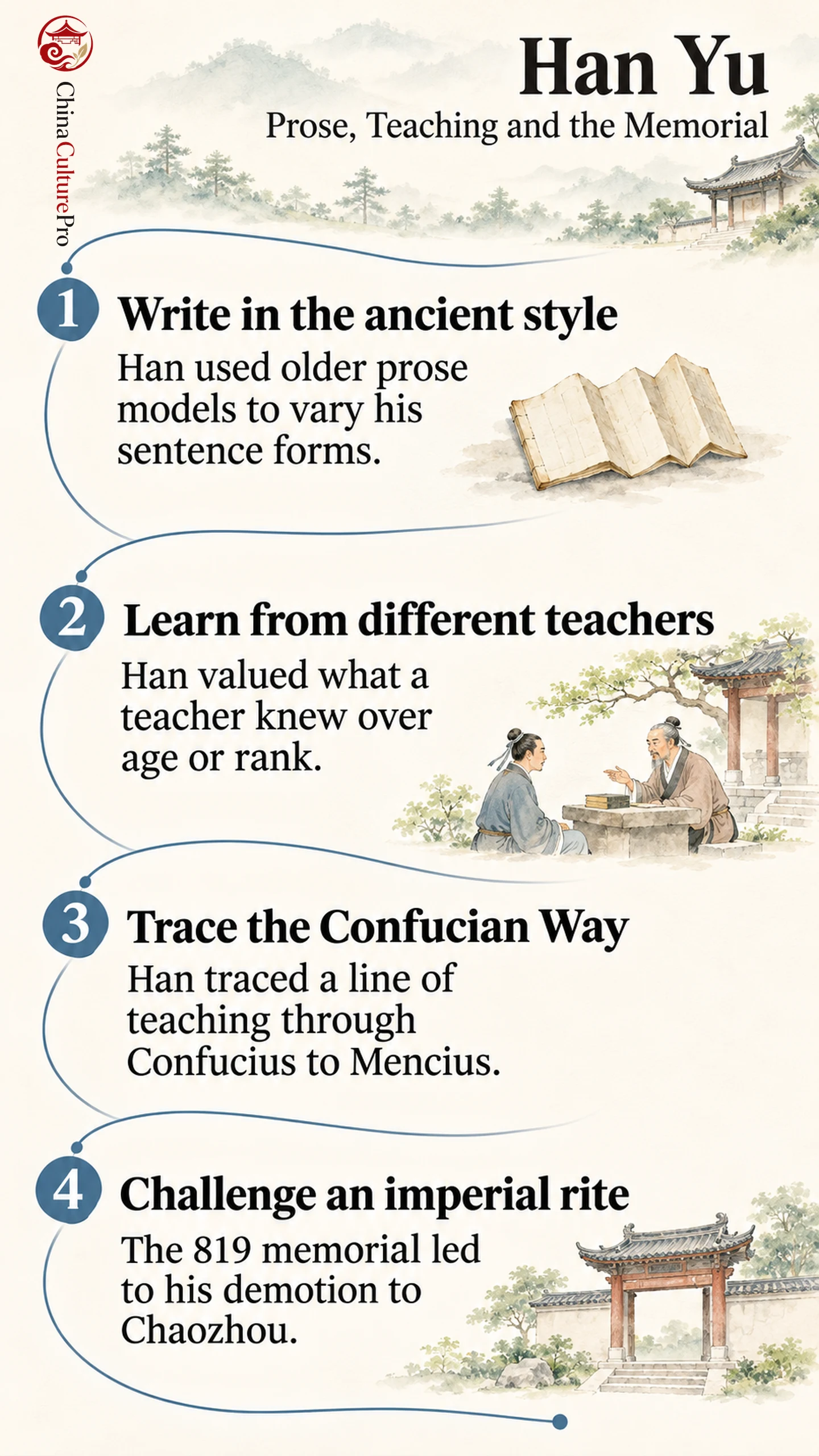
Han Yu (韩愈, Hán Yù, 768–824) was a writer and official of the Tang dynasty (唐, Táng). He helped renew the use of ancient-style prose (古文, gǔwén) and made a case for Confucian ethics in public life.[1][2]
- Teaching: In On the Teacher (师说, Shīshuō), Han argues that learning depends on what someone can teach, regardless of age or social position.[4]
- Confucian tradition: In An Inquiry into the Way (原道, Yuándào), he traces a line of teaching from ancient rulers to Mencius (孟子, Mèngzǐ).[5]
- Imperial ritual: In 819, Han objected to Emperor Xianzong’s (宪宗, Xiànzōng) reception of a Buddhist relic. He was sent to Chaozhou (潮州, Cháozhōu).[6]
His prose survives in several forms, from an essay addressed to a student to a formal petition to the throne.
Han earned the jinshi degree (进士, jìnshì) through the imperial examinations in 792. He taught at institutions in the capital and held posts in government, including vice minister of justice.[3] His writing moved between the classroom, the court and the provinces.
What Ancient-Style Prose Gave Han Yu
Han and Liu Zongyuan (柳宗元, Liǔ Zōngyuán) were prominent advocates of ancient-style prose. They drew on earlier classical writing to loosen the constraints of parallel prose, with its balanced clauses and matching rhythms. Sentence length could follow the argument. Han used it in forms such as epitaphs, historical essays and prefaces.[2]
Greater flexibility could produce elaborate prose. Literary scholar Mei Ah Tan shows how Han used extended sentences and rhetorical turns to reinforce the argument of his short essays.[9]
Teaching and the Confucian Way
On the Teacher asks why educated men hire teachers for their sons but feel ashamed to study with others themselves. Han points to artisans and musicians who learn from each other. Even Confucius (孔子, Kǒngzǐ), he says, sought instruction from different people. Han wrote the essay for a seventeen-year-old student, Li Pan (李蟠, Lǐ Pán).[4]
In An Inquiry into the Way, Han describes a way of life grounded in benevolence (仁, rén) and rightness (义, yì). He connects these qualities to duties within households and between ruler and minister. In his account of Confucian transmission, the teaching passed from ancient rulers through Confucius to Mencius. Han argues that the line broke after Mencius.[5]
The Buddha Relic Memorial and Chaozhou
In 819 the court brought a relic venerated as a finger bone of the Buddha from Famen Temple (法门寺, Fǎmén Sì) into the palace, then sent it to temples in the capital.[8] In his Memorial on the Bone of the Buddha (论佛骨表, Lùn Fógǔ Biǎo), Han argued that the emperor’s example would encourage people to give away their property and neglect their livelihoods. He urged Xianzong to destroy the relic.[7]
The emperor considered severe punishment. Officials interceded, and Han was demoted and sent to govern Chaozhou. He later took a post at Yuanzhou (袁州, Yuánzhōu).[8] He returned to the capital and went on to head the imperial college.[3]
FAQs About Han Yu
Was Han Yu a Neo-Confucian?
He was a Tang thinker whose writing influenced the later Song revival now known as Neo-Confucianism in English.[6]
What is the story about Han Yu and crocodiles?
The Old Book of Tang says that in Chaozhou he made an offering and addressed crocodiles that were said to be preying on livestock. The biography also records a storm and the disappearance of the crocodiles. Those details belong to the story of Han’s time as prefect.[8]
Where can I read Han Yu in English?
The Chinese University of Hong Kong’s Renditions publishes Shih Shun Liu’s translation of On the Teacher online. Columbia’s Asia for Educators offers translated excerpts from Han’s memorial.[4][7]
出典
[1] Charles Hartman. Han Yu, Routledge Encyclopedia of Philosophy
[2] Academy of Chinese Studies. Eight Great Prose Masters of Tang and Song
[3] Hong Kong Education Bureau. Readings in Classical Prose, Han Yu and the Tang Classical Prose Movement
[4] Han Yu, translated by Shih Shun Liu. On the Teacher, Renditions
[5] Han Yu. An Inquiry into the Way, original text
[6] Stanford Global Medieval Sourcebook. Memorial on the Bones of the Buddha, introduction and English translation
[7] Han Yu. Memorial on the Bone of the Buddha, excerpts from Sources of Chinese Tradition
[8] Liu Xu and others. Old Book of Tang, chapter 160, Han Yu biography
[9] Mei Ah Tan. Blending Style and Theme, Grammar and Rhetoric in Han Yu’s Miscellaneous Discourses