

Quick Answer: Who Was Zuo Zongtang?
Zuo Zongtang (左宗棠, Zuǒ Zōngtáng, 1812–1885) was a Qing official and military commander. He helped start the Fuzhou Navy Yard (福州船政局, Fúzhōu Chuánzhèngjú), directed the Qing expedition to regain control in Xinjiang and advocated organizing the region as a province.[1][2][3][4][5]
- Shipbuilding: His 1866 proposal combined construction with technical and naval training.
- Northwest: He directed campaigns carried out by several commanders.
- Administration: The settlement with Russia and the creation of a province followed separate processes.
His role changed as each project moved from planning to execution or negotiation.
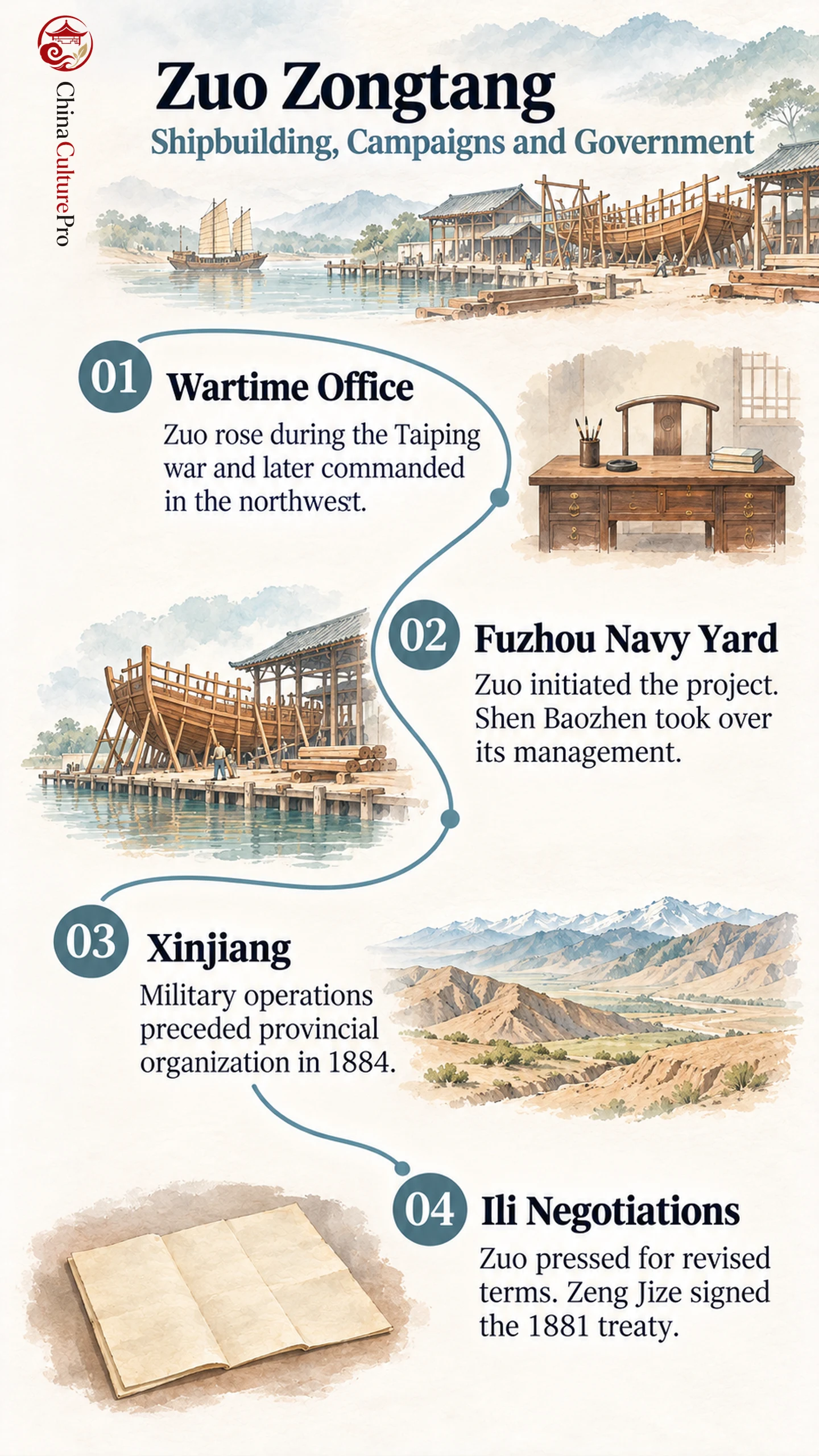
A shipyard, a military expedition and a provincial government can all be associated with one official. They still depended on different people and decisions. Zuo Zongtang’s career shows how late Qing officials moved between launching projects, directing campaigns and proposing institutional changes.
War and Provincial Office Before the Xinjiang Campaign
Zuo came from Hunan and rose during the Taiping Rebellion. He took military and provincial posts and fought Taiping forces in the southeast. His wartime experience helped bring him to positions in which the Qing government gave him authority over large projects and campaigns.[1][4]
After his assignment in Fujian, he directed operations in Shaanxi and Gansu. The fighting against Hui-led uprisings brought widespread destruction and loss of life. The impact extended beyond the armed groups Zuo was sent to defeat. The National Museum of China holds a directive from this period. The object provides evidence of Zuo’s role in the repression before he received the later commission for Xinjiang.[1][4][5]
What He Started at the Fuzhou Navy Yard
Zuo submitted a proposal in 1866 to build steamships in Fujian. The court approved it, and the project took shape at Mawei near Fuzhou. The project combined a dockyard for building vessels with a school for navigation, marine engineering and related work. Foreign specialists helped organize the project and train personnel.[2][3]
Shen Baozhen (沈葆桢, Shěn Bǎozhēn) was appointed in 1866 and took over management in 1867 as Zuo moved to another assignment. The institutional chronology separates the proposal, the appointment of a manager, the construction work and the operation of the school. The yard continued through several years of financing and work after its founding.[2][3]
Xinjiang Campaigns and Provincial Government
Zuo received his Xinjiang military commission in 1875. Qing forces advanced in stages from 1876 against the state led by Yaqub Beg and other opponents. Liu Jintang (刘锦棠, Liú Jǐntáng) was among the field commanders. By 1878, the main campaign had restored Qing control in much of the region. The expedition had a different target from the Russian occupation of Ili (伊犁, Yīlí), which the court addressed through separate talks.[1][4][5]
Zuo advocated creating a province. Provincial organization came in 1884, several years after the main fighting, with Liu Jintang as the first provincial governor. Provincial administration required officials and units that could govern territory after the campaign. Liu’s appointments make the change visible. He had commanded troops in the field and then held an office responsible for provincial government.[4][5][7]
Why Ili Required a Separate Negotiation
Zuo argued against accepting territorial concessions in the first agreement over Ili and made military preparations while the Qing sought revised terms. The court commissioned Zeng Jize to negotiate with Russia. Zeng signed the revised Treaty of Saint Petersburg in 1881. It returned most of the occupied region, while Russia retained a western portion and the Qing agreed to compensation.[4][6]
Zuo pressed for stronger terms, while Zeng held the authority to sign. The biography records Zuo’s objections and preparations. The treaty names Zeng as the representative empowered to sign for the Qing.[4][6]
FAQs About Zuo Zongtang
Did Zuo Zongtang build the Fuzhou Navy Yard alone?
He initiated the project with court approval and foreign assistance. Shen Baozhen oversaw the yard as its work developed.
Who negotiated the 1881 Ili treaty?
Zeng Jize was the Qing representative who signed the revised agreement. Zuo’s role concerned military preparation and advice on the terms.
Was the military campaign the same event as making Xinjiang a province?
The main campaign and provincial reorganization took place years apart. The province was established in 1884.
出典
[1] National Museum of China. Zuo Zongtang’s directive from the Shaanxi–Gansu campaigns
[2] Modern Asian Studies, Cambridge University Press. Keeping the Foochow Navy Yard Afloat
[3] Fuzhou Local History Office. Chronology of the Fuzhou Navy Yard
[4] Draft History of the Qing. Chapter 412: Zuo Zongtang
[5] Enterprise & Society, Cambridge University Press. Profit and Statecraft in Nineteenth-Century China
[6] The World and Japan Database. Revised treaty between China and Russia, February 24, 1881
[7] First Historical Archives of China. Unpublished Memorials of Liu Jintang, First Governor of Xinjiang