

Quick Answer: What Was the Taiping Rebellion?
The Taiping Rebellion (太平天国运动, Tàipíng Tiānguó Yùndòng) was a civil war against the Qing dynasty, usually dated 1850–1864. A religious movement in southern China became a rival government based in Nanjing and controlled substantial territory along the Yangtze.[1][2][3][5]
- Religious origins: The movement grew around a Chinese interpretation of biblical teachings and visions.[3][4][9]
- A rival state: After capturing Nanjing in 1853, the Taiping issued rules, used a calendar and minted coins.[5][6][7][8]
- Human cost: The war killed millions, displaced families and left communities with years of rebuilding and mourning.[1][12][13]
The 1850 starting date covers the outbreak of fighting. The rival kingdom was proclaimed in 1851.[1][2][5]

A copper coin, a proposed system of land distribution and survivors’ accounts show three sides of the same war.[7][8][12]
Hong Xiuquan and the God Worshippers
Hong Xiuquan (洪秀全, Hóng Xiùquán), from Guangdong, experienced visions in 1837 after failing the imperial examinations. He later read Christian tracts by Liang Fa (梁发, Liáng Fā), also known as Liang Afa. In 1843, he interpreted the visions through those teachings. Hong came to believe that he was a younger brother of Jesus and that God had charged him with driving out what he understood as demonic forces.[3][4]
Hong and other organizers drew followers in Guangxi. They became known as the God Worshippers (拜上帝会, Bài Shàngdì Huì). Preaching and shared worship brought converts together in local communities. In Guangxi, local conflict gave some followers reasons to organize for protection as well as worship. Encounters with Qing authorities helped turn that organization toward armed resistance.[1][2][3][4]
The fighting began during a period of several pressures on the Qing dynasty. The first of the Opium Wars had ended in 1842. By the time the Qing faced the Taiping, the dynasty was already dealing with the consequences of war, indemnities and changes to foreign trade.[1][2][3][4]
From Guangxi to the Heavenly Capital
The Jintian Uprising (金田起义, Jīntián Qǐyì) in Guangxi is associated with the proclamation of the Taiping Heavenly Kingdom (太平天国, Tàipíng Tiānguó) in January 1851. The Taiping advanced out of Guangxi and reached the Yangtze. They captured Nanjing in March 1853 and called it the Heavenly Capital (天京, Tiānjīng). The city gave the movement a base on a major river and a center from which it could govern.[1][2][4][5]
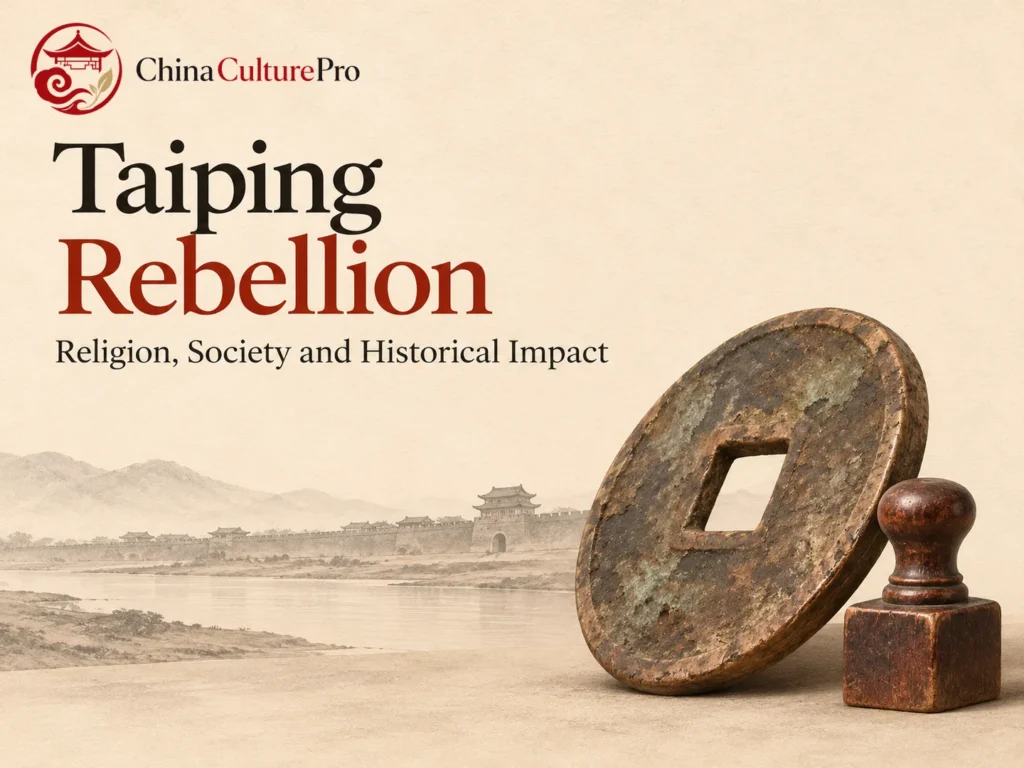
The Taiping used a calendar of their own, minted coins and dealt with foreign representatives. A surviving copper cash coin dated to 1861–1864 bears the name of the Heavenly Kingdom. A wooden military seal from another collection identifies a Taiping command associated with Jiading. The coin carried a claim to authority in ordinary exchange. The seal identified a particular military office and place. Together they show a government with both a public name and local administrative positions.[6][7]
Land, Religion and Household Rules
The Land System of the Heavenly Kingdom (天朝田亩制度, Tiāncháo Tiánmǔ Zhìdù) proposed dividing land according to household size and the quality of the land. The text counted household members regardless of sex and proposed that groups of twenty-five families set aside enough grain to reach the next harvest. An officer would collect the remaining produce for public storage. These proposals show how leaders imagined organizing production and distribution. The text records an intended system. Its rules were never applied consistently across Taiping territory.[3][8][10]
The program extended to worship and domestic life. Taiping leaders revised biblical passages in their own editions and promoted rules that followed their understanding of divine order. They condemned foot binding and imposed separation of men and women in some early settlements or camps. Some women served in military detachments. The movement combined openings for women in some roles with close regulation of daily life, and those arrangements changed over time.[3][9][10]
How Qing Forces Defeated the Taiping
The Qing turned increasingly to regional forces. Zeng Guofan (曾国藩, Zēng Guófān) organized the Xiang Army (湘军, Xiāngjūn), drawing on networks centered in Hunan. Its officers and soldiers were recruited through personal and local ties. These arrangements helped sustain a force for long campaigns and gave regional leaders a greater role in Qing defense.[2][11]
Foreign participants also shaped campaigns in the lower Yangtze. The Ever-Victorious Army (常胜军, Chángshèng Jūn), a force led by foreign officers, fought the Taiping in cooperation with Qing authorities. Private traders, meanwhile, supplied the Taiping with imported weapons. The coalitions that fought and supplied the war changed over time.[6][14]
The Taiping had held Nanjing for more than a decade when Qing forces took it in July 1864. Hong had died shortly before the city fell. The loss of the capital ended the Taiping government as a territorial rival. Qing victory kept the dynasty in power and depended in part on military organizations built during the war.[1][2][4][11]
Loss and Reconstruction
The death toll is commonly described in the tens of millions, though surviving records cannot establish an exact total. Battles and attacks on communities caused extensive loss, while displacement and wartime shortages made ordinary life difficult far beyond the front lines. The Yangtze Delta and its cities suffered major destruction.[1][2][12]
After 1864, survivors had to rebuild homes and institutions, bury the dead and decide how to remember the fighting. Families collected testimony and recorded the names or experiences of people they had lost. Rebuilding also drew on local organizations and provincial officials who had to restore forms of government and public life in places disrupted by the fighting. These tasks continued after the military campaigns that normally define the war’s dates.[12][13]
FAQs About the Taiping Rebellion
When did the Taiping Rebellion start and end?
It is usually dated 1850–1864. Fighting began in 1850, the rival kingdom was proclaimed in 1851, and Qing forces captured the Taiping capital at Nanjing in 1864.[1][2][5]
What did Hong Xiuquan believe?
Hong interpreted his visions through Christian writings and came to believe he was Jesus’s younger brother. His followers developed teachings, religious rules and a political program around their own understanding of biblical authority.[3][4][9]
Why did the Taiping Rebellion matter?
It created a rival state, caused enormous civilian losses and increased the Qing court’s reliance on regional armies. After the fighting, communities had to rebuild institutions and find ways to remember and bury the dead.[2][6][11][12][13]
出典
[1] Columbia University. Taiping Rebellion, 1850–1864
[2] Cambridge University Press. The Taiping Rebellion
[3] Cambridge University Press. The Taiping Land Programme
[4] Biographical Dictionary of Chinese Christianity. Hong Xiuquan
[5] Academy of Chinese Studies. The Jintian Uprising and the Heavenly Kingdom
[6] The British Museum. China’s Hidden Century: Taiping Coins and Seal
[7] The Fitzwilliam Museum. Copper Cash Coin of the Taiping Heavenly Kingdom
[8] Columbia University. Excerpts from the Land System of the Heavenly Kingdom
[9] Studies in World Christianity. Taiping Ideology and the Rewriting of the Chinese Bible
[10] Boston University Open Repository. Jesus’s Brother and the Chinese Periphery
[11] Journal of Institutional Economics. The Regional Army in the Late Qing Dynasty
[12] Stanford University Press. What Remains: Coming to Terms with Civil War
[13] University of California eScholarship. Reconstructing Order After the Taiping Civil War
[14] Israel Research Community Portal. Foreign Military Adventurers in the Taiping Rebellion