
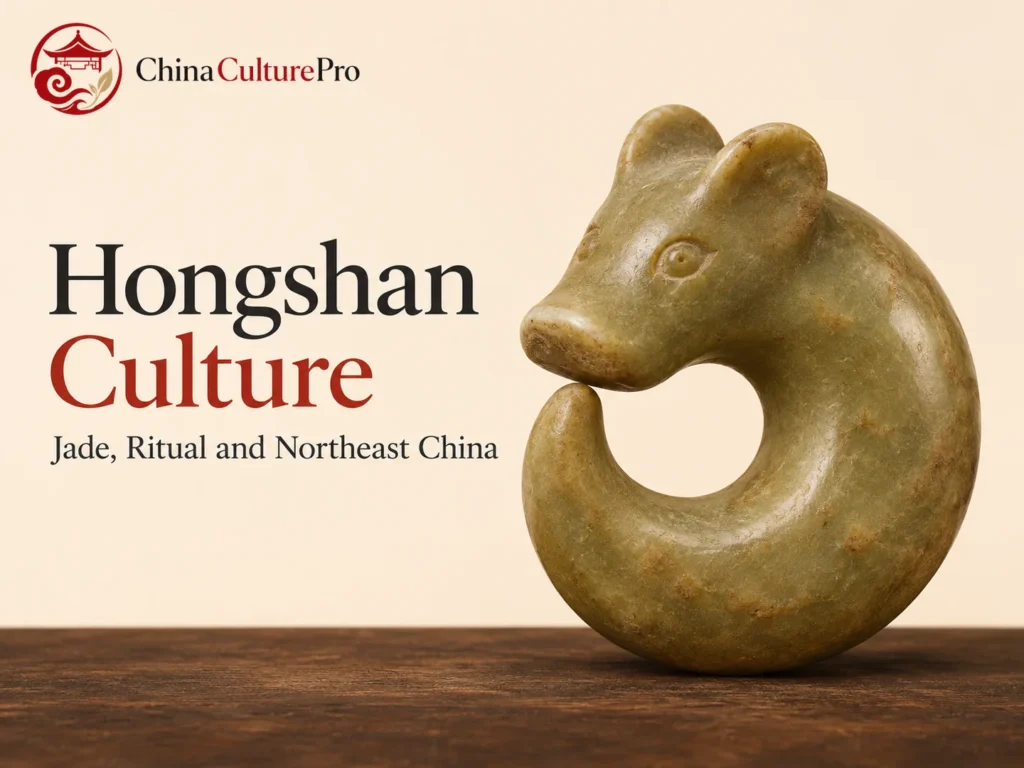

Quick Answer: What Was Hongshan Culture?
Hongshan culture (红山文化, Hóngshān Wénhuà) was a Neolithic archaeological culture in what is now northeastern China. A common broad date range is about 4500–3000 BCE. Its sites preserve traces of farming villages, ceremonial architecture, stone-lined burials and distinctive jade objects.[1][2][3][9]
- Region and dates: Hongshan communities lived in the Liao and Daling river regions and adjoining parts of present-day northeastern China.[1][2]
- Ritual places: A complex of platforms, burials and clay figures preserves evidence of organized ceremonies.[1][2][4]
- Jade and daily life: Jade ornaments and ordinary pottery answer different questions about burial practices, craft and food.[3][5][6][7]
The archaeological label covers many communities and sites across a long period.[1][2][4]
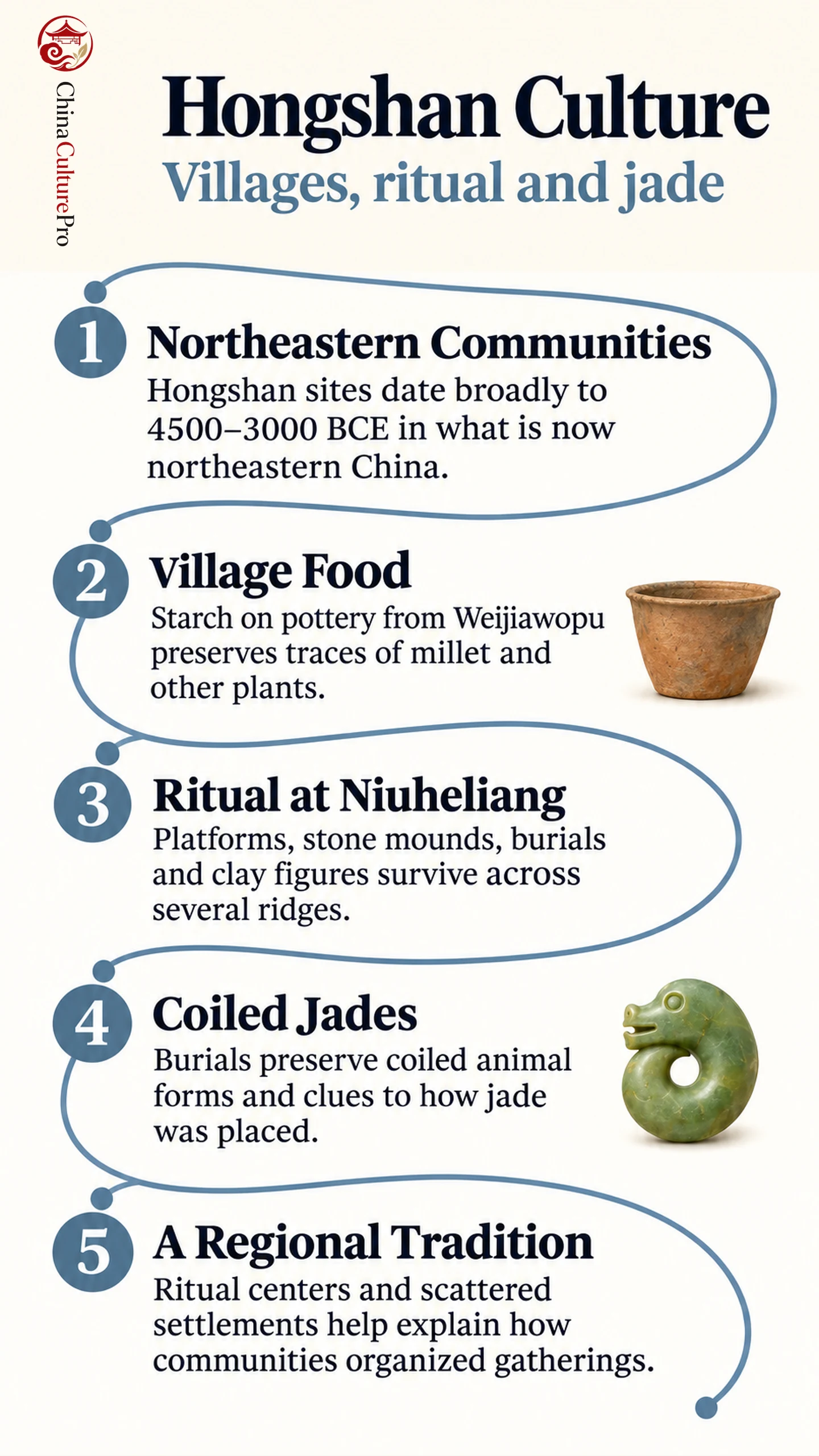
A coiled jade ornament and a jar with traces of millet preserve different sides of Hongshan life. The places where researchers found them help explain what each object can tell us.[3][6][7][8]
Where Hongshan Communities Lived
Archaeologists use the name Hongshan for groups of sites across parts of present-day Liaoning and eastern Inner Mongolia. Hongshanhou (红山后, Hóngshānhòu), near Chifeng, is the site from which the culture takes its name. The broad dates cover a regional sequence. The residential sites and the later ritual complex each preserve a narrower part of that sequence.[1][2]
In the wider record of Chinese prehistory, Hongshan is distinguished by combinations of pottery, jade, ritual buildings and burial practices. The recurring features help researchers relate nearby sites. Excavated houses, vessels and burials then show how activities differed among communities.[1][2][9]
Settlements, Pottery and Food
Weijiawopu (魏家窝铺, Wèijiāwōpù), near Chifeng, is a settlement with a surrounding ditch and traces of residences. Excavators recovered flat-bottomed pottery vessels. Researchers recovered starch from six sampled specimens. They identified grains from millet and from underground parts of plants used for storage, such as roots or tubers.[2][3]
The residues show that cultivated and gathered foods could be used in the same community. The analysts proposed storage or transport as possible uses for the vessels. The starch preserves evidence of foods that came into contact with the pottery. The jars preserve everyday activities that are less apparent in a ceremonial complex or a wealthy burial.[1][3]
Ritual Architecture at Niuheliang
Niuheliang (牛河梁, Niúhéliáng), in western Liaoning, is a late Hongshan complex spread across several ridges. Archaeologists found platforms, stone mounds, burials and the remains of a building commonly called the Goddess Temple (女神庙, Nǚshén Miào). Excavated clay sculpture fragments include a life-size human head. The building’s modern name refers to the sculptures recovered there. Archaeologists can study their size and setting, while the figure’s name and the ceremonies performed there remain unknown.[1][2][4]
Burial structures and offerings varied in size and contents. Their distribution helps researchers study who received elaborate treatment. Landscape surveys used the density of everyday pottery sherds to trace where people lived around the ceremonial areas. That evidence suggests people lived in scattered communities near the complex, and some researchers have proposed that Niuheliang drew participants from a wider area for ritual gatherings.[1][2][4]
Jade Forms and Their Archaeological Context
The term pig-dragon (玉猪龙, yù zhūlóng) is used for some coiled jades with a rounded head and a curled body. The descriptive name refers to the combination of an animal-like head and a compact curve. A grave context can show where the jade was placed and what objects accompanied it.[5][6][7][8]
A coiled jade found in 2024 at Yuanbaoshan (元宝山, Yuánbǎoshān), near Chifeng, is about 15.8 centimeters high. The tomb setting makes it possible to study the object as part of a burial. A museum piece assigned to Hongshan on the basis of shape and workmanship can preserve evidence of craft, while its exact original setting may be unknown. That distinction matters when using the object to interpret a ceremony.[5][6][7][8]
Hongshan jades include more than coiled forms. A tubular head ornament in a museum collection was assigned to Hongshan through comparison with archaeological examples. A nephrite plaque preserves another shape and technique. Similar tubular pieces in burials can help interpret how an ornament was worn. The form of a museum piece can be compared with those objects even when its original findspot is uncertain.[5][6]
What Hongshan Reveals About Early Societies
A cluster of ceremonial buildings can document the ability to organize work and gatherings. Comparing Hongshan sites with Liangzhu culture illustrates how different regions combined jade and monument building in different settings. Hongshan’s ceremonial ridges and scattered settlements differ from the large walled center and waterworks documented at Liangzhu. Together they show the variety of archaeological evidence for the origins of Chinese civilization.[1][2][4][10]
Niuheliang, Hongshanhou and Weijiawopu are listed together on China’s UNESCO World Heritage Tentative List. The entry groups a ceremonial and burial complex with sites that preserve residential evidence. Each location helps explain a different aspect of the wider culture.[2]
FAQs About Hongshan Culture
Where and when did Hongshan culture develop?
It developed in northeastern China, including parts of what are now Liaoning and eastern Inner Mongolia. A common broad range is about 4500–3000 BCE, with narrower dates for individual sites.[1][2]
What is a Hongshan jade pig-dragon?
It is a name for a coiled jade form with a rounded, animal-like head. Examples from excavated burials document one setting in which the objects were placed. Their precise symbolic meanings remain uncertain.[6][7][8]
Was Niuheliang a city?
Niuheliang is best known for its dispersed ritual structures and burials. Archaeological surveys indicate scattered settlements in the surrounding area and support the interpretation of a ritual center used by communities nearby and possibly farther away.[2][4]
出典
[1] Proceedings of the National Academy of Sciences. Hongshan Communities in Neolithic Northeastern China
[2] UNESCO World Heritage Centre. Sites of Hongshan Culture: Tentative List
[3] Acta Anthropologica Sinica. Starch Residues from Weijiawopu Pottery
[4] Antiquity. A Place of Pilgrimage? Niuheliang and Hongshan Society
[5] The Metropolitan Museum of Art. Hongshan Nephrite Plaque
[6] スミソニアン国立アジア美術館。 Tubular Head Ornament
[7] UNESCO. Discovery of Hongshan Jade Dragons
[8] State Council of China. Jade Dragon Found in a Stone Tomb near Chifeng
[9] Smithsonian National Museum of Asian Art. The Neolithic Period
[10] UNESCO World Heritage Centre. Archaeological Ruins of Liangzhu City