


Quick Answer: Who Was Zhao Gao?
Zhao Gao (赵高, Zhào Gāo) was a powerful official in the final years of Qin. He served Huhai (胡亥, Húhài), the Second Emperor, and became central to the story of the dynasty’s collapse. The received historical accounts describe his control of court access, prosecution of Li Si and test of officials’ loyalty.[1][2]
- Succession: Early accounts present different versions of how Huhai came to power.
- Court influence: The received histories give Zhao a growing role in decisions and prosecutions.
- Later language: The deer story gave Chinese an idiom for deliberately distorting the truth.
The differences between the accounts matter most when they describe private decisions or the reasons for an accusation.
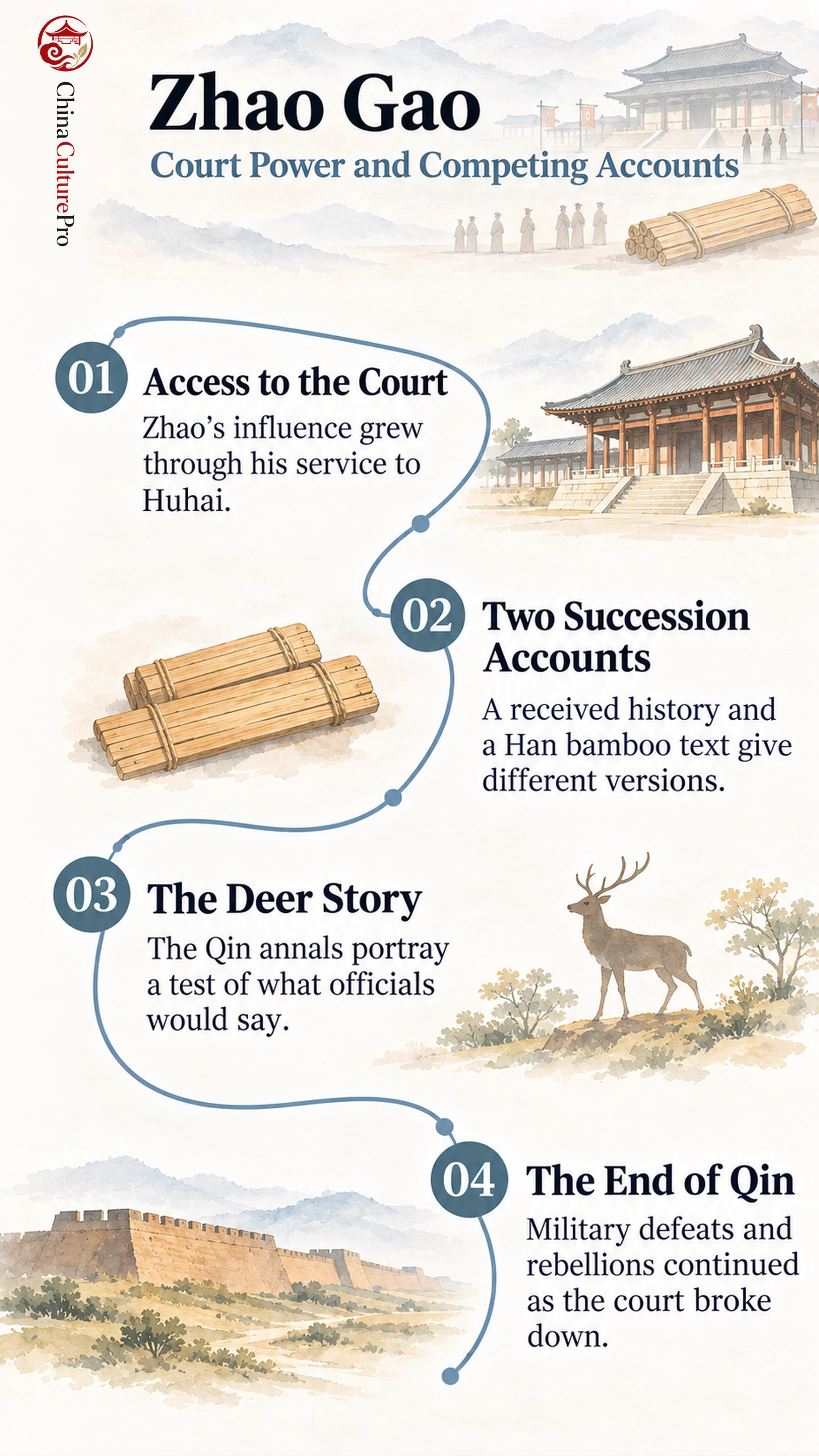
The story of a deer called a horse is usually told as a lesson about deceit. In the Qin history it has a narrower setting. A minister is testing what people will say in front of the emperor, and their answers have consequences.
How Zhao Gao Gained Influence at Court
The received biography of Li Si presents Zhao as an official familiar with legal matters and close to Huhai before the prince became emperor. That background mattered once Huhai took the throne. Zhao could advise him directly, and the account gives him a growing role in deciding whose reports reached the ruler.[2]
The biography first puts the two officials on the same side in the succession. It later portrays Zhao controlling the investigation of Li Si. It describes interrogation, coercion and an effort to make Li’s confession appear reliable when the emperor asked for a check. Li was executed. In the story told by the Records of the Grand Historian, Zhao’s ability to manage what reached the emperor helped turn access into power.[1][2]
Two Accounts of the Qin Succession
After Qin Shi Huang died in 210 BCE, Huhai succeeded. The received account by Sima Qian describes Zhao Gao, Li Si and Huhai arranging a change in the succession and sending orders that led to the death of the elder son Fusu. It is the source of the familiar account of a forged succession order.[1][2]
The Book of Zhao Zheng (赵正书, Zhào Zhèng Shū), a text preserved on Western Han bamboo slips in Peking University’s collection, gives a different account. In this version, ministers propose Huhai and the dying ruler accepts their recommendation. The collection was donated in 2009. Its find context was not established through a documented excavation.[3][4][6]
The manuscript is evidence that another version circulated in antiquity. The age of a copy does not establish that the events happened as it describes. The distinction between a source’s age and the status of its account is central to reading Chinese historical sources.[3][4][6]
What Calling a Deer a Horse Meant
The Qin annals describe Zhao presenting a deer and saying that it was a horse. The emperor asked the people around him. The responses split three ways. Some agreed with Zhao, others identified the deer and some stayed silent. The annals say Zhao used legal means against those who contradicted him. In this version, identifying the animal correctly tells Zhao which officials are prepared to contradict him.[1]
The expression “calling a deer a horse” (指鹿为马, zhǐ lù wéi mǎ) now means deliberately misrepresenting the truth. It belongs among Chinese idioms whose modern meaning is broader than the setting of the original story.[5]
Zhao Gao and the Collapse of Qin
The annals place Zhao’s final moves amid military reverses and rebellions against the Qin dynasty. In their account, he arranged the Second Emperor’s death and placed Ziying in power. Ziying then had Zhao killed. The bamboo text also presents a different account of Zhao’s death. In the annals, his removal leaves a court already facing advancing rebel forces. The dynasty still faced the military consequences of defeats and defections.[1][6]
FAQs About Zhao Gao
Is the deer-and-horse story recorded in an early history?
Yes. It appears in the Qin annals of the Records of the Grand Historian. The text presents it as a test of how officials would respond to Zhao Gao.
Did Zhao Gao become emperor?
He held senior office, including the position of chancellor in the received histories. Ziying was installed as king of Qin.
Does the Book of Zhao Zheng settle how Huhai succeeded?
It preserves a different early account. Its existence shows that accounts of Huhai’s accession varied, while the reliability of their particular claims remains open to interpretation.
出典
[1] Sima Qian, Records of the Grand Historian. Chapter 6: Basic Annals of the First Emperor of Qin
[2] Sima Qian, Records of the Grand Historian. Chapter 87: Biography of Li Si
[3] Tao Yang, Rutgers University Libraries. A new textual study of the Han bamboo manuscript Book of Zhao Zheng
[4] Early China, Cambridge University Press. Introduction to the Peking University Han Bamboo Strips
[5] Taiwan Ministry of Education, Dictionary of Idioms. Zhi lu wei ma
[6] You Yifei, Journal of East-West Humanities. The Obscured Guanzhong Perspective