


Quick Answer: Who Was Zheng Chenggong?
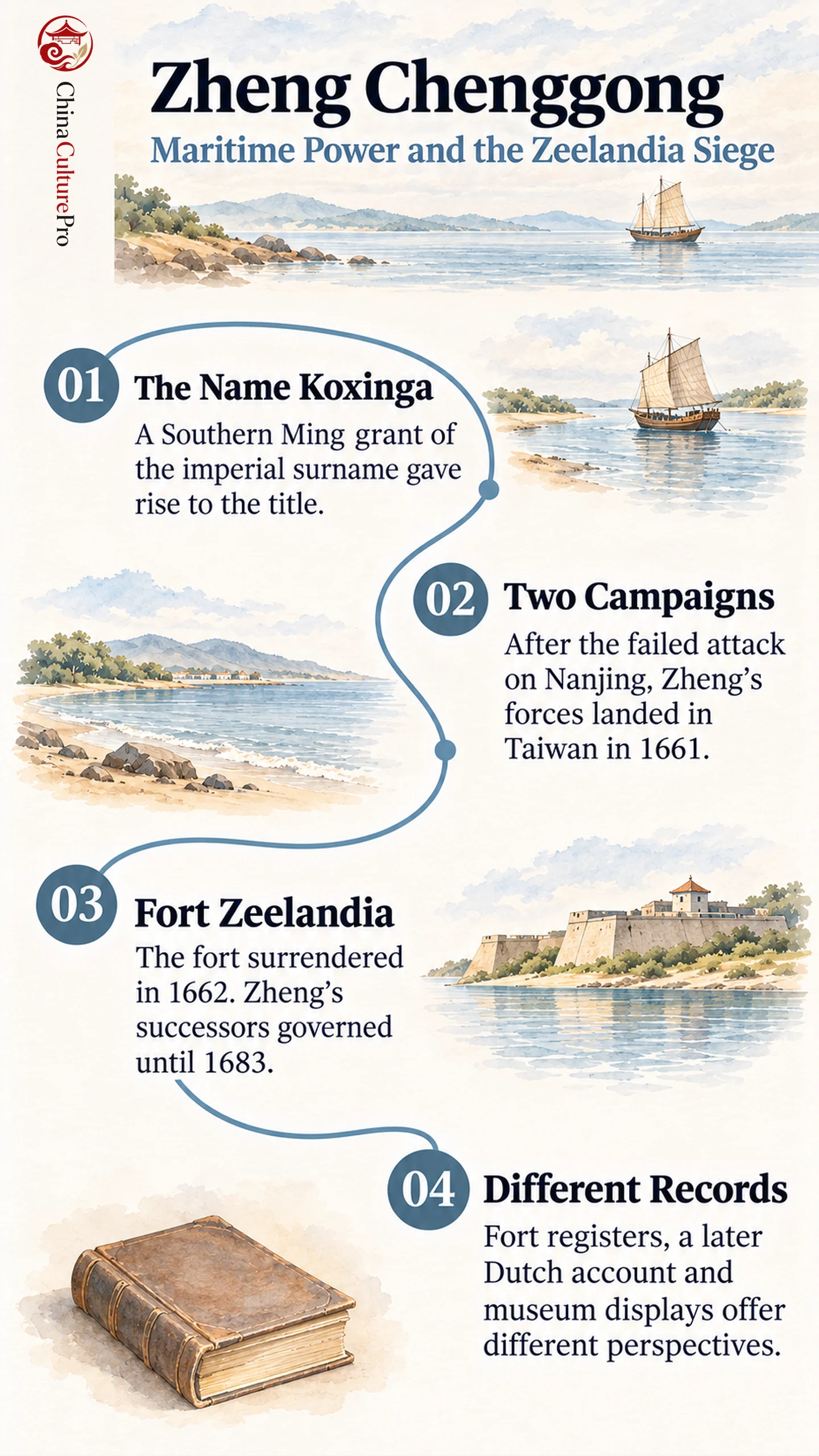
Zheng Chenggong (郑成功, Zhèng Chénggōng, 1624–1662), also known as Koxinga, led a maritime military organization and fought for the Ming cause after the Qing took Beijing. His forces landed in Taiwan in 1661. Fort Zeelandia surrendered in 1662, ending the Dutch East India Company’s rule in southwestern Taiwan.[1][2][3][4]
- Name: Koxinga comes from a title associated with the Ming imperial surname.
- Campaign: He turned to Taiwan after a failed offensive against the Qing at Nanjing.
- Afterward: His successors governed from Taiwan until 1683.
The dates separate the landing, the transfer of the fort and the later end of Zheng rule.
Koxinga’s best-known victory happened across the Taiwan Strait. To understand it, begin with a family that combined shipping, commerce and military power. Then compare the record of a siege with the accounts written by people who wanted to explain its outcome.
The Maritime Network and the Name Koxinga
Zheng was born in Hirado, Japan, to a Japanese mother and Zheng Zhilong, a Chinese maritime trader and commander. He joined his father in Fujian. The family could move goods, people and armed forces between ports. Those activities gave Zheng resources that a land-based commander would not necessarily have had. That context complements the longer history of maritime trade and port connections.[1][2][4]
The Southern Ming Longwu Emperor granted him the imperial surname Zhu and the name Chenggong. The designation Lord of the Imperial Surname (国姓爷, Guóxìngyé) gave rise to the European form Koxinga. The honor gave him a visible relationship to the Ming ruling house even after the Longwu court fell.[1][2]
From the Nanjing Campaign to Taiwan
Zheng’s forces continued opposing the Qing dynasty along the southeastern coast. In 1659, a maritime expedition traveled up the Yangtze and failed to take Nanjing. A base on Taiwan offered his organization another way to maintain its forces and maritime operations. The Dutch East India Company maintained forts and a trading administration near what is now Tainan.[3][4][5]
After landing in 1661, Zheng’s forces took Fort Provintia and besieged Fort Zeelandia. Taking one stronghold did not immediately end the campaign. Fort Zeelandia held out for months. In January 1662, Zheng’s forces captured a position overlooking the fort, bringing more of the defenses within reach of their artillery.[3][4][5][6]
What the Surrender at Zeelandia Changed
Zheng and the Dutch representatives signed the surrender agreement on February 1, 1662. Under the settlement, the Dutch handed over the fort and company property and were able to depart. The transfer gave Zheng a stronghold from which to maintain his administration and armed forces. Zheng died later that year, but his organization continued under his successors until the Qing defeated it in 1683.[3][4]
The transfer at the fort was one part of a wider change. Indigenous communities had their own relationships with the Dutch and with the newcomers. Some local leaders accepted Zheng’s authority. Others resisted or sought alliances with the Dutch. The agreement with the company did not represent a single response shared by everyone on the island.[4][5]
How Later Sources Remember Zheng
Fort Zeelandia’s day registers preserve the Dutch company’s record of affairs. A later publication associated with Governor Frederick Coyett, Neglected Formosa, sought to explain how the company lost its position. The National Museum of Taiwan History holds an illustration from that book. Its publication context matters because Coyett used the account to criticize the company’s leadership.[5][6]
Hirado’s museum interprets Zheng through his birthplace and family. Other histories foreground his Ming allegiance or the campaign in Taiwan. The registers document affairs at the fort. Coyett’s publication assigns responsibility for the defeat. The birthplace museum shows how another community remembers Zheng.[1][3][5][6]
FAQs About Zheng Chenggong
Are Koxinga and Zheng Chenggong the same person?
Yes. Zheng Chenggong is the usual modern name. Koxinga derives from the title associated with the imperial surname bestowed by the Southern Ming.
Why do accounts give both 1661 and 1662?
Zheng’s forces landed and began the campaign in 1661. Fort Zeelandia surrendered in February 1662.
Did Qing rule in Taiwan begin when the Dutch left?
The Zheng organization governed from Taiwan after the Dutch departure. The Qing defeated Zheng’s successors in 1683.
出典
[1] Matsura Historical Museum, Hirado. Zheng Chenggong: An Asian Hero Born in Hirado
[2] The University of Hong Kong research repository. Representations of History in the Poetry of Zheng Jing: Writing About Identity in the Southern Ming
[3] Cambridge University Press. Ming Loyalists Flee to Taiwan (1661–83)
[4] Xing Hang, University of California eScholarship. Between Trade and Legitimacy, Maritime and Continent
[5] Huygens Institute. The United East India Company in Taiwan, 1629–1662
[6] National Museum of Taiwan History. Illustration of Negotiation Between the Dutch Envoy and Zheng Cheng-gong