

Quick Answer: Who Was Confucius?
Confucius, known in Chinese as Kongzi (孔子, Kǒngzǐ), was a teacher and thinker whose ideas about character, relationships and government became foundational in East Asian intellectual life.
- Life: His traditional dates are 551–479 BCE, and his life is associated with the state of Lu in present-day Shandong.
- Teaching: He connected moral learning with respectful conduct and responsibility toward others.
- Text: The Analects (论语, Lúnyǔ) preserves sayings and dialogues attributed to him and his circle.
- Legacy: Later scholars and institutions developed his image and ideas in different directions.
Later accounts of the sage include material that cannot be securely assigned to the historical teacher.
Confucius is remembered through conversations: a student asks about goodness, a ruler asks about government, or a teacher asks whether learning has changed someone’s conduct. His life and later reputation show how a teacher came to represent much more than the lessons of one circle of students.
A Life in the Later Zhou World
Confucius’s personal name was Kong Qiu (孔丘, Kǒng Qiū). He lived during the later Zhou world, when regional rulers competed for authority and inherited political arrangements were under strain. The traditional dates 551–479 BCE place him in the Spring and Autumn period, before the later centuries of Warring States debate.[1]
The surviving accounts support an outline more readily than a precise career calendar. Different sources connect him with different offices and episodes; much of the familiar biography was assembled after his lifetime.[1][2]
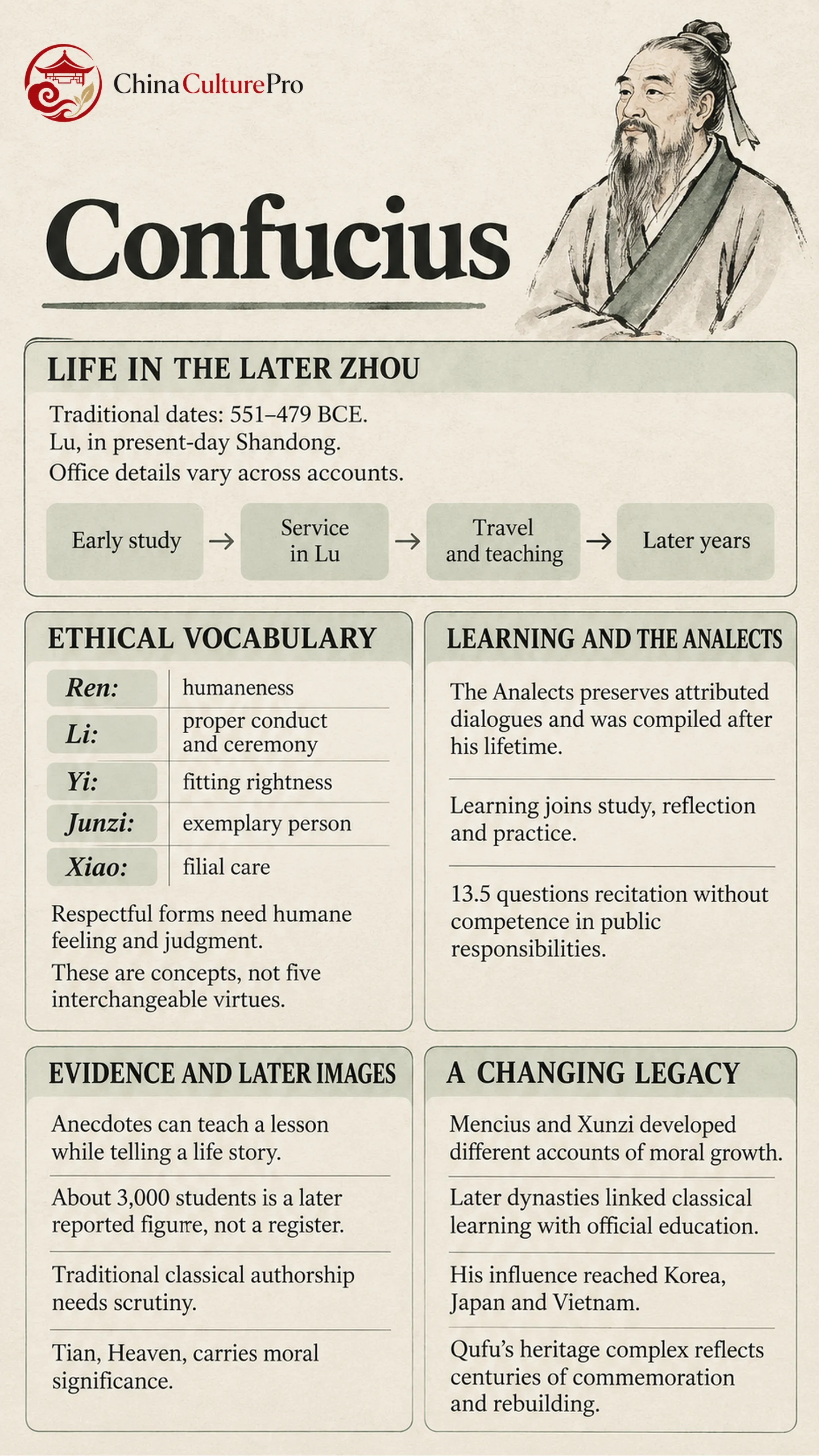
| Traditional phase | What the accounts describe |
|---|---|
| Early life and study | Tradition places his birth in 551 BCE in the state of Lu, in present-day Shandong. |
| Service in Lu | Early sources describe administrative service, but the offices and career sequence vary. |
| Travel and teaching | Accounts remember journeys among states, conversations with rulers and a circle of students. |
| Later years | Tradition places his later teaching in Lu and his death in 479 BCE. |
Some accounts associate him with managing stores and livestock; later biographies assign much higher offices. These differences matter when a modern biography presents an uninterrupted rise through a clear ladder of government posts. A source-based account preserves the uncertainty rather than choosing the most impressive version.[1]
His ambition was not simply to withdraw into private wisdom. The remembered teacher sought an opportunity to improve public life through advice, learning and exemplary conduct. His later influence should not be confused with great political power during his own lifetime.[3]
What Confucius Taught About Character and Relationships
Confucius treated moral formation as work done through relationships, habits and reflection. Five concepts provide an accessible entry point; they are not a complete creed or a list of five interchangeable virtues.[1]
- Ren (仁, rén): humaneness or ethical concern for other people.
- Li (礼, lǐ): learned forms of proper conduct and ceremony.
- Yi (义, yì): rightness or action fitting the situation.
- Junzi (君子, jūnzǐ): an exemplary person formed through learning and conduct.
- Xiao (孝, xiào): filial care and respect for parents.
The connection among ren, li and yi prevents ritual from becoming a performance of manners alone. A respectful form matters because of the humane concern and judgment it expresses. Mourning without grief or courtesy without genuine regard misses something central to the teaching.[1]
The junzi is an ethical aspiration, not simply someone with wealth or hereditary rank. Learning should make conduct dependable under pressure, including when personal advantage points in another direction. The focus is on the person one becomes, not only the correct words one can repeat.
Family and political life remained hierarchical settings. Yet Confucius’s emphasis on responsibility also places demands on those above others: a ruler’s character and example matter, rather than only the obedience of subjects. Understanding the ethical argument does not require pretending that ancient institutions offered modern social equality.[2]
Teaching Through Questions, Practice and the Analects
The Analects preserves a teacher in conversation rather than a neatly ordered textbook. A question about goodness can receive a response fitted to the speaker or setting. Reading the surrounding exchange is often more useful than treating one sentence as advice for every possible situation.[1][3]
Study also had to become practical understanding. Analects 13.5 questions the value of reciting many poems if someone cannot handle public responsibility or respond independently on a mission. The point is not that literary learning is worthless, but that accumulated learning must support competent judgment and action.[4]
This helps explain the place of practice in his educational ideal. Repetition can establish habits, while reflection tests whether those habits express understanding. Moral learning concerns attention, desire and response as well as information. Knowing how to define respect is easier than showing it during disappointment or disagreement.
The Analects was compiled and transmitted after Confucius’s lifetime. It is a central source for his teaching, but not an autograph or a word-for-word recording whose every occasion can be dated. Its dialogues belong to a larger body of early material about him, with a complex history of selection and interpretation.[1]
The Historical Teacher and Later Images of the Sage
Anecdotes about Confucius often teach a lesson while telling a story. Later writers could use his authority to present an ideal teacher, defend a tradition or criticize a political arrangement. An account’s moral purpose does not automatically make it false, but it does affect how historians should use it.[1][2]
Claims that he personally authored or edited all the major classics also need care. Traditional associations with ancient texts helped shape his authority; they are not the same as secure evidence of modern-style authorship. Later tradition gives a figure of about 3,000 students, but this is a reported claim rather than an enrollment record.[1]
His thought also cannot be separated from every religious concern. Tian (天, tiān), usually translated as Heaven, carries moral significance in early accounts, and ritual includes ancestral sacrifice as well as everyday propriety. Later reverence for Confucius developed further sacred and institutional forms. This is more complex than calling him either a purely secular lecturer or the founder of one uniform church.[2]
The most useful distinction is between a claim made in an early text, a later interpretation and a modern summary. Keeping those layers visible makes it easier to appreciate his influence without attributing every subsequent idea to the historical teacher.
Why His Influence Outlasted His Lifetime
Confucianism (儒家思想, rújiā sīxiǎng), the broad tradition associated with his legacy, developed through later thinkers and institutions. Mencius and Xunzi gave different accounts of moral development and human nature. They did not merely repeat a finished psychological system supplied by Confucius.[1][2]
Classical learning gained institutional authority under later dynasties. Still later, Neo-Confucian thinkers such as Zhu Xi gave the Analects a powerful place in a curriculum of moral education. The later examination tradition drew on classical education, but its institutions developed after his lifetime.[1]
His influence reached Korea, Japan and Vietnam, where local thinkers and institutions adapted the inheritance. Modern readers have also criticized, defended and reinterpreted his ideas. This varied reception belongs to the larger history of Chinese philosophy, rather than demonstrating that one unchanged message ruled every later society.[2][3]
Qufu offers a concrete expression of commemoration. Its temple, cemetery and Kong family mansion form a UNESCO-listed heritage property. The complex reflects centuries of rebuilding, patronage and family history; it should not be imagined as a group of buildings left unchanged from the teacher’s lifetime.[5]
FAQs About Confucius
When and where did Confucius live?
His traditional dates are 551–479 BCE. He is associated with the state of Lu in what is now Shandong, China. Details of his career and some biographical episodes remain uncertain.
Did Confucius write the Analects?
No. The collection preserves sayings and dialogues attributed to him, but it was compiled and transmitted after his lifetime. It is evidence for a teaching tradition, not a book he personally wrote in its received form.
What was Confucius’s main teaching?
He connected becoming a good person with learning, humane concern, appropriate conduct and responsibility within relationships. Ritual was meaningful when it shaped and expressed character, rather than merely displayed correctness.
Was Confucius the founder of an imperial examination system?
No. The institutions that later used classical learning to select officials developed long after his lifetime. His influence on their educational ideals is different from personally establishing those institutions.
出典
[1] Stanford Encyclopedia of Philosophy. Confucius
[2] Jeffrey L. Richey. Confucius
[3] Asia for Educators, Columbia University. What Did Confucius Say?
[4] Confucius, translated by James Legge. The Analects, Section 3
[5] UNESCO World Heritage Centre. Temple and Cemetery of Confucius and the Kong Family Mansion in Qufu