

Quick Answer: Who Was Laozi?
Laozi (老子, Lǎozǐ), often written Lao-tzu in older English books, is the traditional figure associated with the Tao Te Ching (道德经, Dàodéjīng). His historical identity remains uncertain; manuscripts, commentaries and religious traditions document the later history of the work and its attributed author.[1][2]
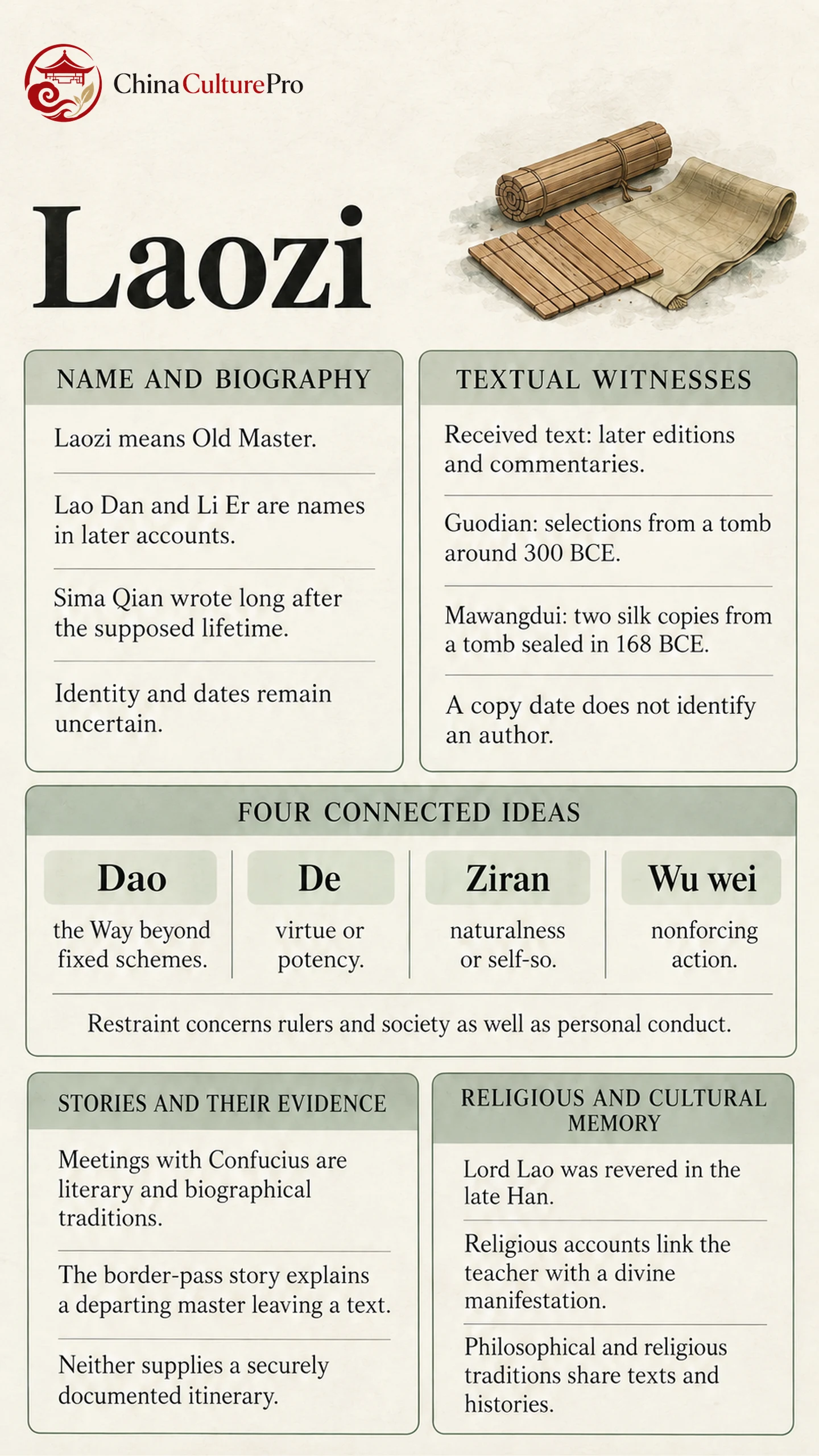
- Name: Usually translated as “Old Master,” Laozi can identify a reputed teacher, the book attributed to him or a revered religious figure.
- Biography: Familiar accounts were recorded long after the period in which he supposedly lived.
- Text: Excavated copies illuminate the book’s transmission without establishing a single author.
- Legacy: His name connects philosophical interpretation with religious worship and cultural storytelling.
A traditional life story, a manuscript date and a religious account supply different kinds of evidence; none should silently stand in for the others.
The name on a Tao Te Ching cover can look as secure as a modern author’s signature. For Laozi, identifying the author means weighing later life stories against the history of the text. Traditions and excavated manuscripts preserve different kinds of evidence, and each answers a different question.
The Old Master, the Name and the First Biography
The influential early biography appears in Sima Qian’s Records of the Historian (史记, Shǐjì), compiled in the late second and early first centuries BCE. It connects Laozi with the names Lao Dan (老聃, Lǎo Dān) and Li Er (李耳, Lǐ Ěr), and describes a keeper of archives serving the Zhou court. These are claims preserved by a retrospective source, not contemporary personnel records.[1]
Sima Qian also preserves competing identifications rather than supplying one securely documented life. The familiar picture of a sixth-century BCE sage, older than Confucius, belongs to this biographical tradition. It should not become an unqualified birth date in a modern introduction. Scholars differ over whether a historical teacher stands behind the name and how much of the received story can be recovered.[1][2]
The distinction affects ordinary reading. “Laozi argues” can be convenient shorthand for an argument in the book. It does not establish that one identifiable man composed every passage. Similarly, calling him an important figure in Chinese philosophy describes the influence of the attributed work and its interpretations, even when the author’s life cannot be reconstructed.
What Manuscripts Can Tell Us About Authorship
Physical witnesses provide firmer anchors for the history of the text. They still need careful interpretation: a copy must already have existed when it entered a sealed tomb, but the tomb’s date does not identify who first composed its contents.[1][3]
The Guodian (郭店, Guōdiàn) bamboo texts and Mawangdui (马王堆, Mǎwángduī) silk copies are excavated witnesses; the received text is the work transmitted through later editions.
| Witness | 史料から確認できること | そこからは分からないこと |
|---|---|---|
| The received text | Later editions and commentaries preserve the familiar work, not an author’s original manuscript. | A continuous record from one named writer’s hand. |
| Guodian selections | Bamboo texts from a tomb dated around 300 BCE preserve portions corresponding to the Laozi. | That the complete familiar book already existed in its received form. |
| Mawangdui copies | Two silk copies came from a tomb sealed in 168 BCE, demonstrating earlier textual circulation. | A birth date or exclusive authorship for the traditional philosopher. |
The Guodian materials matter because they preserve selections rather than a complete equivalent of a modern edition. Their wording and arrangement allow comparison with later versions, while their limited coverage leaves other questions open. The Mawangdui silk manuscripts offer further evidence for early textual forms; two copies are associated with tomb 3, sealed in 168 BCE.[1][3]
Comparing selections, silk copies and later editions makes textual transmission visible. Variants among copies may inform arguments about compilation and editing, but they do not automatically settle how many people contributed or when every passage originated. A Tao Te Ching reading guide can explain editions and translations in more detail; the biographical point is that textual history and personal identity remain separate questions.
The Ideas Associated with the Laozi
Four concepts help explain why the text matters beyond the problem of its author. Their English renderings are aids to reading, rather than exact replacements with a single fixed meaning.[1]
- Dao (道, dào): the Way, understood as a source or course that exceeds a fixed human scheme.
- de (德, dé): virtue or potency through which the Way is expressed.
- ziran (自然, zìrán): naturalness or what is self-so.
- wu wei (无为, wúwéi): nonforcing action rather than total inactivity.
The text questions the confidence with which people impose names, ambitions and rigid schemes on the world. Its discussions of the Dao resist treating a verbal definition as complete possession of what is being described. Images of softness and yielding challenge the assumption that the most conspicuous exertion is always the most effective response.[1]
These themes also have political force. Restraint can concern rulers’ interference, competition for status and the consequences of multiplying demands on a community. Reading wu wei only as a private relaxation technique misses that wider setting. At the same time, interpretations differ over how the passages fit together; an attribution to Laozi does not turn each translation choice into the verified opinion of a known historical individual.[1]
Confucius, the Border Pass and Author Legends
The alleged meeting with Confucius is one of the most memorable stories about Laozi. Accounts place the two in conversation, often presenting Laozi as a challenging elder. Stories in the Zhuangzi (庄子, Zhuāngzǐ) also use encounters involving Lao Dan to explore philosophical positions. Such scenes can reveal how writers contrasted ideals of wisdom; their existence is not independent confirmation that a particular meeting occurred.[1][2]
Another famous account describes Laozi leaving the Zhou world and being asked by a border official to record his teaching before disappearing from view. It supplies an evocative origin for the short book: a departing master leaves words behind while remaining beyond ordinary public knowledge. The story is preserved in the biographical tradition, not supported by a surviving manuscript demonstrably written at that encounter.[1]
Both stories are worth understanding as part of his cultural image. Calling them traditions need not dismiss their literary or religious importance. It keeps their significance from being mistaken for a securely dated itinerary. The related Zhuangzi requires the same attention to the work a philosophical story is doing.
Laozi in Religious and Cultural Memory
Laozi’s significance extends beyond a name on a philosophical book. Lord Lao (老君, Lǎojūn) became a major divine figure, with evidence of imperial reverence in the late Han period. Religious accounts can understand the historical teacher as one manifestation of a being whose activity extends across ages. That is a claim within a religious worldview, not a method for reconstructing a human lifespan.[4]
Modern introductions often separate Daoist philosophy (道家, dàojiā) from religious Daoism (道教, dàojiào). The distinction can orient readers, but their histories and textual resources overlap. It would be misleading to describe religious traditions simply as a later corruption of an originally pure philosophy, or to suppose that all devotees and commentators understood Laozi in the same way.[4]
The broader history of 道家思想 includes institutions, rituals, commentaries and communities as well as reflection on the classic. A portrait, temple image or edition may therefore present a different aspect of Laozi. Identifying that setting helps explain what the image or account is claiming before asking whether it can serve as evidence about an ancient person.
FAQs About Laozi
When did Laozi live?
Tradition often places him in the sixth century BCE, as an elder contemporary of Confucius. His dates are not securely established. Early manuscripts anchor the circulation of textual material, while later biographies preserve accounts of the supposed author.[1]
Did Laozi write the Tao Te Ching by himself?
Single authorship is not established. Manuscript differences and the work’s transmission support investigation of compilation and editing, but they do not provide a complete record of its contributors. The traditional attribution should be distinguished from a documented authorial manuscript.[1]
Did Laozi meet Confucius?
Early literary and biographical traditions describe meetings, but their historical occurrence cannot be securely confirmed. The stories remain important evidence for how later writers represented the two figures and their teachings.[1][2]
Is the Daoist deity Lord Lao the same as the historical thinker?
Religious traditions connect them, often presenting the ancient teacher as a manifestation of Lord Lao. That religious identity and the question of a historically recoverable author belong to different kinds of inquiry.[4]
出典
[1] Alan K. L. Chan. Laozi
[2] Ronnie Littlejohn. Laozi (Lao-tzu)
[3] Francesca Puglia. Mawangdui Laozi 馬王堆老子
[4] Fabrizio Pregadio. Religious Daoism