


Quick Answer: Who Was Liu Zongyuan?
Liu Zongyuan (柳宗元, Liǔ Zōngyuán, 773–819) was a Tang dynasty official, essayist and poet. After a reform movement failed in 805, he was sent to Yongzhou (永州, Yǒngzhōu), where he wrote many of his best-known works.[2]
- Career: Liu served in the capital, spent about a decade in Yongzhou and later governed Liuzhou (柳州, Liǔzhōu).[2]
- Landscape prose: His Eight Records of Yongzhou (永州八记, Yǒngzhōu Bājì) are a major example of Tang writing about landscape.[3]
- Political writing: In a prose piece about a snake catcher, Liu used one family’s story to examine the burden of taxes.[5]
His prose is often read alongside that of Han Yu. His short poem River Snow (江雪, Jiāng Xuě) belongs to another strand of Tang literature.[6][7]
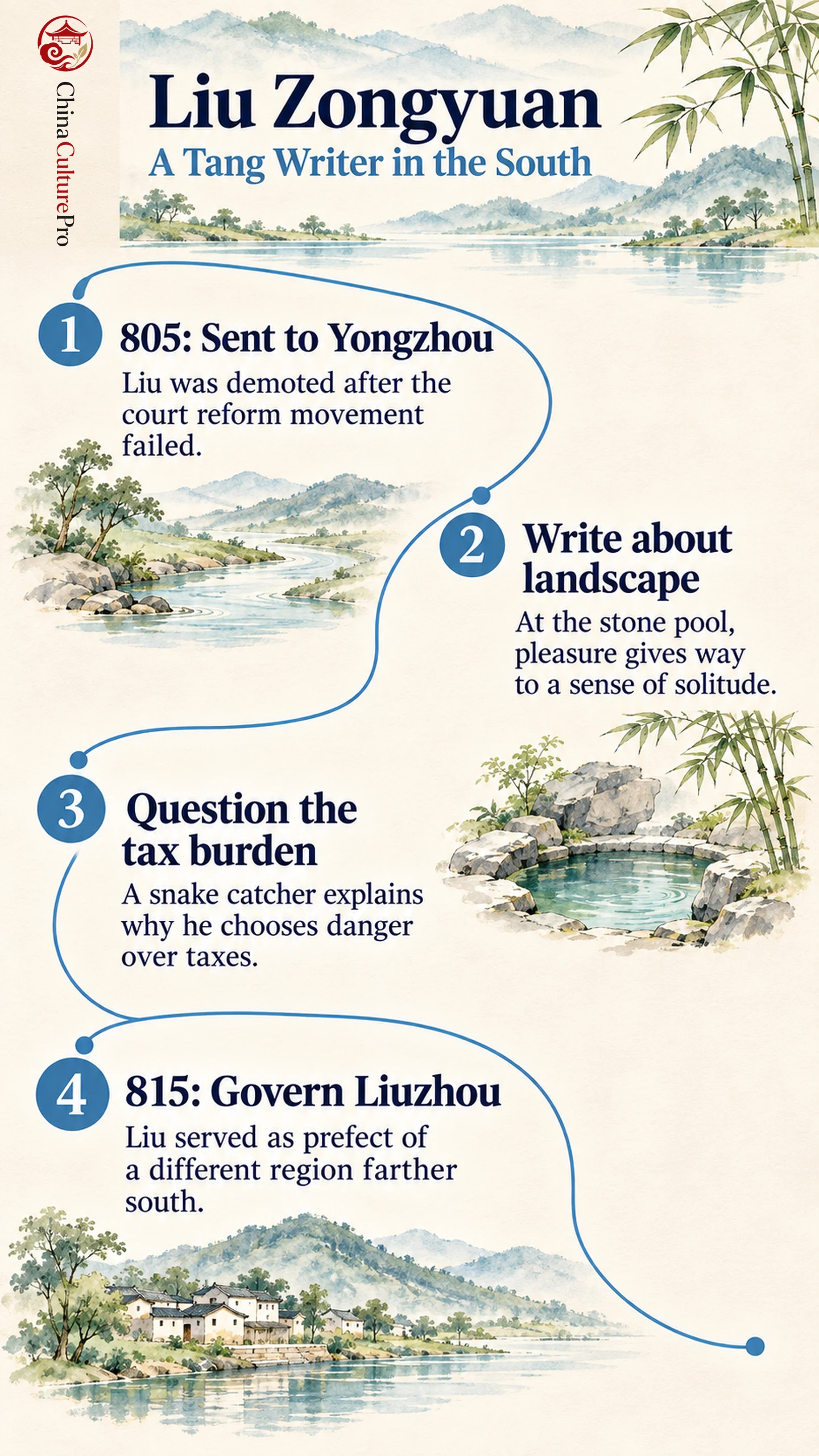
In one essay Liu follows the sound of water through bamboo. In another he asks why a man continues a dangerous occupation. Both start with close observation, then turn when the scene or the person in front of him proves more complicated than it first appeared.
From Court Reform to Exile in Yongzhou
Liu passed the highest level of the imperial examinations in 793. He later worked with Wang Shuwen (王叔文, Wáng Shūwén), whose circle gained influence in 805. When the initiative collapsed, Liu was demoted and sent to Yongzhou in present-day Hunan.[2]
In 815 Liu was appointed prefect of Liuzhou, in present-day Guangxi. The New Book of Tang credits him there with helping people recover family members who had fallen into bondage over debts. He died in Liuzhou in 819.[1]
What Liu Zongyuan Saw at the Small Stone Pool
In Record of the Small Stone Pool (小石潭记, Xiǎo Shítán Jì), Liu hears water before he sees the pool. The water is so clear that the fish seem to be suspended in air, with their shadows visible on the rock below. The account moves from sound to the details that come into view.[4]
After he stops to sit beside the pool, bamboo and trees close in around the scene. The stillness feels cold and lonely, and he leaves. The same seclusion that made the pool a discovery makes him reluctant to stay.[4]
How Liu Used a Snake Catcher’s Story to Discuss Taxes
In On the Snake Catcher (捕蛇者说, Bǔ Shé Zhě Shuō), a man catches dangerous snakes in place of paying taxes. Liu offers to ask the authorities to release him from the work and restore his taxes. The man tells Liu that the work has cost his family lives, yet he would still choose it over the taxes.[5]
Liu lets the man explain his choice before drawing his conclusion about official exactions. The exchange gives the reader a way to understand the severity of those demands through the choices open to one family.[5]
FAQs About Liu Zongyuan
How Was Liu Zongyuan Connected to Han Yu?
Liu and Han Yu are associated with the Tang classical prose movement, which drew on older models of writing. Later readers often discuss their essays together.[7]
What Is the Poem River Snow About?
River Snow shows a lone angler in a small boat after signs of birds and travelers have vanished from the landscape. The poem is built around that contrast.[6]
Are Yongzhou and Liuzhou the Same Place?
They are separate postings. Yongzhou, in present-day Hunan, was the site of Liu’s long exile. Liuzhou, in present-day Guangxi, was the prefecture he governed later.[2]
出典
[1] Ouyang Xiu, Song Qi and others. New Book of Tang, Biography of Liu Zongyuan
[2] Yongzhou Municipal History Office. Liu Zongyuan
[3] Wong Chi Hung. Yuan Jie and Liu Zongyuan in Tang Landscape Literature
[4] Liu Zongyuan. Record of the Small Stone Pool West of the Hill
[5] Liu Zongyuan. On the Snake Catcher
[6] Liu Zongyuan. River Snow
[7] Britannica International Encyclopaedia, Japanese edition. Liu Zongyuan