


Quick Answer: What Does Chun Feng De Yi Mean?
Chun Feng De Yi (春风得意, chūn fēng dé yì) means to feel pleased and confident because things have gone your way. It comes from Meng Jiao’s Tang poem After Passing the Examination (登科后, Dēng Kē Hòu), where a spring ride through Chang’an expresses the delight of passing.[1][2][3]
- Literal image: Feeling fulfilled in the spring breeze.[1][2]
- Original context: The poet celebrates success in the imperial examinations.[2]
- Modern use: Describe someone delighted with a success, such as a promotion or a competition result.[2][3]
The idiom conveys how success feels to the person experiencing it.
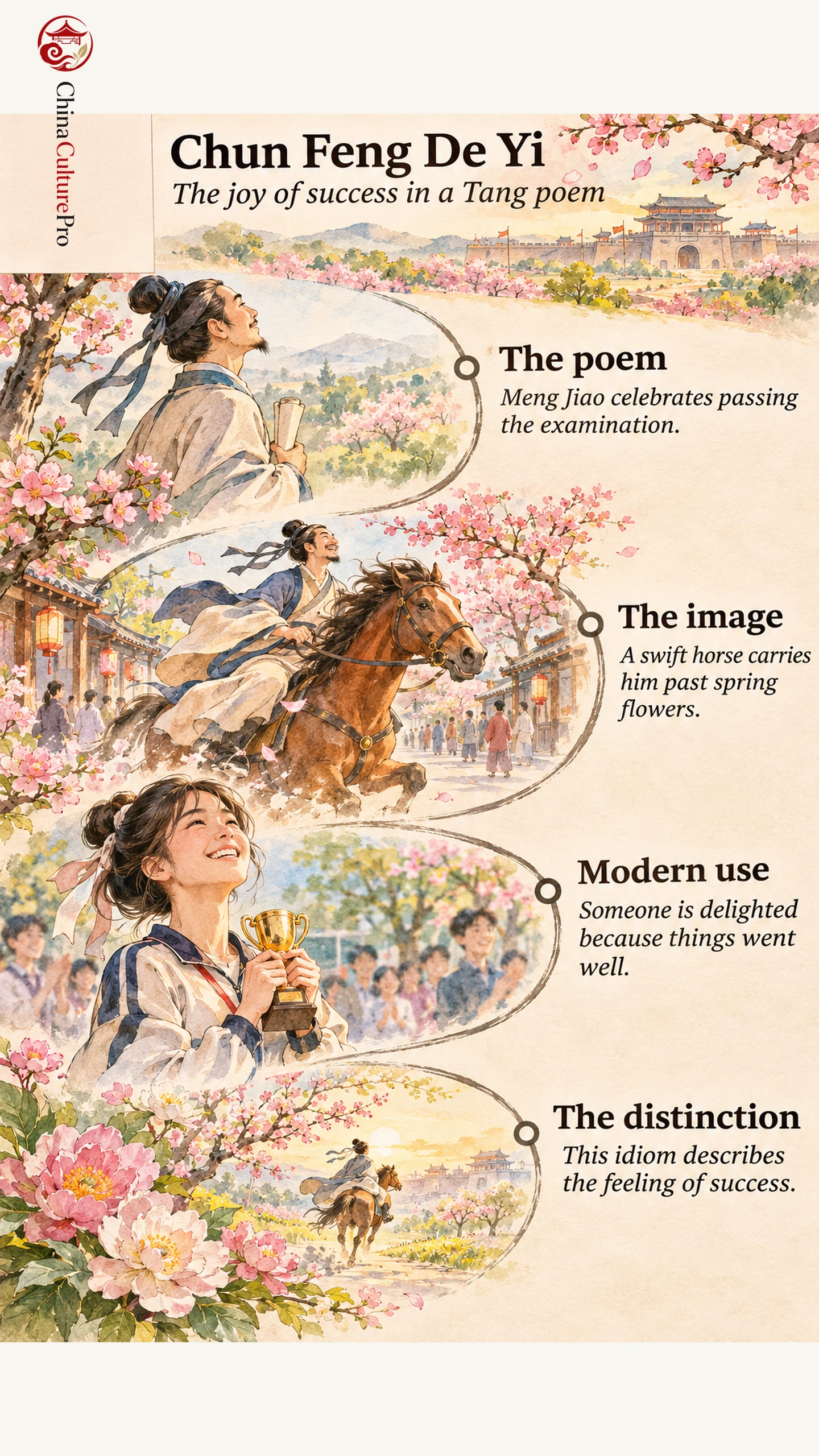
After years of disappointment, the poet’s world seems to open up in a single day. A quick horse, spring air and the flowers of Chang’an turn his relief into a scene readers can remember.[1][2]
Meng Jiao’s Ride Through Chang’an
Meng Jiao’s poem contrasts his earlier constraints with the freedom he feels after passing. The last two lines move outdoors. His horse’s hooves are swift, and he imagines seeing all Chang’an’s flowers in one day. The ride conveys the sudden change in feeling that comes with the examination result.[1][2]
Chang’an was the Tang capital. The imperial examination context gives the pleasure its stakes: success represented a hard-won change in prospects. A reader can follow the poem without taking the day’s flower-viewing as a literal route across the city. The flowers make the newly successful candidate’s delight visible.[1][2]
What De Yi Adds to the Spring Breeze
Chūn fēng is the spring breeze. Dé yì can describe things turning out as one hoped and the satisfaction that follows. The two parts together give the phrase more meaning than a pleasant day outdoors. The weather belongs to the picture, and fulfillment is the emotion the idiom carries into other situations.[1][2][3]
A person can feel this way in any season. In prose, look for what has recently gone well or for the confident bearing of someone enjoying a stretch of success. Outside the poem, an English translation can name the feeling without mentioning the season.[2][3]
How to Use Chun Feng De Yi Today
A narrator might write 她刚赢得比赛,近来正春风得意。 She has just won the competition and is enjoying her success. “She was on top of the world” could work in a lively translation. “She was delighted with how things were going” is a quieter choice.[2][3]
The idiom can be warm in a congratulatory account. A narrator can also use it with distance, particularly if the person seems rather pleased with themself. The surrounding sentence supplies that extra shade. The core idea remains the pleasure of having things go one’s way.[2][3]
How It Differs From Zou Ma Kan Hua
Zou Ma Kan Hua (走马看花, zǒu mǎ kàn huā) is linked to the same poem’s horse and flowers. One of its meanings also recalls the pleasure of seeing one’s hopes fulfilled. In current use it can instead describe looking over something too quickly to understand it in depth. Chun Feng De Yi keeps its attention on the successful person’s feelings.[1][4]
FAQs About Chun Feng De Yi
Does Chun Feng De Yi only refer to passing exams?
Passing the examinations is the original setting. Modern use also covers other successes that leave someone pleased or confident.[2][3]
Is Chun Feng De Yi a compliment?
It can be. A writer may sincerely celebrate someone’s success or let the context add a note of self-satisfaction.[2][3]
How can I translate Chun Feng De Yi into English?
“Elated by success” or “feeling on top of the world” can work. Keep the spring breeze if you are translating the poem and want its imagery.[1][2]
Sumber
[1] Chinese Text Project. Meng Jiao’s After Passing the Examination
[2] Taiwan Ministry of Education. Idiom dictionary entry for 春風得意
[3] Taiwan Ministry of Education. Revised dictionary entry for 春風得意
[4] Taiwan Ministry of Education. Idiom dictionary entry for 走馬看花