
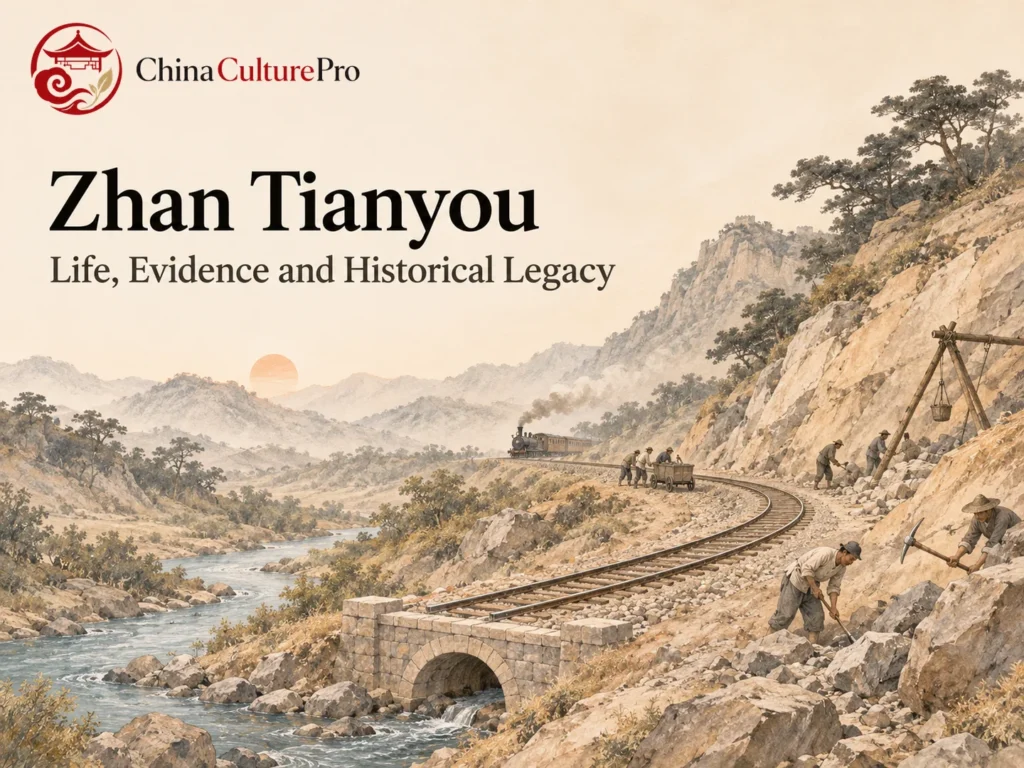

Quick Answer: Who Was Zhan Tianyou?
Zhan Tianyou (詹天佑, Zhān Tiānyòu, 1861–1919), also known as Jeme Tien-Yow, was the chief engineer of the original Jing–Zhang Railway (京张铁路, Jīng–Zhāng Tiělù) from Beijing to Zhangjiakou. The line opened in 1909 and became a landmark in Chinese-led railway construction.[1][3][4][6]
- Training: He studied civil engineering at Yale and worked on railways after returning to China.
- Route: The line used a switchback to handle a difficult climb in the mountains.
- Construction: Shafts gave crews additional access to excavate the mountain tunnel.
The track layout and the method used to excavate the tunnel solved separate engineering problems.

A train can gain height by running along a longer route and reversing direction at a switchback. Excavation can advance on more fronts when crews can reach the tunnel alignment from above as well as from both ends. Zhan Tianyou’s best-known railway project used both ideas in the mountains north of Beijing.
From Yale to Railway Engineering in China
Zhan went to the United States with the Chinese Educational Mission. A directory of returned students records his 1881 degree at Yale and later appointments as an assistant, resident and district engineer. By the time the Qing government appointed him chief engineer of the Jing–Zhang project, he had years of railway experience in China.[1][2][3]
The railway appears in contemporary English as the Peking–Kalgan Railway. Kalgan referred to Zhangjiakou. The English name on a photograph or old catalogue can therefore refer to the same project as the Chinese abbreviation Jing–Zhang.[1][3][6]
What the Jing–Zhang Railway Had to Cross
Work began in 1905. The route ran from Fengtai through Nankou toward Zhangjiakou, crossing mountainous terrain around Qinglongqiao (青龙桥, Qīnglóngqiáo) and Badaling (八达岭, Bādálǐng). The region is also familiar from the history of the Great Wall. The old line had to find a way through the same landscape while keeping a workable gradient for trains.[4][5][6]
The route was constructed in stages. The Fengtai–Nankou section was ready in 1906. Nankou also gained a workshop and station. The works there gave the line an operating base as the mountain section took shape. The mountain stage required a track alignment that could reach the tunnel without an unmanageable climb.[4][5][6]
Two Different Solutions at Qinglongqiao and Badaling
At Qinglongqiao the train approached a point where the tracks met, then reversed onto another leg of the climb. A longer path allowed the route to gain height at a gentler grade than a more direct climb. The switchback also avoided requiring a train to turn through a tight continuous curve at that point.[4][5]
At the Badaling tunnel, the issue was how much rock crews could excavate at once. Vertical shafts gave workers access to the tunnel alignment from above. They could work outward from the shaft access as other crews advanced inward from the portals. The method added working faces, allowing crews to work on several sections at the same time. The switchback changed the distance a train covered to gain elevation. The shafts changed how crews reached the rock they needed to remove.[5]
What the 1909 Photographs Show
The railway’s opening album includes images of stations, tracks, bridges, tunnels and laborers. One photograph catalogued by the Library of Congress shows engineers in front of a railway maintenance car and workers behind them. The catalogue identifies Zhan as third from the right in the front row. The rows make the distinction visible. The engineer directed the project, and the album also shows the people who helped build and operate the line.[6][7]
The images record selected views made for an album marking the railway’s opening. They are evidence of the infrastructure and the people pictured. Beijing’s heritage register lists the track, station buildings and staff quarters at Qinglongqiao. Together they show that operating the route required facilities and people in addition to the track itself.[4][6][7]
FAQs About Zhan Tianyou
Who was Jeme Tien-Yow?
Jeme Tien-Yow was the name Zhan Tianyou used in English. It appears with variant punctuation and spacing in catalogues and records.
Was the Jing–Zhang Railway China’s first railway of any kind?
Its historical distinction concerns Chinese-led design, financing and construction of the same project. Railways had operated in China before the 1909 line.
Why did trains reverse at Qinglongqiao?
Reversing let a train continue uphill on another leg of a longer route. This helped reduce the grade it needed to climb.
Sources
[1] Library of Congress. Half-length Portrait of Zhan Tianyou
[2] Yale-China. History of Yale-China
[3] Biographies of Returned Students. Jeme, Tien-Yow
[4] Beijing Municipal Administration of Cultural Heritage. Jing–Zhang Railway from Nankou to Badaling
[5] Jilin Railway Museum. Construction of the Jing–Zhang Railway
[6] Library of Congress. Photographs of the Jing–Zhang Railway Construction
[7] Library of Congress. Yan dao zhuan che