


Quick Answer: Who Built the Great Wall of China?
The Great Wall (长城, Chángchéng) was built in stages by many states and dynasties. Qin Shi Huang (秦始皇, Qín Shǐ Huáng) linked and extended earlier northern defenses after unifying China. The Han dynasty (汉朝, Hàn cháo) expanded its frontier defenses westward, and much of the familiar masonry comes from the Ming dynasty (明朝, Míng cháo).[1][2][3]
- Materials: Surviving stretches include rammed earth and plant layers as well as brick and stone.[1][3]
- Defense: Walls worked with watchtowers, beacons, gates and forts to observe movement and defend or control passage.[1][3][7]
- Length: The 2012 national survey counted about 21,196 kilometres of wall and trench remains from multiple periods.[4]
The age and construction of any one stretch depend on where it stands and which project it belonged to.[1][3]
On a ridge near Beijing, the Great Wall can look like a continuous line of brick and stone. In Gansu, sections may survive as weathered banks of earth with reeds visible between layers. Both belong to its history. In the wider course of Chinese history, the wall’s materials, routes and uses changed with the governments and landscapes that shaped it.[1][3]
Four Stages of Great Wall Construction
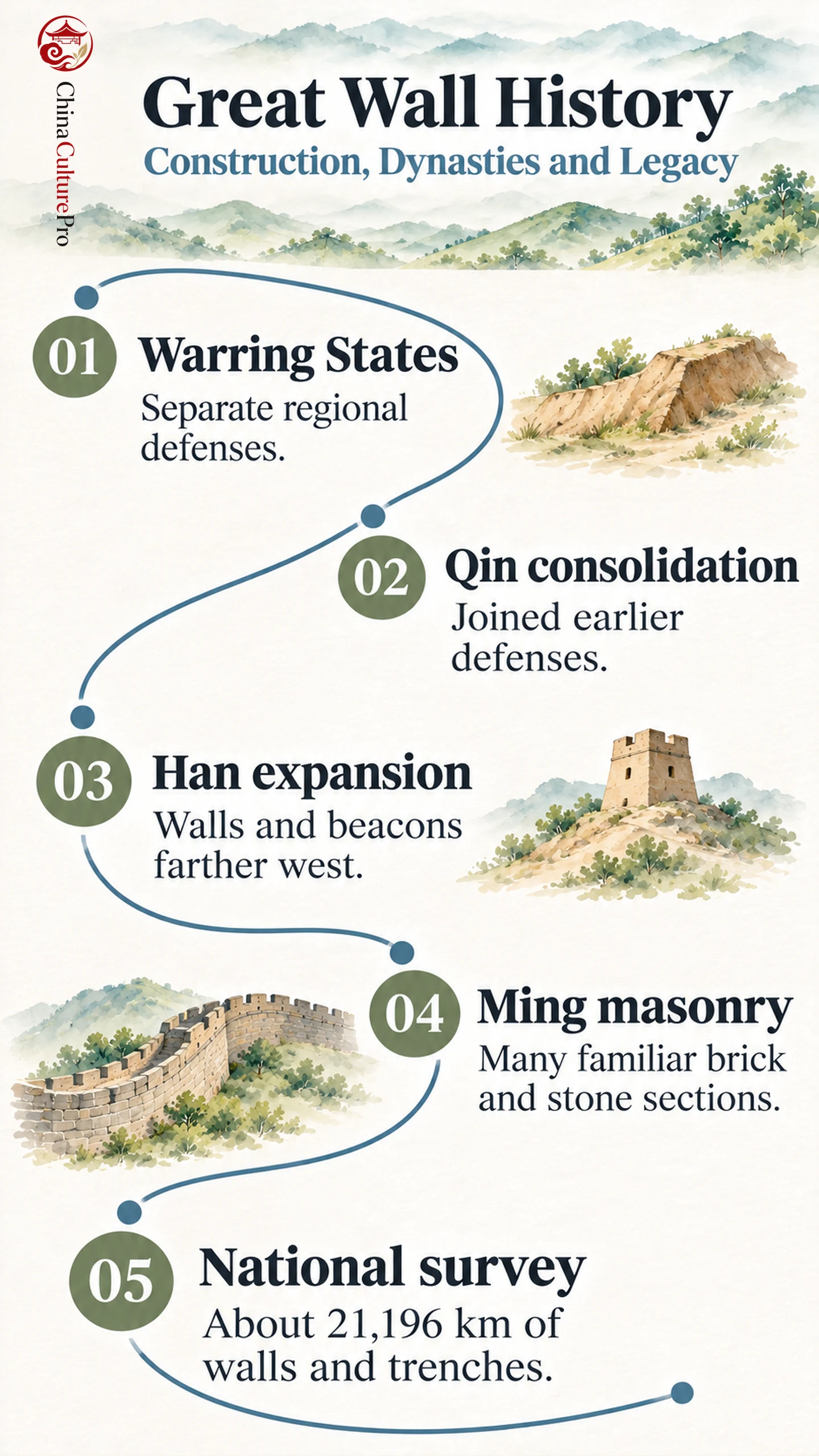
States built walls before imperial unification. Successive dynasties expanded, rebuilt or repositioned defenses as their frontiers changed. These four stages help explain the differences among surviving sections.[1][2][3]
| Étape | What changed |
|---|---|
| Warring States defenses | During the Warring States period (战国时期, Zhànguó Shíqī), rival states built separate walls to defend their territories. |
| Qin consolidation | The Qin dynasty (秦朝, Qín cháo) joined and reinforced parts of earlier northern defenses after unification in 221 BCE. |
| Han western expansion | Han defenses reached west along corridors through today’s Gansu, with walls and beacon towers serving frontier posts and transport routes. |
| Ming frontier works | Between 1368 and 1644, the Ming dynasty built or reinforced extensive lines of walls, towers and passes. |
The association with Qin Shi Huang comes from his consolidation of some earlier defenses under one empire. A recognizable stretch of masonry in a modern photograph usually belongs to a much later building phase. Construction also took place between the Han and Ming. A study of western remains included beacon towers and wall segments from the Tang and Song periods.[1][3]
Why the Wall Changes from Earth to Masonry
Rammed earth is soil compacted in layers. In parts of Gansu and Xinjiang, builders combined compacted earth and gravel with bundles of locally available reeds or wood. At Majuanwan near Dunhuang, researchers documented alternating layers of reeds and rammed earth. They examined the preserved plant material to learn about conditions around the oases where it grew.[3]
Ming sections in other landscapes often used brick and quarried stone, producing the familiar high walls and crenellated tops. The contrast between layered earth and masonry is part of the history of ancient Chinese engineering. Builders used the materials available to them for the terrain and kind of defense required. A fragment of earth and reeds can preserve evidence that would be absent from a masonry wall.[1][2][3]
How the Frontier Defenses Worked
A wall could slow or channel movement. Towers helped defenders observe approaches, while beacons passed warnings between posts. Forts sheltered troops and passes concentrated traffic where a road crossed the defenses. Ridges, desert and valleys affected how those elements were placed. The strength of a position depended in part on whether the people staffing it could observe an approach and alert another post.[1][3]
Military infrastructure also intersected with trade. In the western corridors, some walls, forts and beacons lay along routes used by traders. Sections of the Great Wall form part of the Chang’an–Tianshan World Heritage corridor for the Silk Roads. The same passage could matter to an army that wanted to watch movement and to a merchant who needed a practicable route.[3][7]
What the Great Wall’s Length Measures
The 2012 national survey and recognition process reported 21,196.18 kilometres of wall and trench remains. The inventory includes related structures such as towers, gates and forts as separate features. Its length total adds measured wall and trench sections from many places and periods. Measuring a single surviving section, or considering the Ming works alone, answers a narrower question.[4]
How the Wall Entered Cultural Memory
In versions of the Meng Jiangnü (孟姜女, Mèng Jiāngnǚ) legend, a woman searches for her husband after he is taken to work on the wall. Learning that he has died, she weeps until a section collapses. The story has regional forms. A version in the Chinese intangible cultural heritage catalogue is associated with communities along the earlier Qi wall in Shandong. The story is part of a folklore tradition that remembers wall building through the loss experienced by a family.[5]
UNESCO inscribed the Great Wall on the World Heritage List in 1987. Its recognition brings attention to the military structures and their place in the landscape. The national survey also treats earthen fragments, ditches and other less conspicuous remains as evidence. That wider inventory brings stretches such as the layered earth at Majuanwan into the same historical account as the Ming masonry near Beijing.[1][4]
The wall also acquired a modern legend about its visibility from the Moon. A NASA image often associated with that claim was taken from the International Space Station using a high-powered lens.[6]
FAQs About Great Wall History
Is the Great Wall a continuous structure?
The remains form multiple lines and branches from different periods. An individual stretch can be continuous, while the historical remains as a whole extend across many separate locations.
Are the best-known sections from the Qin dynasty?
Many familiar masonry stretches near Beijing were built or rebuilt under the Ming. Earlier works associated with the Qin and Han often used compacted earth.
Can the Great Wall be seen from the Moon?
No. NASA’s photograph of the Great Wall from the International Space Station was taken much closer to Earth using a powerful lens.
Sources
[1] UNESCO World Heritage Centre. The Great Wall
[2] National Geographic Education. The Great Wall of China
[3] Scientific Reports. Ancient Great Wall Building Materials Reveal Environmental Changes Associated with Oases in Northwestern China
[4] China Great Wall Heritage. Great Wall Resource Survey and Recognition
[5] China Intangible Cultural Heritage Digital Museum. The Legend of Meng Jiangnü
[6] NASA. Great Wall
[7] UNESCO World Heritage Centre. Silk Roads: the Routes Network of Chang’an–Tianshan Corridor