


Quick Answer: What Is Xiangyunsha?
Xiangyunsha(香云纱,xiāngyúnshā)is a Guangdong textile associated with a distinctive dyeing and finishing craft. English descriptions also call it gambiered Canton gauze or mud-silk. The Hong Kong Polytechnic University uses those names for its exhibition of the tradition.[1]
- The base: Traditional examples use silk cloth.
- The treatment: Plant dye, repeated sun-drying and a mud-treatment stage contribute to the finish.
- The appearance: A familiar form has a dark, lustrous face and a brown reverse.
The textile name does not specify one universal weave, garment shape or surface pattern. The underlying cloth and its finishing process need to be considered separately.
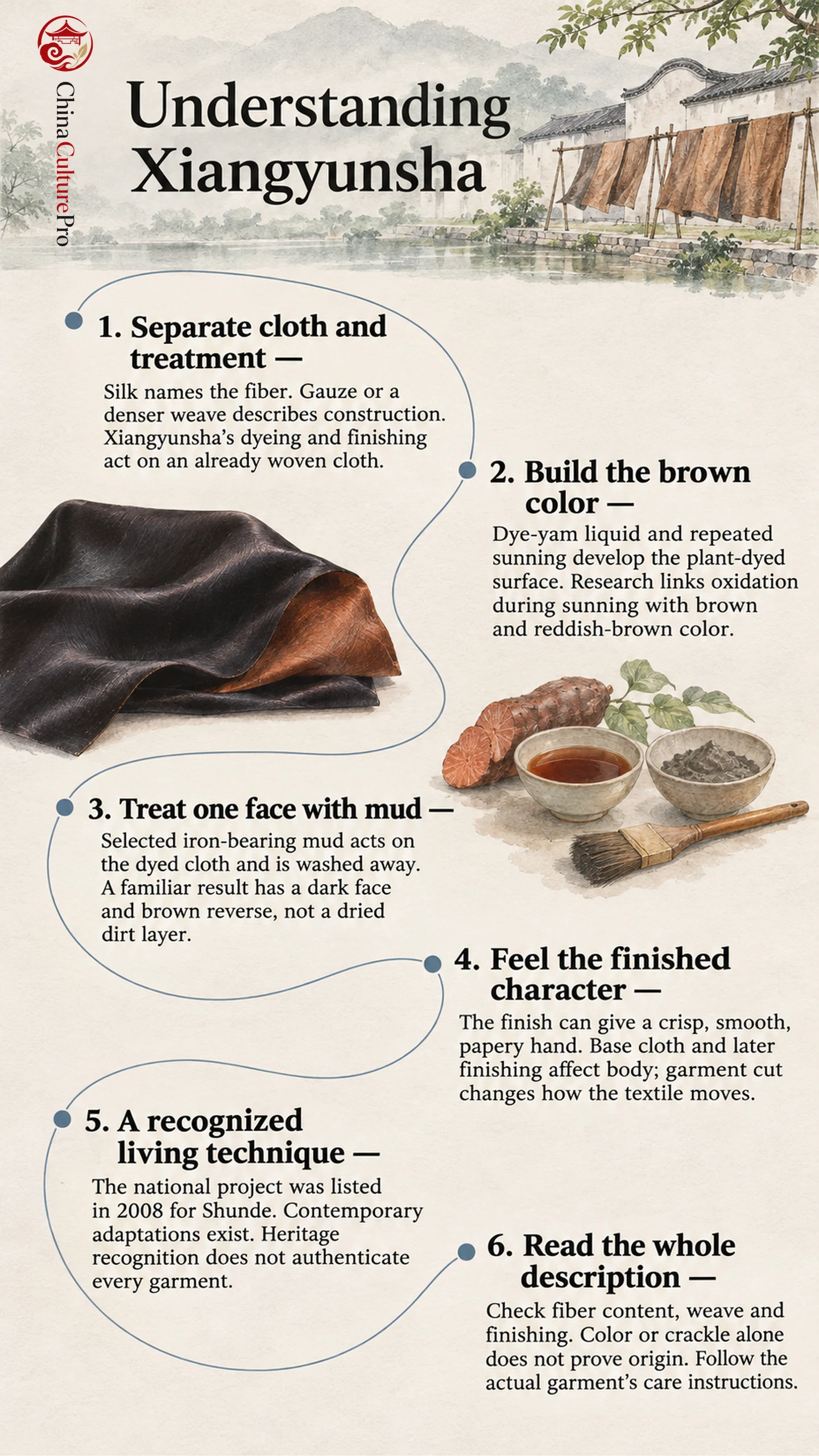
A folded length of dark silk reveals a warm brown reverse beneath its black face. Its surface holds a quiet sheen, while the fabric has more body than the floating softness often associated with silk. Within Chinese silk clothing, xiangyunsha is especially useful for understanding how finishing can transform an already woven material.
The Silk Base Is Separate from the Finish
The cloth exists before it receives the distinctive treatment. A historical study distinguishes a narrower use of the name for patterned gauze from a broader use covering different silk bases treated by the craft.[2] The English word “gauze” can therefore be too narrow if it is read as a description of every modern piece.
Fiber, weave and finish answer different questions. Silk identifies the fiber; an open gauze or a denser cloth describes its construction; dyeing and finishing describe later treatment. A garment’s cut adds another layer of choice.
This distinction also helps with history. An early reference to plant dyeing establishes only part of the material history; evidence for the combined silk-and-mud process is a separate question. The wider history of Chinese silk provides context, while a claim about a particular cloth needs evidence for that combination of materials and techniques.
Plant Dye and Repeated Sun-Drying
Shuliang(薯莨,shǔliáng), a dye-producing yam identified in textile research as Dioscorea cirrhosa, supplies the plant material. Guangdong University of Technology’s Lingnan Costume Museum describes crushing its tubers and separating the reddish-brown liquid from the residue for the dyeing stage.[3]
Repeated wetting and exposure to sunlight build the color. Li Weixian’s experimental study examined changes in the tannins during sunning and linked oxidation to the development of brown or reddish-brown color.[4] Sunlight is part of the transformation, not merely a convenient way to dry a finished black fabric.
“Gambiered” is an established English textile label. For the plant itself, use the botanical identification given in the research.
River Mud and the Two Different Faces
The mud stage acts on cloth already treated with the plant dye. A process study describes applying selected river or pond mud to one face, allowing the color to change, and then washing the mud away.[5] The characteristic dark face is not simply a layer of dried dirt left on the garment.
The official heritage description identifies iron-bearing river mud among the materials used.[6] Its interaction with the preceding treatment produces a different result from the brown plant-dyed surface alone. In the familiar two-sided form, the treated face becomes dark while the reverse retains a brown character.
That difference is a useful way to understand the process. It is not a laboratory test for an unknown purchase: dark and brown sides alone cannot establish the fiber content, workshop, age or precise production history of a cloth.
Body, Surface and Clothing Design
The finish contributes body and a distinctive surface as well as color. The process study describes a crisp, smooth, somewhat papery hand and emphasizes that makers adjust operations to the cloth and conditions.[5] The base cloth and later finishing influence how much body a particular piece retains.
Construction still matters. A loose top, a structured jacket and a fitted qipao or cheongsam make different demands on the same broad fabric family. A finish can shape the visual effect, while the base cloth and garment design influence movement and drape.
The 2024 PolyU exhibition presented new student designs.[1] The exhibition explored contemporary interpretations of the textile, extending its use beyond a single garment style.
Heritage, Shunde and Continuing Adaptation
The national register lists xiangyunsha dyeing and finishing techniques in the second batch announced in 2008, project Ⅷ-107, under traditional craftsmanship. It identifies Shunde District, Foshan, Guangdong, and the Lunjiao cultural station in the project record.[6]
The listing recognizes the technique. Individual garments still need their own material and production descriptions. The guide to Chinese intangible cultural heritage explains that distinction between a listed practice and individual products.
Adaptation is also documented. The official record for practitioner Liang Zhu describes experiments with printed cloth, other fiber bases and modern finishing methods.[7] Such work shows the craft’s continuing development. It also makes an actual composition statement important: a treatment inspired by the tradition and a traditional silk-based cloth are not interchangeable material descriptions.
Reading a Fabric Description
Begin with the stated fiber content, then ask about the base cloth and finishing. Terms such as silk, gauze, mud-treated and patterned describe different features. A clear description is more informative than a poetic trade name on its own.
Surface effects need context too. A recent interview feature explains that some crackled appearances involve additional washing or finishing, rather than sunlight alone.[8] Visible markings should be read alongside the maker’s account, not treated as automatic proof of authenticity or a flaw in every case.
For a finished garment, follow its own care label and the maker’s instructions. Heritage status, natural ingredients and a dark surface do not establish one universal washing method. They also do not establish medical benefits or a blanket environmental guarantee.
FAQs About Xiangyunsha
Is xiangyunsha always gauze?
No. The term has narrower and broader uses; check the weave and fiber content of the actual cloth.
Is the black surface simply dried mud?
No. The mud participates in the treatment and is washed away; the resulting finish remains.
Does every piece have to be plain black?
No. Patterned bases and contemporary adaptations are documented. Ask how a particular fabric was made.
Does national heritage status authenticate a garment?
No. The cited listing recognizes a dyeing and finishing practice, not every product marketed under the name.
Sources
[1] Hong Kong Polytechnic University. The Craftsmanship of Gambiered Canton Gauze: 2024 Exhibition
[2] Liao Fei and colleagues. Research on the Origins of Xiangyunsha: Definitions and Material Evidence
[3] Lingnan Costume Museum, Guangdong University of Technology. Extracting the Dye-Yam Liquid
[4] Li Weixian. Dyeing Mechanism of the Sunning Process in Gambiered Guangdong Silk
[5] Li Weixian, Zhao Yaoming and Shi Yanming. Gambiered Guangdong Silk: Processing and the Resulting Finish
[6] China Intangible Cultural Heritage Network (Réseau chinois du patrimoine culturel immatériel). Xiangyunsha Dyeing and Finishing Techniques: National Project Ⅷ-107
[7] China Intangible Cultural Heritage Network. Liang Zhu: Traditional Practice and Adaptation
[8] Sun Jun, Guangzhou Daily, republished by Xinhua. Xiangyunsha: Craft, Surface Effects and Contemporary Interpretation