
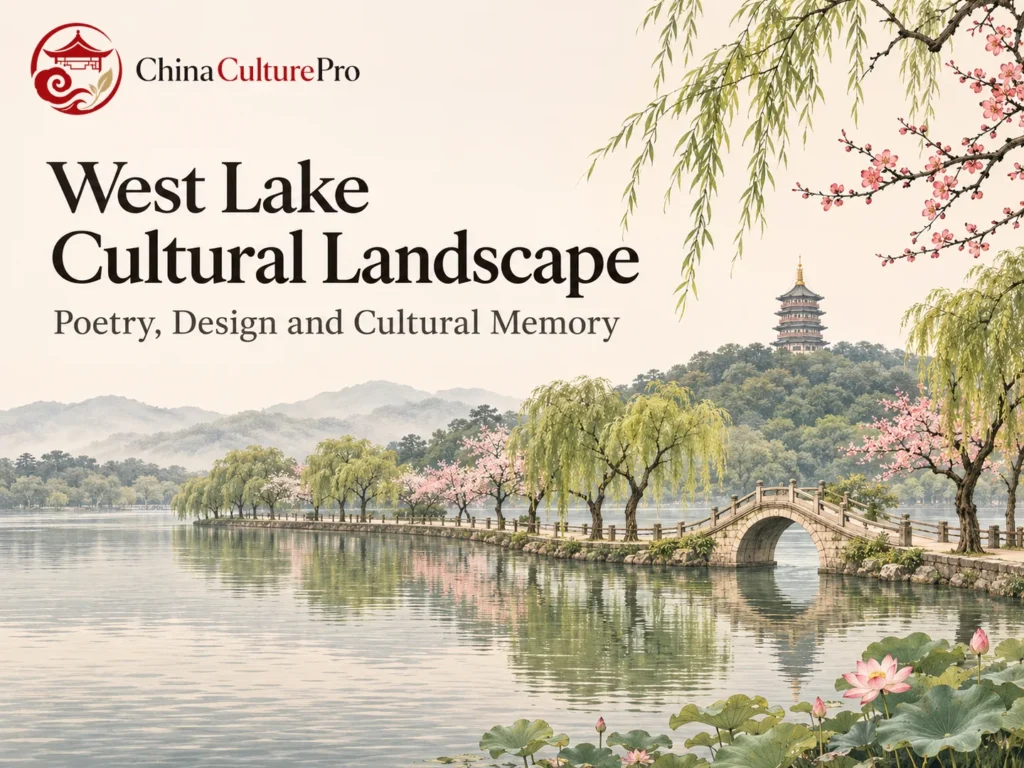

Quick Answer: Why Is Hangzhou’s West Lake a Cultural Landscape?
Hangzhou’s West Lake (西湖, Xīhú) is a World Heritage cultural landscape made up of the lake, surrounding hills and designed features such as causeways and islands. Poets and painters helped give names and meanings to views formed over centuries of water management and building.[1][2]
- Designed water. Dredging and construction shaped routes and vantage points around the lake.[1][2]
- Named scenes. The Ten Scenes (西湖十景, Xīhú Shíjǐng) direct attention to particular views, seasons or light.[1]
- A shared model. West Lake influenced later garden design, including Beijing’s Summer Palace.[1][3]
The landscape combines work on water and land with ways of looking recorded in art and literature.[1][2]

A scene at West Lake can have three parts: the physical place, the point from which it is seen and the season or light suggested by its name. Together they explain why a bridge, pagoda or causeway can be both infrastructure and a subject for a painting.
How Water Management Shaped the Views
Repeated dredging helped shape the lake’s main artificial features between the ninth and twelfth centuries. In the Northern Song, the official and poet Su Shi (苏轼, Sū Shì) directed work to dredge the lake and form the Su Causeway. Mud removed from the water became part of a long raised route crossed by stone bridges.[1][2]
The causeway did more than divide an open surface. Walking across the water changes which shoreline, hillside or bridge fills the view. Managing the lake supplied the material for a path that now defines many views.[1][2]
How to Read the Ten Scenes
| Named scene | What the name asks you to notice |
|---|---|
| Spring Dawn on the Su Causeway | The long crossing viewed with spring foliage and early light |
| Remnant Snow on the Broken Bridge | A bridge in the foreground and the visual effect of melting winter snow |
| Three Pools Mirroring the Moon | Small stone towers, open water and their relation to moonlight and reflections |
| Leifeng Pagoda (雷峰塔, Léifēng Tǎ) in the Sunset | A landmark on the south side seen in evening light |
The classic set took shape during the Southern Song. Each name gives a reader or painter a way to frame the scene. A bridge or pagoda remains visible on many days, but the name describes how a particular condition can change the way that place is seen.[1][2][4]
Poetry, Pagodas and Later Garden Design
Su Shi’s comparison of West Lake to the legendary beauty Xi Shi invites readers to regard the scenery as distinctive in sunshine and rain. That poem and the names of the scenes show two ways literature shaped the way people looked at the lake.[1][5]
Leifeng Pagoda shows that a famous view can persist after its building changes. The old pagoda collapsed in 1924. The present one was built on the site in 2002. The scene’s name preserves a way of looking toward the hill, while the building records a more recent reconstruction.[4][6]
Religious sites added other layers to the hills. At Lingyin Temple, halls and rock-cut images show how a wooded valley supported Buddhist activity. The landscape also mattered beyond Hangzhou. The Summer Palace in Beijing adapted West Lake’s combination of causeways, bridges and open water to a Qing garden.[1][3][7]
FAQs About the West Lake Cultural Landscape
Is West Lake a natural lake or a designed garden?
The lake and its hills provide the basic setting. Its causeways, islands, plantings and buildings reflect centuries of water management and landscape design.[1][2]
Do the Ten Scenes describe ten separate buildings?
They are named views. Some focus on a structure or causeway, while others direct attention to a season, plant or quality of light.[1][4]
Does the present Leifeng Pagoda date from the Song era?
The earlier pagoda collapsed in 1924. The current structure was built on the historic site in 2002.[6]
Sources
[1] UNESCO World Heritage Centre. West Lake Cultural Landscape of Hangzhou
[2] Hangzhou municipal English portal. Where nature is shaped by hand, the Su Causeway and the lake
[3] UNESCO World Heritage Centre. Summer Palace, an Imperial Garden in Beijing
[4] Hangzhou municipal English portal. Leifeng Pagoda in the Sunset
[5] Hangzhou municipal English portal. Su Shi and the poetry of West Lake
[6] Hangzhou municipal English portal. Leifeng Pagoda at West Lake, Hangzhou
[7] Hangzhou municipal English portal. Lingyin Temple and its setting