

Quick Answer: What Are the Three Kong Sites in Qufu?
Qufu’s Three Kong Sites (三孔, Sān Kǒng) in Shandong are the Temple of Confucius (孔庙, Kǒng Miào), the Kong Family Mansion (孔府, Kǒng Fǔ) and the Cemetery of Confucius (孔林, Kǒng Lín). Together they preserve architecture and records of ritual commemoration, official family responsibilities and burial across generations.[1][2]
- Temple. A foundation dated to 478 BCE developed into a large ceremonial complex.[1]
- Mansion. Courts and halls accommodated offices as well as private quarters for the senior Kong lineage.[1][2]
- Cemetery. A separate wooded burial ground contains the tomb of Confucius and those of descendants.[1]
The three parts have different building histories. The main temple’s founding date applies to the institution rather than to every visible hall.[1][2]

At Qufu, the route into a temple hall tells a different story from the sequence of rooms in a family residence or the path through a cemetery. The distinction helps explain how the memory of Confucius was sustained through state patronage, a hereditary household and the records of descendants.
A Temple for Commemorating Confucius
The Temple of Confucius grew around ceremonies honoring Confucius. Its traditional foundation is dated to 478 BCE. For a passage attributed to Confucius in a museum or guidebook, check which edition of the classical text the writer cites. Destruction and rebuilding brought substantial later changes, including work by imperial craftsmen. The dated origin and the date of any given courtyard or hall are separate questions.[1][2]
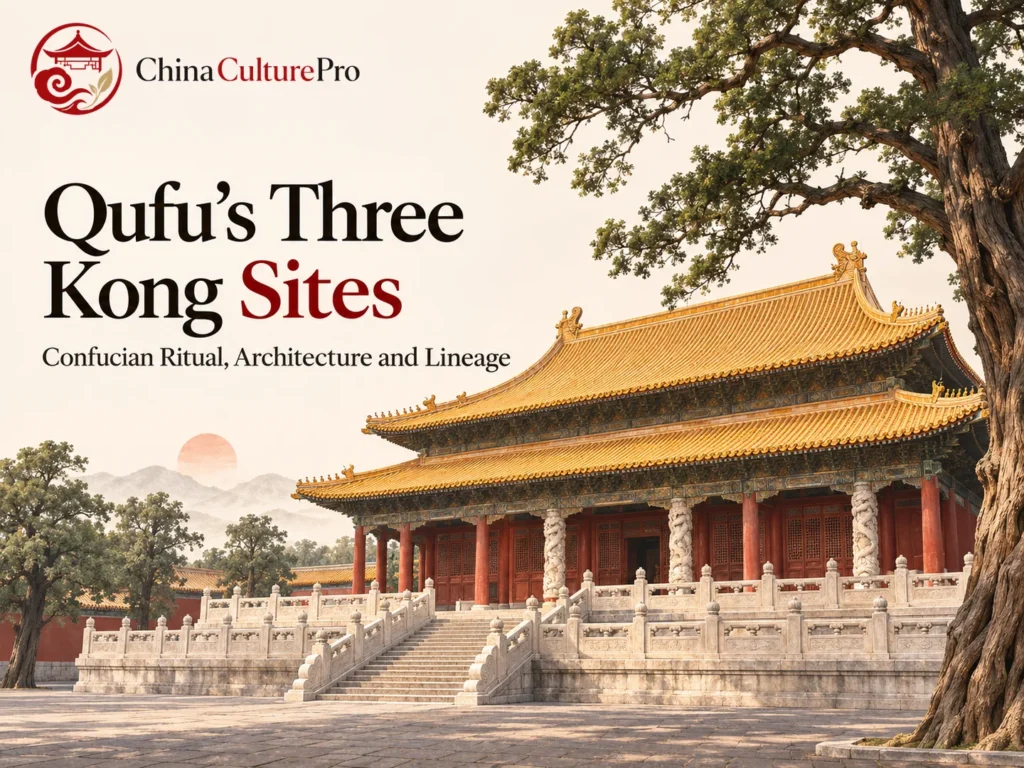
The main axis leads through a series of gates and courts toward Dacheng Hall (大成殿, Dàchéng Diàn). Its elaborate roof and carved dragon columns help mark its ceremonial rank. Stone inscriptions across the complex record many periods of patronage. A reader can use the placement and date of a particular text to identify which period or purpose it records, as in other Chinese temple inscriptions.[1][2]
A Mansion for Administration and Family Life
The Kong Family Mansion lies by the temple. On the mansion’s middle axis, the front halls accommodated public duties and receptions, while the rear buildings housed family life. Moving from front to rear means passing into a different use of space. The mansion’s official rooms reflect the public responsibilities attached to the family’s hereditary status.[1][2]
The mansion’s surviving records include administrative and household archives from the Ming and Qing. Those records help explain how an institution used rooms and courtyards. Gates and halls mark divisions of space that the written archives can help explain.[1][2]
A Cemetery That Records a Lineage
The Cemetery of Confucius, also called the Kong Forest, lies north of the historic city. The tomb of Confucius is one part of a large, multi-generation burial ground. Tomb placement and inscriptions can offer direct evidence about commemoration and family identity.[1][2]
A grave marker and a Chinese genealogy page preserve different kinds of information. For a lineage question, compare the person named, the date of the record and the relationship it actually specifies. A shared surname by itself cannot prove a specific line of descent.[1][2]
FAQs About Qufu’s Three Kong Sites
Are the Three Kong Sites one building?
They are a temple, a mansion and a cemetery. The temple and mansion stand next to each other, while the cemetery lies north of the historic city.[1]
Which part is associated with Confucius’s tomb?
The Cemetery of Confucius holds his tomb and the graves of many Kong descendants.[1]
Does Dacheng Hall date to 478 BCE?
The date marks the founding of the temple to honor Confucius. The hall is from much later building phases and is associated with Qing imperial craftsmanship.[1][2]
Sources
[1] UNESCO World Heritage Centre. Temple and Cemetery of Confucius and the Kong Family Mansion in Qufu
[2] Donia Zhang. Qufu City and Confucian Architecture