

Quick Answer: Who Was Wei Qing?
Wei Qing (卫青, Wèi Qīng; died 106 BCE) was a Western Han commander under Emperor Wu (汉武帝, Hàn Wǔdì). His campaigns against the Xiongnu (匈奴, Xiōngnú) expanded Han control around the Yellow River’s northern bend and carried major armies beyond the desert.[1][2]
- Rise: A household servant gained imperial access through his sister and advanced through military command.
- Achievement: Campaigns brought territorial gains and appointment as the empire’s senior general.
- Evidence: Early histories preserve both battlefield success and the costs of campaigning.[1][2]
His career should be read alongside the separate achievements of his nephew, rather than combining their victories into one biography.
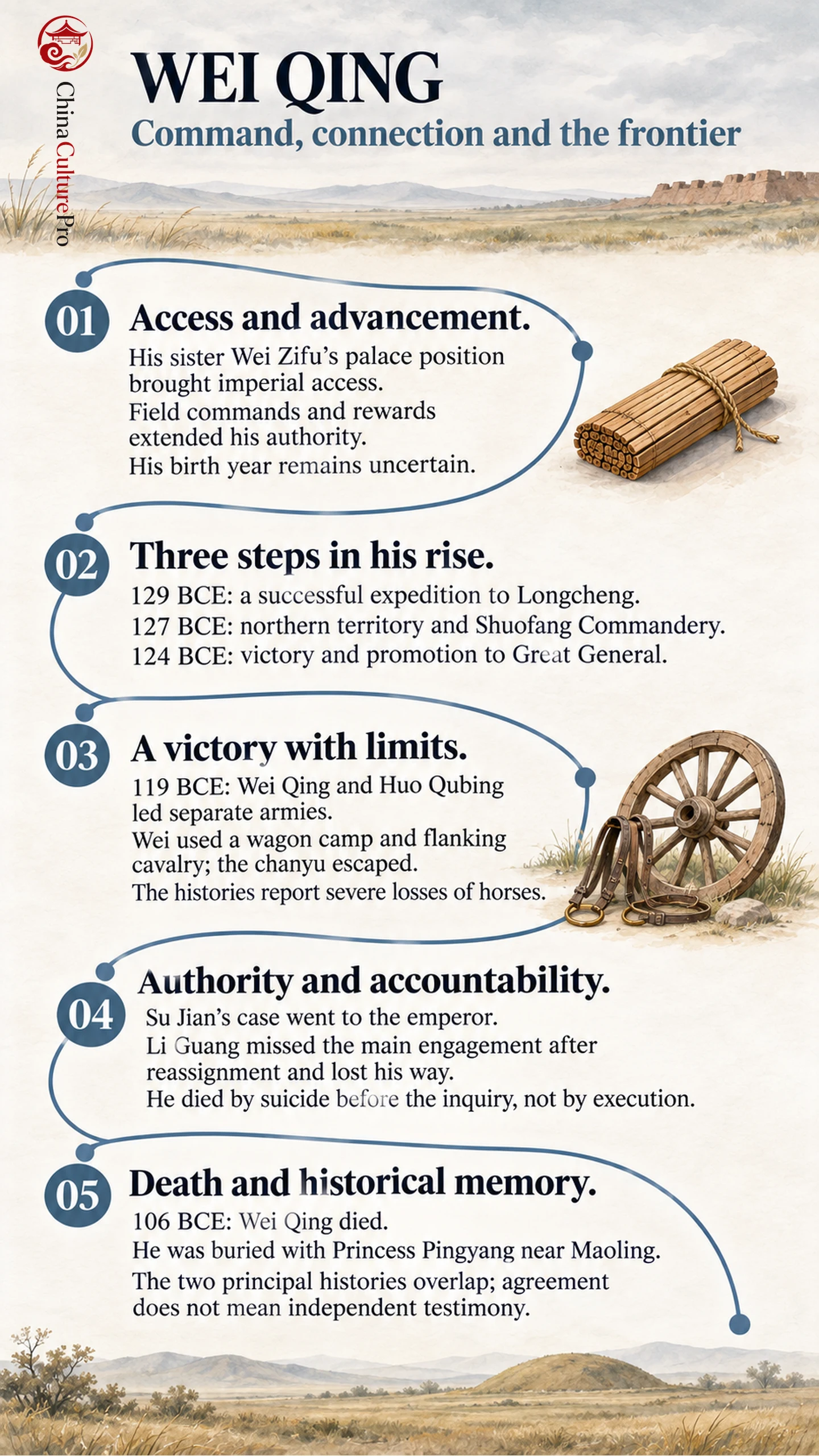
Wei Qing’s rise links imperial family politics with a change in the scale of Han warfare. His record becomes clearer when territorial gains, battlefield decisions and relations with other commanders are considered separately, with attention to how the surviving histories tell the story.
From Household Service to Imperial Connection
His mother served in the household associated with Princess Pingyang (平阳公主, Píngyáng Gōngzhǔ), the emperor’s sister. The histories describe a childhood of herding sheep and being treated as a subordinate within his father’s family. They do not supply a secure birth year.[1][2]
His sister Wei Zifu (卫子夫, Wèi Zǐfū) entered the palace and gained the emperor’s favor, eventually becoming empress. Her position brought opportunities and danger to her relatives: the narrative describes Wei Qing’s seizure by a hostile aristocratic household, rescue by companions and subsequent imperial appointment.[1][2]
His sister’s position brought access to court; field commands brought further advancement. The histories record rewards after particular expeditions, unsuccessful campaigns by other favored commanders and increasing responsibility placed under Wei Qing.
The Campaigns That Changed His Position
Three early campaigns explain how he moved from a newly appointed cavalry commander to authority over other generals. The gains were not all in the same frontier region.[1][2]
| Date | Campaign or result | Pourquoi c’est important |
|---|---|---|
| 129 BCE | Advance from Shanggu (上谷, Shànggǔ) to Longcheng (龙城, Lóngchéng). | He returned with a success when the other forces achieved little or suffered defeat. |
| 127 BCE | Conquest around the Yellow River’s northern bend; creation of Shuofang Commandery (朔方郡, Shuòfāng Jùn). | A raid became territorial administration; he received the title Marquis of Changping (长平侯, Chángpíng Hóu). |
| 124 BCE | Night attack on the Right Wise King’s (右贤王, yòu xián wáng) camp; the ruler escaped. | He was appointed Great General (大将军, dà jiāngjūn), with other commanders placed under him. |
Shuofang belonged to the northern frontier of the Han empire. It should not be confused with the western corridor associated with his nephew’s later expeditions. The establishment of a commandery and construction of its defenses also required administration after the cavalry returned.[1][2]
The Northern Campaign of 119 BCE
In 119 BCE, Wei Qing and his nephew Huo Qubing (霍去病, Huò Qùbìng) each led a major cavalry army across the desert on different routes. Wei Qing encountered the forces of the chanyu (单于, chányú), the Xiongnu ruler; Huo fought farther east on a separate advance.[1][2]
Wei Qing arranged heavy wagons into a defensive camp before sending cavalry forward. As evening approached, wind and blowing sand reduced visibility. The narrative then describes Han wings moving around the opposing force. The chanyu escaped with a small mounted group, and pursuit failed to capture him. Success in this battle therefore did not mean the destruction of Xiongnu leadership.[1][2]
The expedition depended on far more than battlefield maneuver. The histories count 140,000 official and privately supplied horses passing the frontier for the two armies, with fewer than 30,000 returning. This is a report about horses, not a count of soldiers killed. It illustrates the exceptional strain on transport and remounts.[1][2]
Earlier, Zhang Qian (张骞, Zhāng Qiān) had guided troops toward reliable water and pasture. That experience connected diplomatic travel with the practical demands of sustaining a cavalry force.[1][2]
Command, Favor and Responsibility
Military authority involved deciding who should answer for a defeat. In 123 BCE, Su Jian (苏建, Sū Jiàn) returned after his force had been overwhelmed. Wei Qing rejected an argument that he should execute the subordinate simply to demonstrate authority. He sent the case to the emperor, who allowed Su Jian to redeem the penalty.[1][2]
The outcome for Li Guang (李广, Lǐ Guǎng) in 119 BCE was different. After being reassigned to an eastern route, Li lost his way and missed the main engagement. Wei Qing ordered an inquiry for the report to the emperor; Li killed himself rather than undergo the proceedings. He was not executed on Wei Qing’s orders.[1][3]
Li’s own biography gives the reassignment additional context: imperial reservations about the aging general and Wei Qing’s preference for another subordinate also influenced it. The commanders’ positions were unequal, and a victorious army still produced a bitter dispute.[3]
Death, Burial and the Historical Record
Wei Qing died in 106 BCE. He had married Princess Pingyang, and the Book of Han (汉书, Hàn Shū) records their joint burial near Maoling (茂陵, Màolíng), the imperial mausoleum. The text also links the absence of another northern expedition during his remaining lifetime to depleted horse stocks and campaigns elsewhere, rather than merely to personal decline.[2]
The principal accounts are the Records of the Grand Historian (史记, Shǐjì), by Sima Qian (司马迁, Sīmǎ Qiān), and the later Book of Han. Much of their narrative overlaps. Agreement between them should not automatically be counted as two wholly independent witnesses.[1][2]
Both frame his rise through court connection, rewards and demonstrations of restraint. They also preserve imperial proclamations presenting expansion as justified punishment. Those proclamations express the Han court’s position; they do not supply an impartial description of all frontier communities. Reading the military record alongside its narrative framing separates historical evidence from heroic retelling.[1][2]
FAQs About Wei Qing
When was Wei Qing born?
His birth year is uncertain. The early biographies describe his childhood without giving a date; his death in 106 BCE is recorded.[1][2]
How was Wei Qing related to Huo Qubing?
Huo Qubing was his sister’s son. They served under the same emperor but commanded separate forces in the major expedition of 119 BCE.[1][2]
Did Wei Qing destroy the Xiongnu?
No. His campaigns changed the frontier and inflicted serious defeats, but the chanyu escaped in 119 BCE and the Xiongnu remained a political power.[1][2]
Where was Wei Qing buried?
He was buried with Princess Pingyang near Emperor Wu’s Maoling mausoleum. The Book of Han records the marriage and joint burial.[1][2]
Sources
[1] Sima Qian. Records of the Grand Historian, Chapter 111: Wei Qing and Huo Qubing
[2] Ban Gu and other compilers. Book of Han, Chapter 55: Wei Qing and Huo Qubing
[3] Sima Qian. Records of the Grand Historian, Chapter 109: Li Guang