
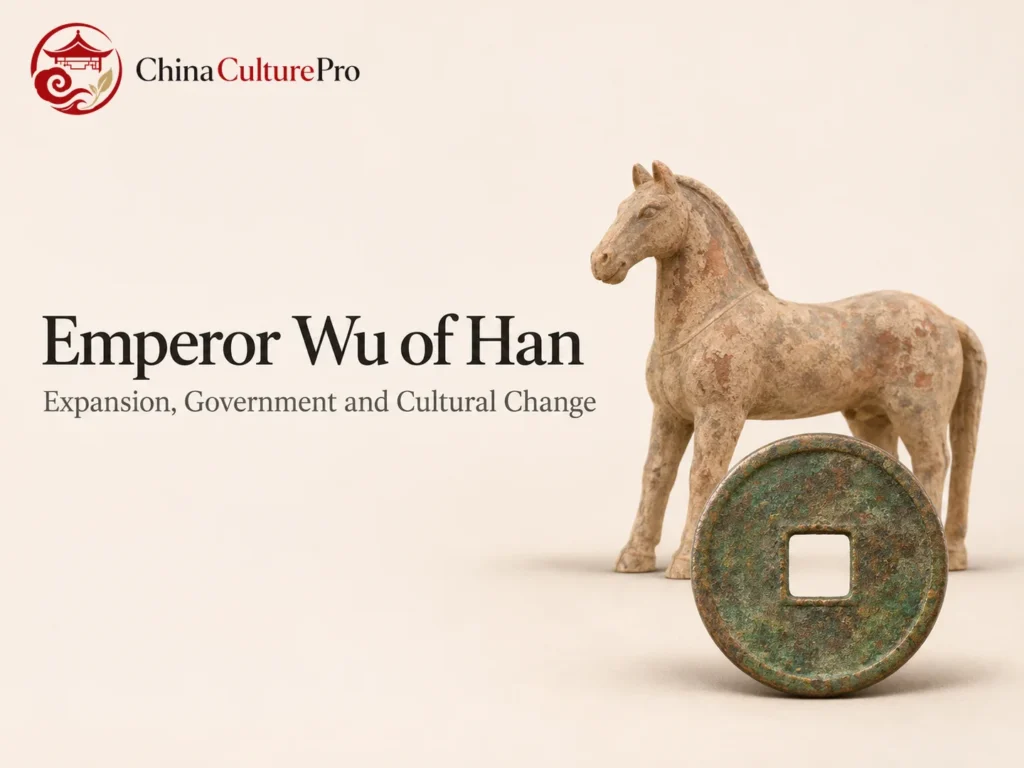

Quick Answer: Who Was Emperor Wu of Han?
Emperor Wu (汉武帝, Hàn Wǔdì) ruled the Western Han dynasty from 141 to 87 BCE. His court extended Han power through military campaigns and diplomacy, expanded its control over important goods, and gave classical learning a larger role in government.[1][2][3][5][7]
- Frontiers: Campaigns against northern rivals and missions to Central Asia widened the court’s reach.
- Government: State monopolies and coinage changes formed part of a larger effort to direct economic resources.
- Learning: Court patronage strengthened the role of classical texts. Historical writing also flourished.
- Legacy: War costs and state economic policies remained matters of debate after his death.[1][2][3][5][6][7]
The evidence includes physical objects from the reign and arguments recorded after it.
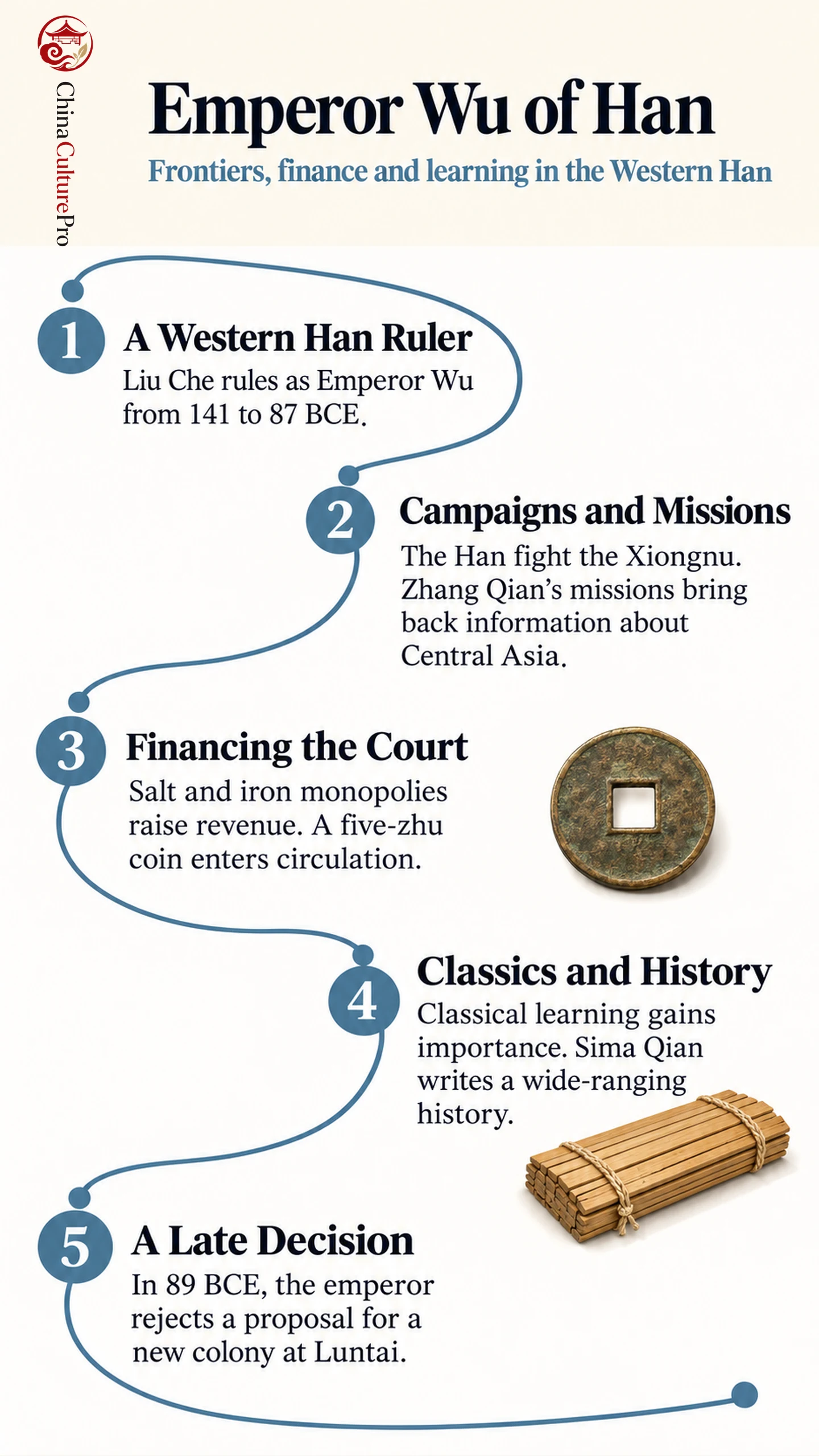
A small Han bronze coin and a later court debate give two ways to study Emperor Wu. The coin shows a denomination introduced during his reign. The debate shows how officials and scholars argued about economic policies after his death. Together they help explain what it took to finance a court that operated over a growing territory.[5][6]
Liu Che and the Western Han Court
Emperor Wu’s personal name was Liu Che (刘彻, Liú Chè). He succeeded to the throne in 141 BCE, generations after Liu Bang established the Han. He inherited an existing imperial administration and a court that had to balance its relationship with regional rulers and northern neighbors.[1][2]
His reign marks a change in the scale of what the Han dynasty tried to do. Long campaigns and missions needed supplies and officials to handle them. Court projects in learning and ritual also required people who could turn written traditions into advice for the government. Expansion depended on work in the capital as well as on decisions at the frontier.[2][3][5][7]
Frontier Campaigns and Zhang Qian’s Missions
The Han fought the Xiongnu (匈奴, Xiōngnú), a powerful confederation north of the empire. As hostilities intensified, the court moved cavalry across large distances and used garrisons and beacon stations to hold or warn frontier settlements. The rivalry also gave the Han a reason to seek allies farther west.[2][3][5]
The court’s armies operated on other frontiers as well. It sent forces toward the Korean peninsula and south into the region of present-day northern Vietnam. These campaigns connected different border regions to Han administration and created new demands on the center.[2][9]
Emperor Wu sent Zhang Qian (张骞, Zhāng Qiān) to seek an alliance with the Yuezhi. He did not secure the alliance, but the mission brought back information about the peoples and routes of Central Asia. The mission had been sent for a strategic purpose, and its account of routes and peoples later served other purposes. Subsequent exchanges built on networks that were already active. The Silk Road developed through those networks and cannot be dated to a single expedition.[3][4]
Monopolies and the Five-Zhu Coin
The state took control of important parts of the salt and iron trades. Officials defending the monopolies argued that the frontier could not pay for its own garrisons and that revenues helped fund defense. Critics argued that government involvement in production and trade placed burdens on ordinary people. Those positions survive in a text about a debate held in 81 BCE, during the reign of Emperor Wu’s successor.[5]
The five-zhu coin (五铢钱, wǔzhū qián) was first issued in 118 BCE. The bronze coin was round with a square hole, a form already used under the Qin. Its inscription referred to a unit of weight, giving the denomination its name. The square hole allowed coins to be strung together. The form remained useful long after the court that introduced the denomination. It offers physical evidence of monetary policy alongside the written record of monopolies.[6]
Classical Learning and Sima Qian
Emperor Wu’s court gave greater prominence to the study of classical texts and to people trained to interpret them. Those changes helped make classical learning important to an official career. The tradition later known as Confucianism gained influence in court culture. Officials still needed practical forms of administrative, military and financial knowledge.[1][2][7]
The reign also shaped the life of Sima Qian (司马迁, Sīmǎ Qiān), whose history became a model for later writers. His work placed the Han among much earlier rulers and societies. He also experienced the court’s coercive power after defending an officer whose surrender had angered the emperor. His career illustrates the gap between working close to imperial records and being free to challenge an imperial decision.[1][8]
Costs, Late Decisions and Legacy
In 89 BCE the emperor rejected a proposal to establish new agricultural colonies at Luntai (轮台, Lúntái). The surviving edict cites the burden a new project would impose and discusses the failures and costs of earlier military decisions. It gives evidence of a particular change of course late in his reign. The later debate about monopolies shows how those costs remained politically contentious after his death.[5][9]
Among Chinese historical figures, Emperor Wu stands out for the reach of his court and the range of institutions associated with it. The missions to Central Asia, the monetary changes and the debates over state trade help show both how the court extended its power and why people questioned some of the means it used.[2][3][5][6]
FAQs About Emperor Wu of Han
When did Emperor Wu of Han reign?
He took the throne in 141 BCE and ruled until his death in 87 BCE. He was a Western Han emperor.[1][2]
Did Emperor Wu create the Silk Road?
His envoys expanded Han contacts with Central Asia, including through Zhang Qian’s missions. The Silk Road was a network of routes that developed over time through the activity of many peoples and states.[3][4]
Why did the Han court control salt and iron?
The monopolies raised state revenue. Officials later defended them as a way to finance frontier defenses. Critics argued that the policies burdened households and interfered with production and trade.[5]
Sources
[1] The Metropolitan Museum of Art. Han Dynasty
[2] Indiana University ScholarWorks. The Reign of Wu-di
[3] Cambridge University Press. Zhang Qian and Han Expansion into Central Asia
[4] University of Washington Silk Road Seattle. The Western Regions in the Historical Records
[5] Columbia University Asia for Educators. A Record of the Debate on Salt and Iron
[6] East China Normal University Digital Museum. Five-Zhu Coin
[7] Harvard University Scholar Repository. Statecraft and Classical Learning
[8] The Chinese University of Hong Kong. Sima Qian
[9] University of Washington Press. A Han Emperor Accepting the Blame: Edict by Emperor Wu