

Quick Answer: Who Was Wang Mang?
Wang Mang (王莽, Wáng Mǎng; c. 45 BCE–23 CE) founded the Xin dynasty (新朝, Xīn cháo), ruling from 9 to 23 CE between the two major periods of Han history. A Han regent before his accession, he promoted reforms inspired by antiquity.[1][2][5]
- Authority: He presented political change through ancient precedents and claims of heavenly approval.
- Reforms: His government changed land rules, trade in enslaved people, currency and administration.
- Fall: Rebellion and military defeat ended his regime in 23 CE.[2][3][4]
The aims of his edicts, their implementation and later judgments of his character must be examined separately.
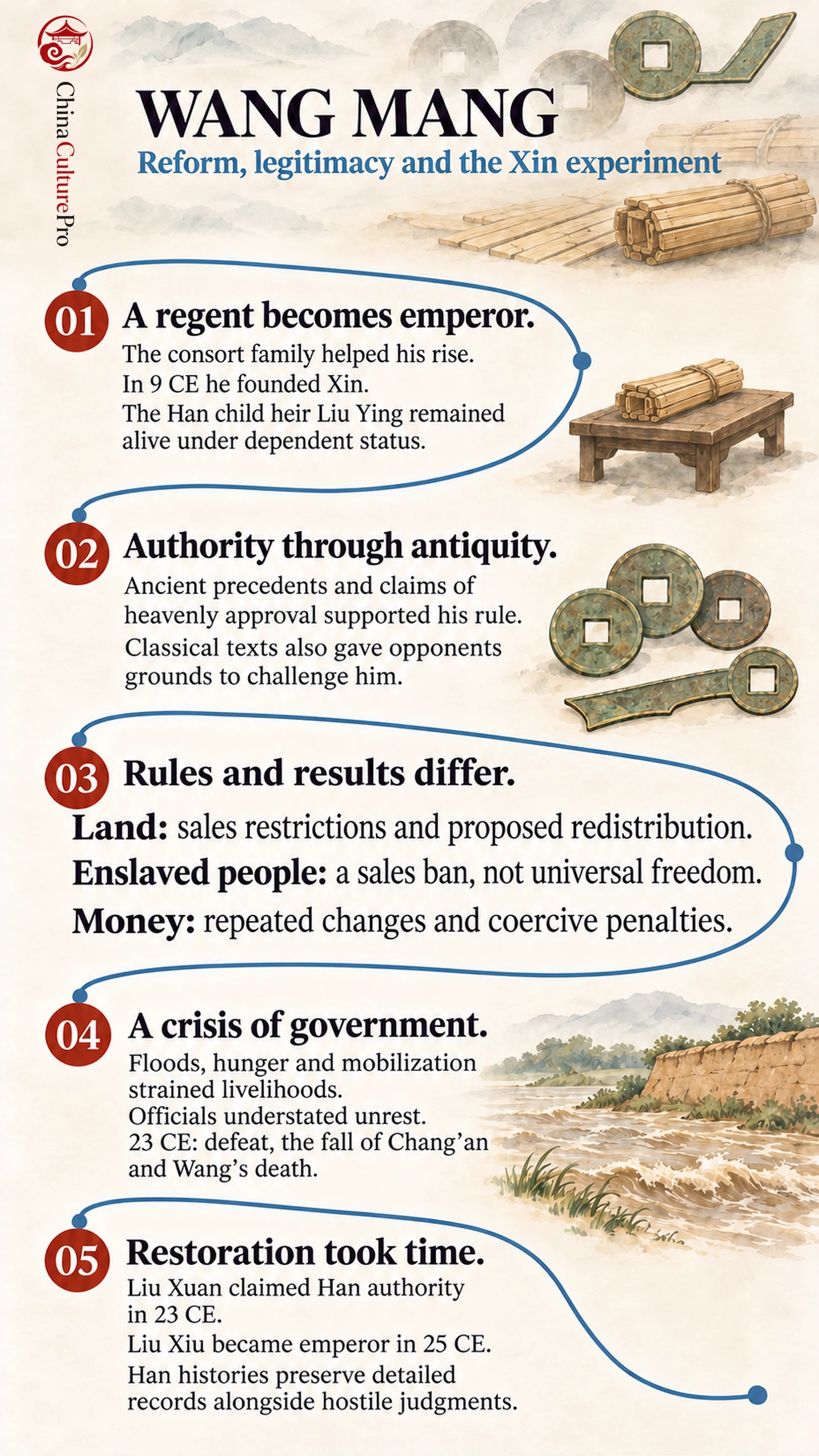
Wang Mang is remembered both as a usurper and as an ambitious reformer. Neither label explains how his government worked. His career becomes clearer when court patronage, appeals to antiquity, economic regulations and the crisis of the final years are considered together.
From the Consort Family to the Regency
He was a nephew of Wang Zhengjun (王政君, Wáng Zhèngjūn), the powerful empress dowager. The family connection opened a route to senior office, while his reputation for learning, restraint and generosity attracted supporters. The biography later treats much of that public conduct as calculated; that hostile interpretation must be distinguished from the offices and alliances it describes.[1]
After Emperor Ai (汉哀帝, Hàn Āidì) died without a direct heir, Wang gained renewed control of government through the dowager’s authority. Successive decisions about young heirs increased his leverage. Eventually he acted as regent for Liu Ying (刘婴, Liú Yīng), the child chosen as Han heir.[1]
His imperial accession in 9 CE replaced Han rule with Xin. Liu Ying was not killed at that transition: the new regime granted him a dependent status as duke. The biography instead describes his confinement and dependence under the new regime.[2]
Why Xin Claimed Ancient Authority
Ancient precedent supplied a language for accumulating authority. Wang repeatedly compared his regency with that of the Duke of Zhou (周公, Zhōugōng), a model associated with the early Zhou order. Honors, declarations and ritual changes progressively narrowed the distance between serving a ruler and becoming one.[1][5]
The Mandate of Heaven (天命, tiānmìng) provided another claim: favorable signs supposedly authorized a transfer of rule. These reports are evidence of political communication and belief, not proof that Heaven selected a dynasty. Appointments, ancestral ceremonies and renamed offices made the claim visible in government.[1][2]
Classical learning did not produce one unanimous political position. The same texts could justify Wang’s actions or be used by opponents to criticize his concentration of power. Supporters and opponents contested authority within a shared culture of Confucian learning.[5]
Land, Slavery and Currency Reforms
The reforms extended into ownership, labor and exchange. Their stated purposes included restraining concentration of wealth and restoring institutions represented as ancient. What an edict prohibited, however, was not always what a modern summary claims it achieved.[2][3]
| Policy | Measure in the record | Limite à garder à l’esprit |
|---|---|---|
| Land | Rename land wangtian (王田, wángtián), or royal fields, restrict sales and redistribute specified excess holdings. | The prescription does not demonstrate complete redistribution; restrictions were later relaxed. |
| Enslaved people | Rename privately held slaves sishu (私属, sīshǔ) and prohibit their sale. | A ban on sale did not itself free every enslaved person; state enslavement continued. |
| Money and markets | Change currencies and introduce official mechanisms for prices, supplies and lending. | Repeated revisions and penalties could disrupt the transactions they sought to regulate. |
Monetary experimentation began before Xin. A surviving gold-inlaid knife-shaped coin is dated to 7 CE and assigns a nominal value of five thousand. Its issuance belongs to the regency, not the dynasty that began in 9. The history of Chinese currency includes changes in legal value as well as metal and shape.[1][3][6]
The narrative records continued private use of older wuzhu (五铢, wǔzhū) coins and punishments for rejecting the new money. It also describes offenders and their families being made state slaves. These details complicate any claim that the regime established universal emancipation.[2][3][4]
Floods, Rebellion and the Fall of Chang’an
River flooding, food shortages and displacement interacted with mobilization, official coercion and disrupted livelihoods. The biography records a major breach of the Yellow River (黄河, Huáng Hé) and a failure to repair it. Its account of the later rebellion also describes officials understating unrest and a ruler unwilling to accept poverty as an explanation for resistance.[2][4]
Tian Kuang (田况, Tián Kuàng), an official commanding in the east, reported that local authorities understated rebel numbers and that supervising missions burdened the districts. Wang replaced his field command. The narrative exposes failures in reporting and official incentives alongside hunger and military pressure.[4]
In 23 CE, the defeat of Xin forces at Kunyang (昆阳, Kūnyáng), involving Liu Xiu (刘秀, Liú Xiù), weakened the regime. Liu Xuan (刘玄, Liú Xuán) had already claimed Han authority as the Gengshi Emperor (更始帝, Gēngshǐ dì). Chang’an (长安, Cháng’ān) fell later that year, and Wang Mang was killed in the palace fighting.[4][7]
The Red Eyebrows (赤眉, Chìméi) belong to the wider rebellion, but their capture of the capital came in 25 CE. They should not be substituted for the forces and city uprising that ended Wang’s life two years earlier.[4][7]
Han Restoration and a Hostile Historical Record
Xin’s collapse did not immediately produce a unified restored empire. Liu Xuan’s regime and Liu Xiu’s growing power were distinct. Liu Xiu took the imperial title in 25 CE; further campaigns were needed to consolidate his authority. The restoration was a process of competition and conquest.[7]
The Hanshu (汉书, Hànshū), or Book of Han, preserves detailed edicts and narratives but ends Wang’s biography with an exceptionally severe moral condemnation. Written under the restored Han, the account interprets his seizure of the throne from the position of the dynasty that survived him.[4]
Critical reading neither discards this evidence nor adopts every judgment as neutral fact. It compares named measures with reported enforcement, reversals and material remains. The distinction between historical evidence and later storytelling also applies to modern attempts to turn Wang into a simple hero or villain.
FAQs About Wang Mang
Was Wang Mang a socialist?
That modern label is misleading if treated as a precise identity. His policies drew on ancient models and imperial authority; their actual rules and effects are more useful than a later ideological nickname.[2][3][5]
Did Wang Mang abolish slavery?
He prohibited sales of privately enslaved people, but did not eliminate enslavement. The record also describes state enslavement as a punishment, including for monetary offenses.[2][3][4]
Who restored the Han after Wang Mang?
Liu Xuan claimed a Han restoration in 23 CE. Liu Xiu became emperor in 25 and built the lasting Eastern Han regime through subsequent consolidation.[7]
Sources
[1] Ban Gu and other Han-history compilers. Book of Han, Chapter 99, Part One: Wang Mang
[2] Ban Gu and other Han-history compilers. Book of Han, Chapter 99, Part Two: Wang Mang
[3] Ban Gu and other Han-history compilers. Book of Han, Chapter 24: Food and Money
[4] Ban Gu and other Han-history compilers. Book of Han, Chapter 99, Part Three: Wang Mang
[5] Béatrice L’Haridon, Early China. Wang Mang (c. 45 BCE–23 CE) and Classical Learning as Path to Supreme Power
[6] University of Washington, Silk Road Seattle. Western Han Coin: Wang Mang, Issued 7 CE
[7] Fan Ye and later commentators. Book of Later Han, Chapter 1, Part One: Emperor Guangwu