

Quick Answer: What Does Tujia Culture Include?
Tujia(土家族,Tǔjiāzú)culture includes regional languages, patterned weaving, dance, instrumental music, timber architecture and locally varied family traditions.
- Communities: Important areas lie around the Wuling Mountains in Hunan, Hubei, Chongqing and Guizhou. [1]
- Language: Many Tujia people use Chinese; heritage-language use varies.
- Cloth: Woven coverlets and patterned bands preserve distinct techniques.
- Arts: Collective dance, dramatic enactment and percussion have different forms.
- Daily life: Building, food preparation and family occasions transmit practical knowledge.
An ethnic identity is broader than one language or stage performance. Local names, materials and occasions help explain the traditions without assuming that everyone practices them identically.

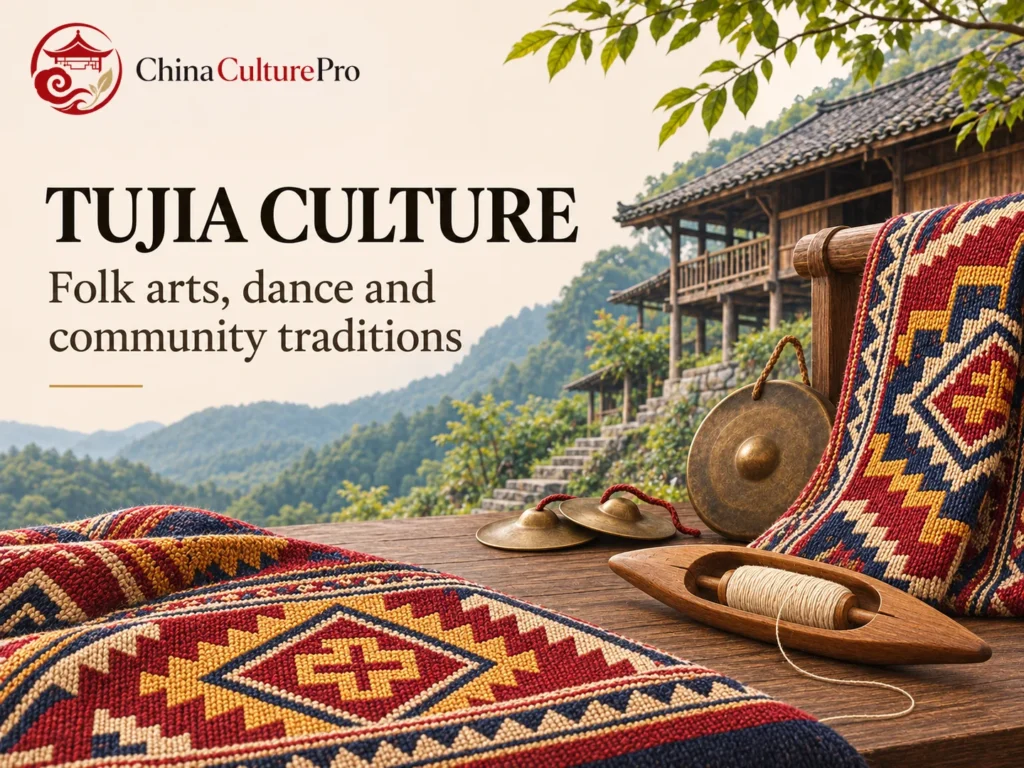
A colorful woven coverlet, a hillside timber house and a percussion ensemble reveal different sides of Tujia culture. Each has a practical or social setting. Looking closely at how it is made or performed explains more than treating the objects as interchangeable ethnic symbols.
Tujia Communities, Language and Historical Context
Tujia communities live across the adjoining Wuling mountain regions of four provincial-level areas. [1] Western Hubei and Hunan connect with broader Jingchu cultural histories, while northeastern Guizhou provides another regional setting.
Tujia should also be distinguished from Tu(土族,Tǔzú). These are separate Chinese ethnic categories, despite their similar English spellings. The Tu culture guide concerns a different community. [1][2]
The Tujia language(土家语,Tǔjiāyǔ)has northern and southern varieties. Chinese is widely used in Tujia communities, so an ethnic label does not establish the language of an individual’s everyday conversation. [1]
Historically, a tusi(土司,tǔsī)was a hereditary local ruler appointed within an imperial administrative system. Laosicheng provides a documented example associated with Tujia communities and is part of the Tusi Sites World Heritage property. [3] This history explains an institution and its regional setting; it should not be converted into a claim that all contemporary Tujia people share one ruling lineage.
Xilankapu Brocade: Woven Pattern and Household Use
Xilankapu(西兰卡普,xīlánkǎpǔ)is associated with patterned Tujia coverlets. In the documented Xiangxi tradition, continuous warp threads and discontinuous patterning wefts build the design. Weavers work from the reverse side to form patterned surfaces. The design is woven into the textile, rather than stitched onto finished cloth as embroidery. [4]
Patterned bands form another category of Tujia weaving, using a different warp-patterning method. Coverlets and narrow bands illustrate related craft traditions with different patterning methods. Preparing thread, dyeing, arranging the warp and selecting pattern threads each require learned decisions. [4]
Contemporary practice includes adaptation. Documented weavers in Miao’ertan have developed double-sided weaving and reworked inherited geometric motifs for scarves. [5] That gives a concrete example of innovation within a craft tradition, rather than making every newer product either an unchanged ancient object or a departure from all tradition.
Baishou, Maogusi and Daliuzi: Three Different Arts
Baishou dance(摆手舞,bǎishǒu wǔ), Maogusi(毛古斯,Máogǔsī)and Daliuzi(打溜子,dǎliūzi)are often mentioned together, but they do different things.
| Art | Distinctive form and cultural content |
|---|---|
| Baishou dance | Collective movement evokes farming, hunting, daily tasks, ancestral narratives and community histories. [6] |
| Maogusi | A dramatic dance form uses characters, dialogue and enacted fishing, hunting or agricultural scenes. [7] |
| Daliuzi | Instrumental ensemble music builds rhythmic and timbral relationships between percussion parts. [8] |
Maogusi performers may wear straw and bark coverings as part of their roles. That costume belongs to an enactment; it is not evidence that contemporary Tujia people normally dress that way. Some versions have ceremonial connections, while public presentations may select or rearrange material. [7]
A March 2025 donation from Longshan to Shanghai’s Oriental Musical Instruments Museum offers a specific Daliuzi example: two cymbal parts and two gongs form a four-part bronze-instrument set. [8] Its musical organization differs from a dance simply accompanied by an unspecified drum.
These distinctions place Tujia traditions within the diversity of Chinese performing arts. Instrument, movement, spoken role and occasion are useful clues when identifying a performance.
Timber Homes and Local Building Knowledge
Diaojiaolou(吊脚楼,diàojiǎolóu)are raised timber buildings associated with several southwestern communities, including Tujia localities. In Shizhu, Chongqing, documented building practice includes structures adapted to mountain and river-valley settings. [9]
Raised supports can extend usable floor space across a change in ground level. Depending on the layout, a main range and raised side wing may combine with balconies, corridors and carved wooden details. The building’s relation to its slope and household activities matters alongside its roofline. [10]
Wood selection, fitting structural components and arranging rooms are practical forms of knowledge. A visually similar modern building may use different materials or construction methods. Claims that every example is entirely timber, contains no metal or follows one plan require evidence for that structure.
Traditional clothing descriptions include locally woven blue or dark cloth with decorative edging; everyday dress varies by wearer and occasion. [10]
Foods and Family Occasions
Regional food descriptions include maize, rice and other starches, alongside meat and vegetable preparations. Hezha(合渣,hézhā)uses ground soybeans cooked with their pulp and leafy vegetables. [10] This preparation belongs within the wider range of Chinese soy foods; it is not simply another name for pressed tofu.
Guo Gannian(过赶年,guò gǎnnián)is an early New Year celebration retained in some localities, traditionally a day before the usual New Year’s Eve; the practice is regional. [10]
Some contemporary descriptions note the combining of third-day birth greetings with full-month celebrations. [10] Such adjustments connect food and social occasions with changing household arrangements, illustrating how participants adapt inherited practices.
FAQs About Tujia Culture
Are Tujia and Tu the Same Ethnic Group?
No. They are different officially recognized groups. Their similar English names should not be used interchangeably.
Do All Tujia People Speak the Tujia Language?
No. Language use varies, and Chinese is common. Speaking a particular language is not a universal feature of Tujia identity.
Is Xilankapu Embroidery?
Its patterns are formed through weaving. Embroidery adds stitches to an existing fabric, so the methods should be distinguished.
Is Maogusi Costume Everyday Tujia Clothing?
No. Straw and bark coverings belong to particular performance roles. They should not be treated as a general portrait of contemporary daily dress.
Sources
[1] National Ethnic Affairs Commission. Tujia: overview
[2] National Ethnic Affairs Commission. Tu: overview
[3] UNESCO World Heritage Centre. Tusi Sites
[4] China Intangible Cultural Heritage Network. Tujia brocade weaving
[5] China Intangible Cultural Heritage Network (Réseau chinois du patrimoine culturel immatériel). Miao’ertan weaving and contemporary practice
[6] China Intangible Cultural Heritage Network (Réseau chinois du patrimoine culturel immatériel). Tujia Baishou dance
[7] China Intangible Cultural Heritage Network. Xiangxi Tujia Maogusi
[8] Shanghai Conservatory of Music, Oriental Musical Instruments Museum. Donation of Tujia Daliuzi instruments and dongdongkui
[9] Chongqing Local Chronicles Office. Tujia diaojiaolou building techniques
[10] National Ethnic Affairs Commission. Tujia customs