


Quick Answer: What Does Mulao Culture Include?
Mulao(仫佬族,Mùlǎozú)culture includes local language, collective rituals, narrative songs, singing gatherings and household traditions.
- Communities: A major center lies in northern Guangxi, while other communities live in Guizhou. [1][2]
- Language: Mulao speech belongs to the Kam-Sui group and has developed through contact with neighboring languages. [1]
- Festival: A thanksgiving and vow-fulfillment tradition connects ritual specialists, families and village gatherings. [3]
- Song: Narrative repertoires and improvised exchanges preserve knowledge in performance and songbooks. [5]
An ethnic category does not imply that every community shares one dialect, festival calendar or religious practice. Local examples need their own setting.
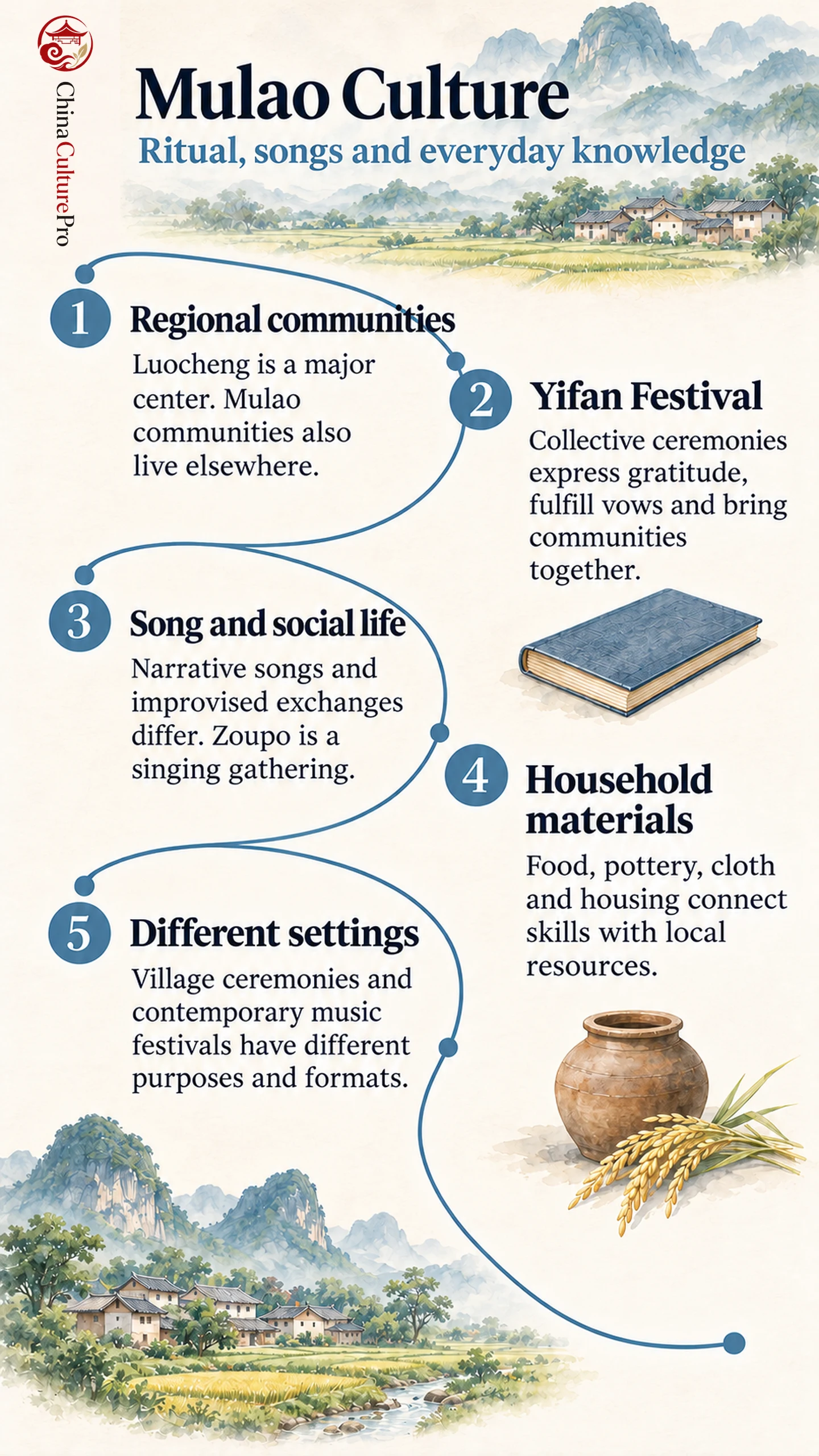
A ritual chant and a playful song exchange may both be heard at a celebration, yet their purposes differ. Understanding Mulao culture means identifying who performs, what the occasion asks of them, and how village practice relates to a public festival stage.
Luocheng and Regional Mulao Communities
Luocheng(罗城,Luóchéng)Mulao Autonomous County in northern Guangxi is a major center, including communities around Dongmen, Siba and Long’an. Settlements also extend into surrounding counties. Karst hills and small valley plains connect farming areas with the larger landscape. [1]
Mulao communities also live in parts of Guizhou, including Majiang, Kaili and nearby areas. Official recognition under the name Mulao dates to 1956. Historical names and today’s ethnic categories belong to different classification settings; a broad older label should not become an exclusive modern genealogy. [2]
The following cultural examples focus mainly on Luocheng. They do not supply a complete inventory for every Mulao community within Guizhou or elsewhere.
Language, Multilingual Life and Written Records
Mulao, often called Mulam in linguistic writing, belongs to the Kam-Sui language group. Related languages include those of neighboring Maonan communities. Relatedness does not make the two ethnic identities or their speech interchangeable. [1]
Contact with Zhuang communities and Chinese-speaking neighbors shaped vocabulary and multilingual communication. Chinese characters also served as a medium for recording local knowledge. Spoken language, the language of a particular song and the script used in a notebook must therefore be identified separately. [1]
A village study published in 2026 discusses Chinese-character records and clan genealogies in relation to local ritual history. Such records are one form of evidence alongside performance and oral accounts; “oral tradition” need not mean that no one writes anything down. [4]
Yifan Festival: Gratitude, Ritual and Gathering
Yifan Festival(依饭节,Yīfànjié)expresses thanksgiving, the fulfillment of vows and hopes for a productive, secure year. Collective ceremonies traditionally organize participants through local kinship groups and take place in community or ancestral spaces. The Luocheng tradition entered the national intangible heritage list in 2006. [3]
The older ritual calendar follows locally selected occasions around the beginning of winter and recurring community cycles. It should not be reduced to one fixed annual Gregorian day. Published origin stories include rescue narratives and heroic figures; these are traditional explanations, not independently verified dates of invention. [3]
Ritual music has a specific job. Fieldwork in Shiwei village in November 2022, published in a 2026 study, documented specialists chanting and playing instruments, participants joining some sung exchanges, and movement within the ceremony. That observation concerns one village and occasion, not a compulsory format for every celebration. [4]
Ancient Songs and Zoupo Singing Gatherings
The gugu(古歌,gǔgē), or ancient-song repertoire, brings stories, social knowledge and expressive singing together. Its national folklore listing dates to 2021. The repertoire continues through performance and learning; its title does not establish a composition date for every lyric. [5]
Three broad categories help explain its range:
- Narrative songs: Gutiao songs(古条歌,gǔtiáogē)tell historical stories, heroic accounts and legends.
- Improvised answers: Suikouda(随口答,suíkǒudá)uses spontaneously made verses for social exchanges and customary occasions.
- Competitive wit: Koufeng songs(口风歌,kǒufēnggē)give singers scope for improvised verbal contests. [5]
Zoupo(走坡,zǒupō)refers to singing gatherings associated with meeting friends and courtship. The tradition is documented around Luocheng and Liucheng, with people exchanging songs on slopes, by rivers and in other gathering places. It identifies a social occasion rather than one set song. [6]
Older descriptions connect gatherings with the first and eighth lunar months; a modern spring program can draw on the same tradition in a different format. Song categories, gathering occasions and festival programs should not be treated as synonyms. [6][8]
Homes, Food and Everyday Craft
Historical Mulao houses in Guangxi often used earth walls and tiled roofs, with animals housed separately. A recessed coal-burning hearth was a distinctive domestic feature in documented local homes. These features belong to documented local housing traditions; present homes take other forms too. [7]
Rice, maize and tubers appear among staple foods. Sour accompaniments include preserved alliums and beans, alongside vegetables, meat and fish. These fit within the wider diversity of Chinese preserved vegetables without defining one uniform menu. [7]
Pottery, metalwork and textile production also supported farming households. Deep blue cloth and silver ornaments appear in clothing accounts, while contact with neighboring communities and changing everyday dress complicate any idea of a permanently fixed costume. [7]
Village Ritual and Contemporary Festival Stages
Village rituals and public cultural festivals offer different experiences. The Shiwei study places music within relationships among ritual specialists, kinship groups and participants. Listening to a chant only as a concert piece would miss its role in the ceremony. [4]
On April 17, 2026, a Luocheng music festival brought Zoupo traditions onto a large stage, combining mountain songs with pop and rock styles. Folk performances and games formed part of the wider program. This was a dated contemporary presentation, rather than proof that such a concert format belongs to an unchanged old rite. [8]
The distinction allows both settings to be understood on their own terms. Performing arts can continue through local practice, adaptation and new audiences, with each presentation preserving some features and changing others.
FAQs About Mulao Culture
Are Mulao and Maonan the Same People?
No. They are distinct ethnic categories whose languages are related. Similar names and neighboring settlements do not make them interchangeable. [1]
Does Yifan Festival Have One Fixed Annual Date?
No. Village ceremonies follow local choices and recurring cycles. A public festival’s advertised date describes that event, not every community’s ritual calendar. [3]
Is Zoupo the Same as Yifan Festival?
No. Zoupo is a social singing tradition, while Yifan concerns collective thanksgiving and ritual. A cultural program can present material from both. [3][6]
Does Oral Transmission Mean There Are No Songbooks?
No. Ancient songs have been transmitted through learning from singers as well as handwritten songbooks. Speech, performance and writing can support one another. [5]
Sources
[1] National Ethnic Affairs Commission. Mulao overview
[2] China ICH Network. Mulao ethnic names and communities
[3] China ICH Network. Mulao Yifan Festival
[4] Xie Meilin and Narantsatsral Delgerkhuu. Field Investigation Yifan at Shiwei
[5] China ICH Network. Mulao ancient songs
[6] Guangxi Library. Mulao Zoupo festival
[7] National Ethnic Affairs Commission. Mulao customs
[8] People’s Daily. Sanyuesan traditions and new stages