


Quick Answer: What Did the Examination Statuses Mean?
In the Qing civil examinations, candidates acquired different statuses at different stages. The terms describe where a candidate stood on the examination route. A candidate could spend years preparing or testing at one level before advancing.[1][2]
- Candidate: Tongsheng (童生, tóngshēng) was a candidate who had yet to qualify as a registered student.[1]
- Student: Xiucai (秀才, xiùcái) was the common name for shengyuan (生員, shēngyuán), the status reached after the qualifying examinations.[1][2]
- Higher ranks: A provincial success became a juren (舉人, jǔrén), a metropolitan success a gongshi (貢士, gòngshì), and a successful palace candidate a jinshi (進士, jìnshì).[1][2]
The usual route describes examination standing. Actual appointment to government office involved further decisions.[2][4]
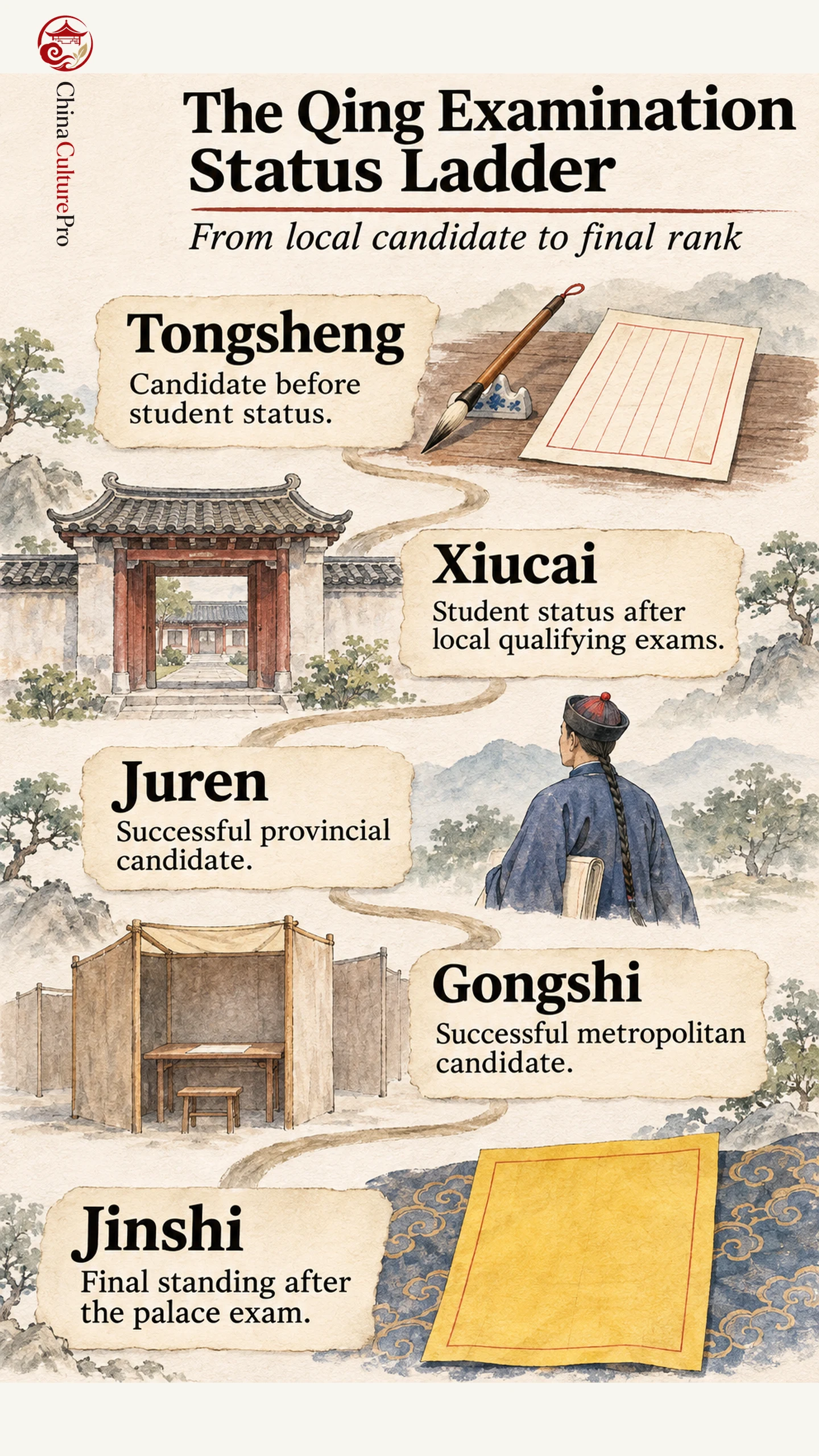
A Qing biography might call someone a juren even if that person never became a jinshi. The word records an achievement already made. To read it, identify the examination that produced the status and the opportunities that followed.[1][2][3]
The Statuses in Order
This table gives the usual route described in Qing records. The names of tests and qualifications had other uses in earlier periods.[1][2][3]
| Statut | What it meant in the usual Qing route |
|---|---|
| Tongsheng | Candidate before obtaining registered student status |
| Xiucai or shengyuan | Successful candidate in the local qualifying examinations |
| Juren | Successful candidate in the provincial examination |
| Gongshi | Successful candidate in the metropolitan examination |
| Jinshi | Final status after the palace examination and ranking |
From Tongsheng to Registered Student
Tongsheng applied to candidates who had yet to obtain student status, regardless of their age. The Qing qualifying route typically involved county, prefectural and final qualifying examinations. Passing the county and prefectural tests moved a candidate closer to the qualifying examination administered by education officials. Success brought recognition as a shengyuan, commonly called a xiucai. In this setting the two names described the same basic qualification.[1][2]
An eligible shengyuan could continue toward the provincial examination. The rules also admitted some qualified people with other recognized student statuses. Confucian schools were part of the institutional setting for student registration and training.[1][3]
From Juren to Jinshi
Provincial success made a candidate a juren. The candidate could then sit the metropolitan examination in the capital. Passing it made him a gongshi and qualified him for the palace examination. The final examination placed successful candidates in classes under the emperor’s authority.[1][2][3]
Status, Final Rank and Office
A surviving Qing record can distinguish each of these. The Palace Museum discusses Zhou Fuqing, whose final palace result was fifteenth in the third class. A subsequent court examination and selection affected his appointment. Appointments depended on further selection and posting decisions. A degree-holder’s subsequent office is a different entry in a biography. The example shows why a title such as jinshi, a palace rank and a position in office carry different information.[4]
FAQs About Qing Examination Statuses
Was a tongsheng necessarily a child?
The Qing label applied to candidates who had yet to qualify for student status. It could apply to adults.[1]
Were xiucai and shengyuan separate levels?
In this Qing context, shengyuan was the recognized student status and xiucai was a common name for it.[1][2]
What came between juren and jinshi?
A juren who passed the metropolitan examination became a gongshi. That made the candidate eligible for the palace examination, after which successful candidates received a jinshi class and rank.[1][2]
Sources
[1] Qin Guojing, The Palace Museum. The Qing Palace Examination
[2] Academia Sinica, Museum of the Institute of History and Philology. Archives of the Grand Secretariat: The Civil Service Examinations
[3] The Palace Museum. The Provincial Examination
[4] The Palace Museum. Zhou Fuqing’s examination and appointment records