

Quick Answer: How Did Tang China and Silla Exchange Culture?
The Tang dynasty (唐朝, Táng Cháo) and Silla (新罗, Xīnluó), a kingdom on the Korean Peninsula, exchanged Buddhist learning, literature and goods. The two states first fought as allies and then as rivals in the seventh century. Their political relationship changed, while people continued to travel between the peninsula and Tang China. [1][2][3][4][6][7]
- Monasteries: Silla monks studied with Tang teachers and built teaching networks at home.
- Writing: Students used the literary and administrative skills they learned in China.
- Shipping: Silla merchants linked ports and supported communities across the sea. [3][4][5][6][7]
The same channels could serve different purposes. A sea crossing could take a monk to a teacher or a merchant to a community abroad. [2][3][6][7]
A Buddhist monk, an examination candidate and a maritime trader crossed between Silla and Tang China for different reasons. Each left a record that reveals a different kind of exchange.
From Military Alliance to Separate Rule
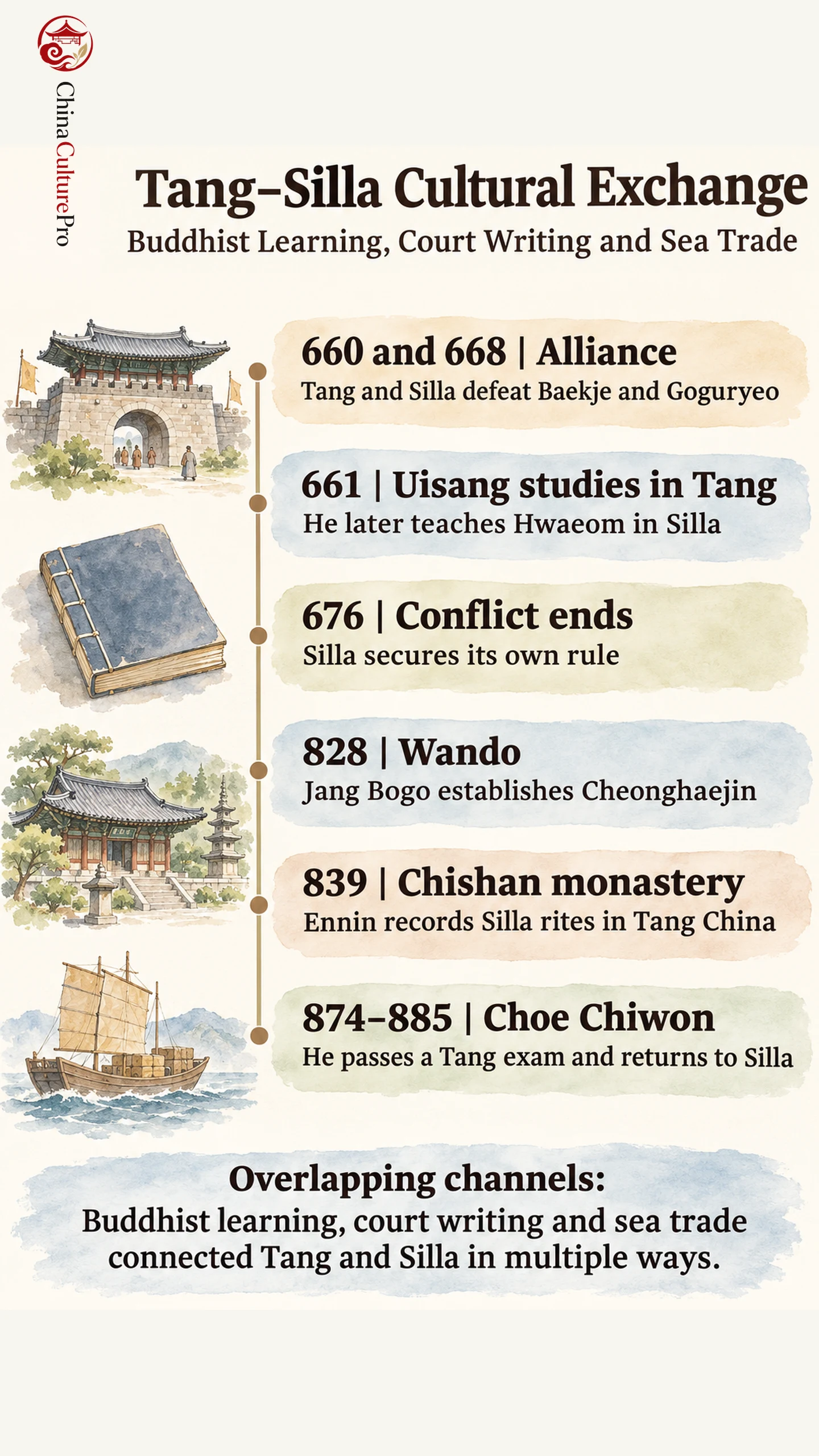
In 648 Silla formed an alliance with the Tang dynasty against its rivals on the Korean Peninsula. The allies defeated Baekje in 660 and Goguryeo in 668. The victories removed the common rivals and left Silla and the Tang court in disagreement about who would govern the conquered territories. [1][2]
Silla fought Tang forces and secured its position over much of the peninsula by 676. Historians call the larger kingdom that emerged from the wars Unified Silla. Its rule covered much of the peninsula, while former Goguryeo lands farther north followed a different course. Balhae emerged in 698 farther north, while Silla continued to rule from its own capital at Gyeongju. [1][2]
Silla’s court continued to deal with Tang China on its own behalf. Diplomatic documents used forms that ranked the Tang emperor above the Silla king. Historian Choi Hee-Joon reads this language as part of the protocol the courts used with each other. It described the terms of formal contact while the Silla kings governed from Gyeongju. [2][10]
What Uisang Brought Back From Tang China
The Silla monk Uisang (义湘, Yìxiāng) went to Tang China in 661. He studied with Zhiyan at Zhixiang Monastery in the Zhongnan Mountains. The teaching he helped establish in Silla is known as Hwaeom (华严, Huáyán) in Korean. It drew on the same body of scripture and thought known in Chinese Buddhism as Huayan. [3]
After returning to Silla in the early 670s, Uisang developed a network of temples and students. Buseoksa became one of the places associated with his teaching. His Diagram of the Dharma Realm condensed a complex teaching into a short text organized as a diagram. Later scholars continued to write commentaries on it, using Uisang’s presentation as a way to teach Hwaeom in Korea. [3]
How Choe Chiwon Used His Tang Education
The writer Choe Chiwon (崔致远, Cuī Zhìyuǎn) traveled to Tang China to study. He passed a Tang examination for foreign candidates in 874, served in Tang offices and returned to Silla in 885. The knowledge involved was practical as well as literary. For example, Choe wrote for a Tang military governor during the Huang Chao rebellion. He later used formal writing in the service of the Silla court. [4][5]
Choe collected writings from his Tang years in a work known as Plowing a Cassia Garden with a Writing Brush. He presented the collection to the Silla king after returning. It preserves Tang-era work by a Silla author who used literary Chinese in the service of both states. Its value lies partly in showing what trained officials wrote, including documents as well as verse. [4][5]
How Jang Bogo’s Network Moved People and Goods
The maritime organizer Jang Bogo (张保皋, Zhāng Bǎogāo) established Cheonghaejin (清海镇, Qīnghǎizhèn) on Wando in 828. The Silla court authorized the maritime base, which enabled Jang to organize voyages and shipping across routes linking the peninsula, China and Japan. His network also supported the Fahua Monastery at Chishan in Shandong, connecting trade with a religious community abroad. [6][7]
The Japanese monk Ennin wrote about Silla people and maritime networks he encountered in Tang China. His diary provides evidence from outside the diplomatic records. Merchants connected Silla communities at several ports. Their connections also helped travelers find passage and support, even when they were moving for religious study. [6][7][8]
Ennin’s record of worship at Chishan in 839 gives an example of what the community carried with it. The Academy of Korean Studies uses the diary to describe the procedures of Silla Buddhist rites performed at the monastery in Tang territory. The record describes people using the Silla language and identifies chanting, scriptural explanation and discussion as parts of a service. It gives a glimpse of how the community practiced Buddhism abroad, rather than just noting that a temple existed there. [6][8][9]
FAQs About Tang–Silla Cultural Exchange
Did Silla and Tang remain allies throughout the period?
No. They cooperated against Baekje and Goguryeo, then fought over the territories left by those kingdoms. The fighting ended in 676, while cultural contacts continued. [1][2][3][4][6]
What did Silla students do in Tang China?
Some pursued Buddhist study. Others learned literary and administrative skills or took Tang examinations. Choe Chiwon’s career shows one path that was open to a successful student. [3][4][5]
Why do Japanese records matter for Tang–Silla exchange?
Ennin traveled in Tang China and wrote about Silla people and ships there. His account shows how a journey between Japan and China could depend on networks from the Korean Peninsula. [7][8]
Sources
[1] The Metropolitan Museum of Art. Korea, 500–1000 CE
[2] Lim Ki-hwan, translated by Daniel Kane. A History of Korea: The Wars of Korean Unification and the Era of Northern and Southern States
[3] Academy of Korean Studies. Uisang
[4] Kim Busik and compilers, with notes by the National Institute of Korean History. History of the Three Kingdoms, chapter 46: Choe Chiwon
[5] Richard D. McBride II. Of Monasteries and Monks: Mainstream Sinitic Buddhism in the Poetry of Ch’oe Ch’iwon
[6] Academy of Korean Studies. Jang Bogo
[7] Acta Asiatica. Research on the History of Japan’s Contacts with Other Countries
[8] Ennin, translated by Edwin O. Reischauer. Ennin’s Diary: The Record of a Pilgrimage to China in Search of the Law
[9] Academy of Korean Studies. Rites of Silla Monasteries
[10] Choi Hee-Joon. Silla’s Perception of the International World Order as Seen through Diplomatic Documents