

Quick Answer: What Are Tibetan Prayer Wheels?
Tibetan prayer wheels (转经筒,zhuànjīngtǒng) are rotating containers for sacred writings, commonly repeated mantras (真言,zhēnyán). In Tibetan Buddhist practice, turning them is understood as a way of activating or symbolically reciting the enclosed texts. They range from handheld implements to larger installed wheels, with some forms moved by wind, water or other power. The visible cylinder and the texts inside belong together: this is a devotional object rather than simply a spinning decoration.[1]

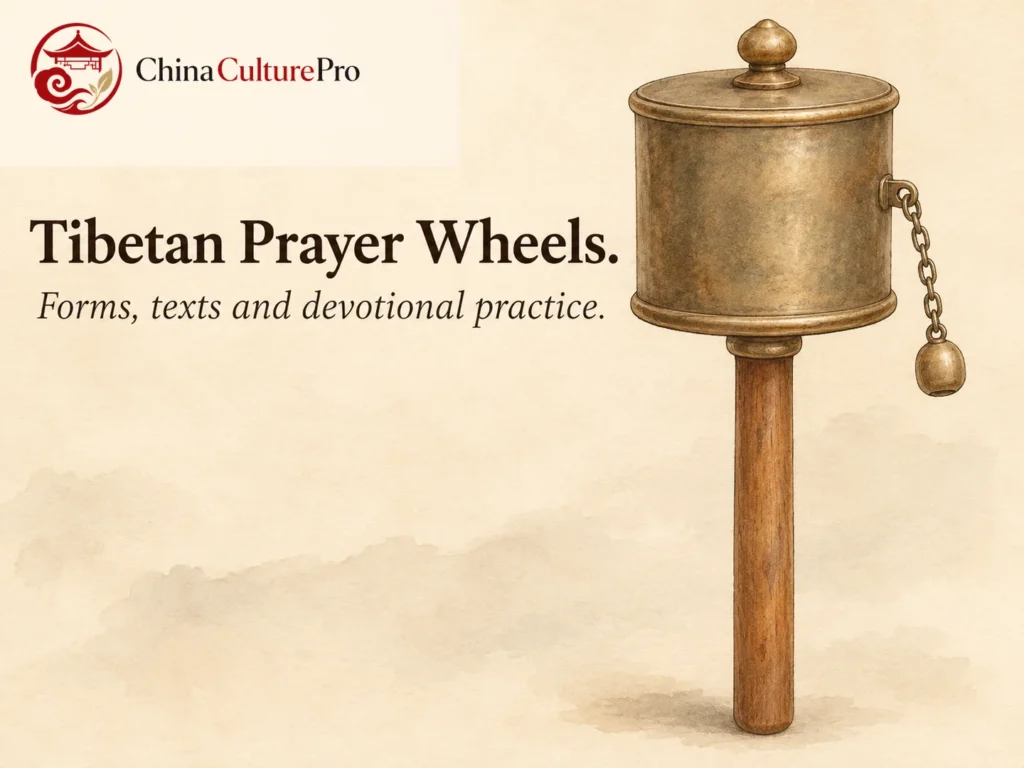
A small cylinder turns above a wooden handle, while larger versions stand beside paths and religious buildings. Their movement is easy to notice; the texts they contain are usually hidden. This guide connects the mechanism with its contents and explains its place in Tibetan cultural practice.
The Cylinder, Axle and Handheld Mechanism
A handheld wheel combines a hollow cylinder with a central spindle and a handle. The cylinder rotates around the spindle rather than turning as one fixed piece with the handgrip. A small weight attached to the side by a chain helps sustain its movement when the user moves the wrist.[2]
Materials and decoration vary. One museum example dated from the mid-nineteenth to early twentieth century combines metal, wood, bone and turquoise. Its drum has inset stones and letters, while its handle is a wooden stick. Such details distinguish an individual object without changing the basic relationship between container, axle and movement.[2]
The handle provides a steady grip while the cylinder and enclosed writing turn. The user’s movement and the object’s construction work together.
Texts Inside: Mantras and Other Sacred Writings
A familiar text is Om Mani Padme Hum, conventionally described as a six-syllable mantra associated with Avalokiteshvara, the bodhisattva of compassion. This figure is known in Chinese as Guanyin (观音,Guānyīn). Devotees can recite the mantra while turning a wheel; prayer beads may help count the spoken repetitions. The relationship between words, compassion and repeated practice is more important than reducing the phrase to a decorative inscription.[3]
The contents are not identical in every object. A nineteenth- to twentieth-century museum wheel contains a woodblock-printed page from a biography of Milarepa (米拉日巴,Mǐlā Rìbā), a revered Tibetan religious figure. That example prevents a common overstatement: a wheel need not contain only repeated copies of one mantra.[4]
Preparing the interior is also part of its religious use. In a documented modern commission, printed mantra sheets were blessed, wrapped tightly around the central axis, enclosed and sealed. The case shows why the unseen contents matter alongside the outer container.[5]
Handheld, Installed and Powered Forms
Size, mounting and power source can vary independently. A fixed wheel may be turned by hand or driven by another source.[1]
| Form or power source | How it turns | Typical relationship to the user |
|---|---|---|
| Handheld wheel | Wrist movement, assisted by a side weight. | A portable implement can be used while sitting or walking.[2] |
| Installed wheel | People turn a cylinder mounted on an axle or supporting structure. | It can be part of a temple or pilgrimage setting.[1] |
| Environmentally or mechanically powered wheel | Wind, water, warm air or a powered mechanism supplies movement. | Rotation does not depend on someone holding a handle.[1] |
Turning, Recitation and Religious Merit
Within Tibetan Buddhist practice, turning a prayer wheel is connected with merit (功德,gōngdé), understood as positive religious action and its beneficial consequences. Practitioners may combine it with spoken recitation and circumambulation: walking around a sacred site or object as an act of devotion. The same person can turn a wheel, speak a mantra and follow a pilgrimage route.[6]
Clockwise turning is customary in the Tibetan Buddhist examples described here, connected with the orientation of the text and the wider devotional practice. Pilgrims may also move clockwise around a sacred site while carrying a wheel.[7]
The religious explanation extends beyond the individual performing the action: compassion and concern for other beings give the practice its wider orientation. Intention and recitation belong to this setting, alongside the physical movement.[3][6]
Reading an Object in Its Devotional Context
A museum object can preserve evidence of both workmanship and use. The unusual wheel containing the Milarepa page was assembled using a jade archer’s ring and a repurposed cigarette holder. The repurposed materials distinguish this particular wheel.[4]
Contemporary making also brings together craft and religious knowledge. During 2008 and 2009, National Museums Scotland and practitioners at Kagyu Samye Ling discussed the design, materials and arrangement of a prayer-wheel house. The resulting installation included cylinders with prepared texts and a blessing of the completed wheels. The commission connected construction with the religious preparation of the texts and completed wheels.[5]
When studying a wheel, ask what is known about its materials, date, contents and intended setting. An inscription on the exterior, a catalogue description of the interior and an account of devotional use provide different kinds of evidence. Together they offer a fuller explanation than the cylinder’s appearance alone.
FAQs About Tibetan Prayer Wheels
What is inside a Tibetan prayer wheel?
Usually sacred texts, often mantras written or printed repeatedly on rolled paper. Individual examples can contain other religious writings.
Why are prayer wheels usually turned clockwise?
In Tibetan Buddhist practice, this direction relates to the orientation of the writing and established devotional custom.
Are prayer wheels used only by monks?
No. Lay and ordained practitioners both use them; portable forms also belong to everyday devotional activity.
Does every prayer wheel look the same?
No. Materials, size, decoration and the source of movement differ, while a rotating container and enclosed texts remain central.
Sources
[1] Elena Pakhoutova. Prayer Wheel: Accumulating Merit Every Day
[2] University of Michigan Museum of Art. Prayer Wheel, object 1983/1.424
[3] Smithsonian National Museum of Asian Art. Shadakshari Avalokiteshvara: contemporary practice and relevance
[4] The Metropolitan Museum of Art. Prayer Wheel and Xylographic Folio Page
[5] National Museums Scotland. The making of a Tibetan prayer wheel house
[6] University of Virginia Library. Ceremonial objects in Tibetan religious practice
[7] British Museum. Prayer wheel: curatorial description