

Quick Answer: What Are Tibetan Prayer Flags?
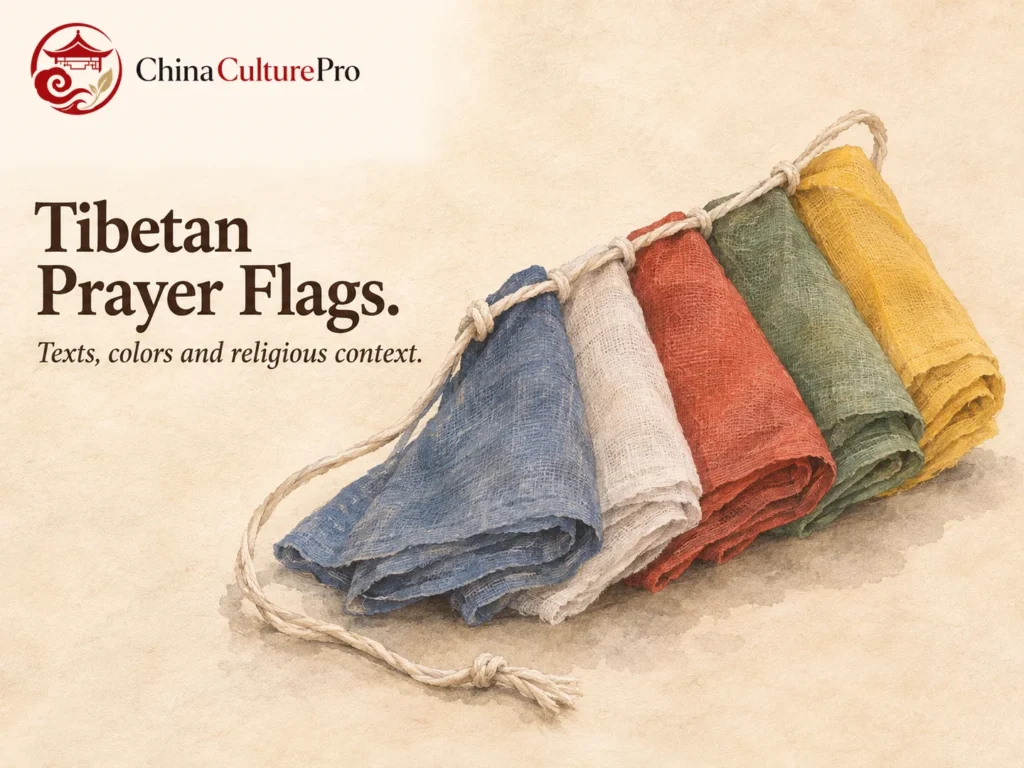
Tibetan prayer flags(经幡,jīngfān)are religious prints, commonly on cloth, displayed where the wind can move them. Familiar forms include colored panels on a horizontal string and long vertical flags attached to poles.[1]
- Printed content: Flags can carry sacred texts, mantras and auspicious images.
- Colors: Five-color sets are common, but their order and interpretation need a specific traditional context.
- Religious purpose: Their use expresses intentions of blessing and benefit, rather than simply decorating a landscape.
The English name does not mean that every flag contains the same prayer, pictures the same figure or follows one universal color system. Religious meanings should be distinguished from claims of proven effects.
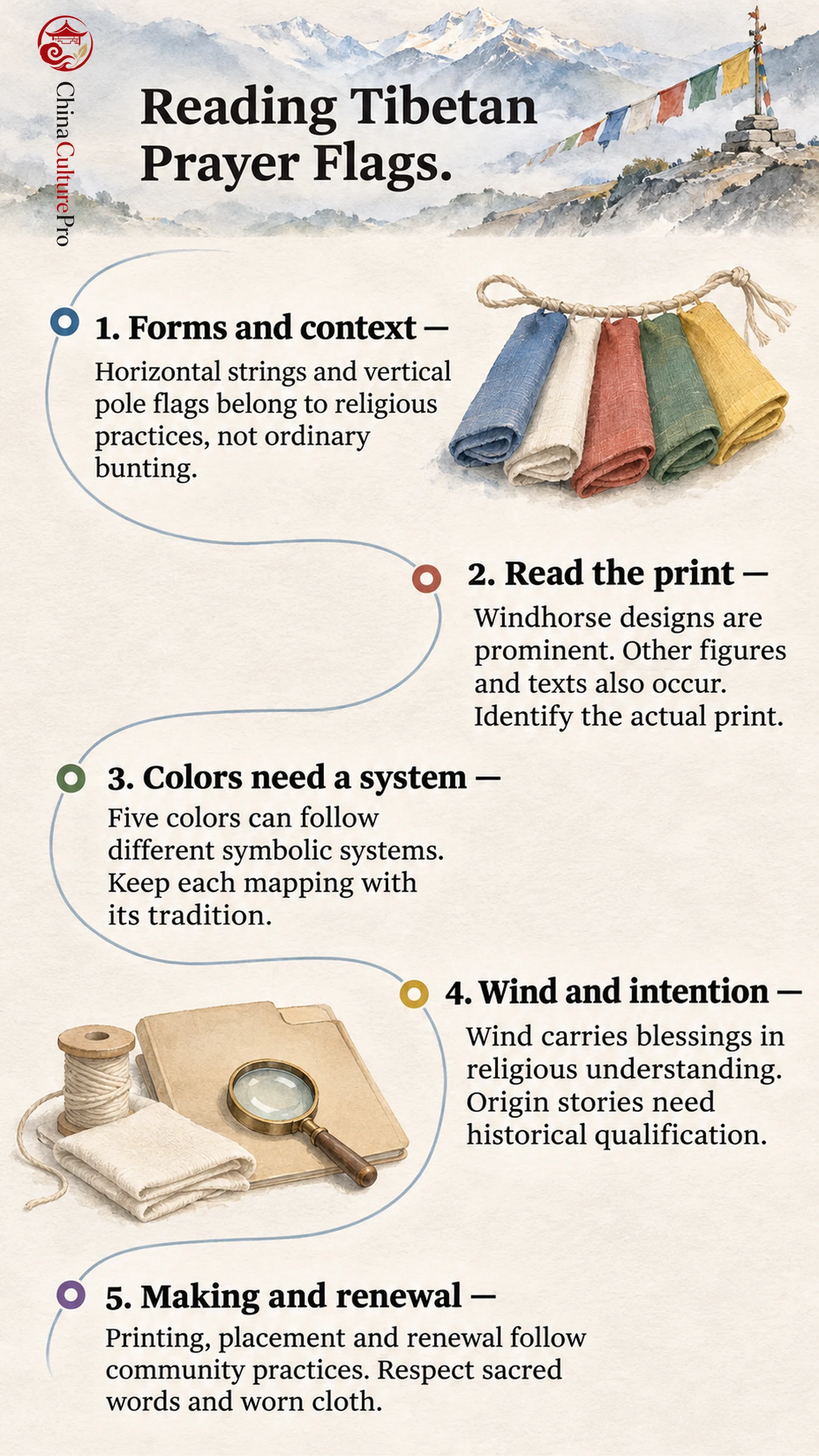
A string of colored flags can carry a printed religious text, shaped by choices about language, images and use. Looking only at its colors can hide what the maker intended it to carry. This guide explains the familiar forms while keeping particular designs, community practices and systems of symbolism in view.
Cloth Strings, Pole Flags and Religious Context
The horizontal string is a familiar form: separate cloth panels are attached along a line. Vertical flags present a different arrangement, with a narrow length of printed cloth raised on a pole. Both occur in Himalayan religious practice; a vertical flag is not simply a horizontal set turned on its side.[1]
A catalogue example makes the scale concrete. One twentieth-century set from Nepal contains 25 printed panels of cloth. That record identifies an actual object, rather than establishing how many flags every string must contain.[2]
Prayer flags appear within Tibetan Buddhism(藏传佛教,Zàngchuán Fójiào)and Bon(苯教,Běnjiào)traditions, with differences among designs and interpretations. Their presence across these contexts is a reason to identify the particular object and community instead of assigning every flag to one uniform practice.[3]
They belong within Tibetan religious and cultural life, rather than being interchangeable with national flags or ordinary festival bunting. Printed content and religious intention are central to that distinction.
Printed Texts and the Windhorse Design
The windhorse(风马,fēngmǎ), known as lungta in Tibetan, is a prominent design. A horse at the center carries an auspicious jewel, with other symbolic animals arranged around it. Lungta is a Tibetan term and should not be mistaken for the Mandarin pronunciation of the Chinese rendering.[2][3]
The Nepalese catalogue example combines a central horse with Tibetan text that includes transliterated Sanskrit mantras and Tibetan prayers. Its four corner animals are represented by written names. This matters when reading an image: the absence of a drawn animal in a corner does not necessarily mean the animal is absent from the design.[2]
Not every prayer flag centers on a horse. Other designs feature deities, teachers or figures such as Gesar. Text and image can therefore change together; it is inaccurate to label every printed flag with the name of a single mantra.[3]
A mantra is a particular sacred formula, rather than an arbitrary collection of decorative letters. When a catalogue offers a transcription or translation, keep it connected with that object. A familiar-looking script alone cannot establish that two flags carry identical words.
Five Colors and More Than One System
One commonly published Buddhist windhorse set runs blue, white, red, green and yellow. In that context, the colors are explained through the following elements:[4]
| Couleurs | Element association in this mapping |
|---|---|
| Bleu | Sky and space |
| Blanc | Air and wind |
| Red | Feu |
| Vert | Eau |
| Jaune | Terre |
This is a useful mapping to recognize, but it should travel with its context. Merigar, a Dzogchen community in Italy, describes a different order for its own flags: green, red, yellow, white and blue. It associates these with wood, fire, earth, metal and water in a jung-tsi elemental-astrology sequence.[5]
The difference is substantive. Blue is associated with sky and space in the first table and with water in Merigar’s described sequence. Combining the two into one universal color chart would erase the systems being explained.
For a particular set, identify its tradition and accompanying explanation before assigning each panel a meaning. A photograph’s viewing direction also does not by itself establish how its maker describes the order.
Wind, Blessings and the History of the Practice
In the religious understanding attached to prayer flags, wind carries the benefit of sacred words outward. The Nepalese catalogue describes flags placed at high passes so their good wishes may reach beings in every direction. This explains a devotional intention, rather than predicting an individual outcome.[2]
The history has several layers. Research discusses the possibility that raising flags predated Buddhism in Tibetan cultural areas, while Buddhist texts and ritual uses became part of later traditions. That possibility does not identify a single inventor or a securely dated first flag.[6]
A surviving printing block provides a different kind of evidence: a Himalayan woodblock catalogued to the fifteenth–nineteenth centuries records the material practice of reproducing prayer-flag designs. Its broad date range is an object attribution, not a date for the origin of the whole tradition.[6]
Prayer wheels also involve sacred texts, but their physical operation differs. A flag exposes printed material to moving air; a wheel encloses texts within a rotating form. Similar religious intentions do not make them the same object.
Making, Hanging and Renewing Flags
Woodblock printing transfers a prepared text and image onto cloth. Mechanized production also exists, so a flag’s appearance should not automatically be taken as proof of hand printing. In an account of Bhutanese practice, the clarity and correct orientation of the letters are part of treating the printed text properly.[7]
Placement instructions belong to particular communities. Keeping sacred flags off the ground is one common expression of respect. Merigar follows its teacher’s instruction to suspend flags between designated poles rather than on buildings, showing why one photograph of rooftop flags cannot establish the preferred arrangement everywhere.[5][8]
Losar(藏历新年,Zànglì Xīnnián), or Tibetan New Year, is an important occasion for renewal in several communities. Older cloth can fade and fray through exposure, and this impermanence is itself part of the religious explanation.[8]
Some communities ceremonially burn worn cotton flags.[8] This describes a religious custom, rather than a universal disposal instruction. For a set entrusted to you, follow the relevant community’s handling guidance and applicable fire restrictions.
FAQs About Tibetan Prayer Flags
What is the order of Tibetan prayer flag colors?
Blue, white, red, green and yellow is a common Buddhist windhorse order. Other documented systems use different sequences, so identify the particular tradition.
Does every prayer flag show a windhorse?
No. Windhorse designs are prominent, but flags can also feature other religious figures and texts. The specific print determines its content.
Are prayer flags the same as prayer wheels?
No. Flags are displayed in moving air, while wheels rotate with sacred texts inside. Their forms and uses are related but distinct.
What happens when prayer flags fade?
Outdoor cloth fades and wears through weathering. Some communities renew sets at Losar and follow their own customs for handling worn flags.
Sources
[1] Foundation for the Preservation of the Mahayana Tradition. Types of Holy Objects: Prayer Flags
[2] University of Virginia Library. Tibetan Religious Art: String of 25 Printed Prayer Flags
[3] Jeff Watt, Himalayan Art Resources. Prayer Flags Description
[4] Tibetan Nuns Project. The Meaning of Windhorse Tibetan Prayer Flags
[5] Merigar. Merigar Prayer Flags
[6] Rubin Museum of Himalayan Art. Prayer Wheel: Text, Objects and Related Flag Traditions
[7] Karma Phuntsho, Bhutan Cultural Library. Prayer Flags
[8] Tibetan Nuns Project. How to Hang and Dispose of Tibetan Prayer Flags Respectfully