


Quick Answer: What Defines Tianjin Culture?
Tianjin (天津, Tiānjīn) grew where canal traffic and coastal routes connected northern China with other markets. The port already handled goods before it opened as a treaty port in 1860. Its cultural history also lives in local arts, including Yangliuqing New Year prints (杨柳青木版年画, Yángliǔqīng Mùbǎn Niánhuà), painted clay figures and teahouse comedy.[1][2][3][4][5]
- Port communities: Grain and other cargoes moved through a city tied to the Grand Canal and the Hai River. Later foreign concessions affected the shape of the waterfront.[1][2]
- Folk arts: Yangliuqing prints combine woodblocks and hand coloring. The Clay Figure Zhang tradition uses modeled, painted figures.[3][4]
- Performance: Tianjin became an important setting for xiangsheng (相声, xiàngsheng), a spoken comedy form that can be heard in teahouses.[5]
A riverfront building, a print and a teahouse each record a different kind of public life.
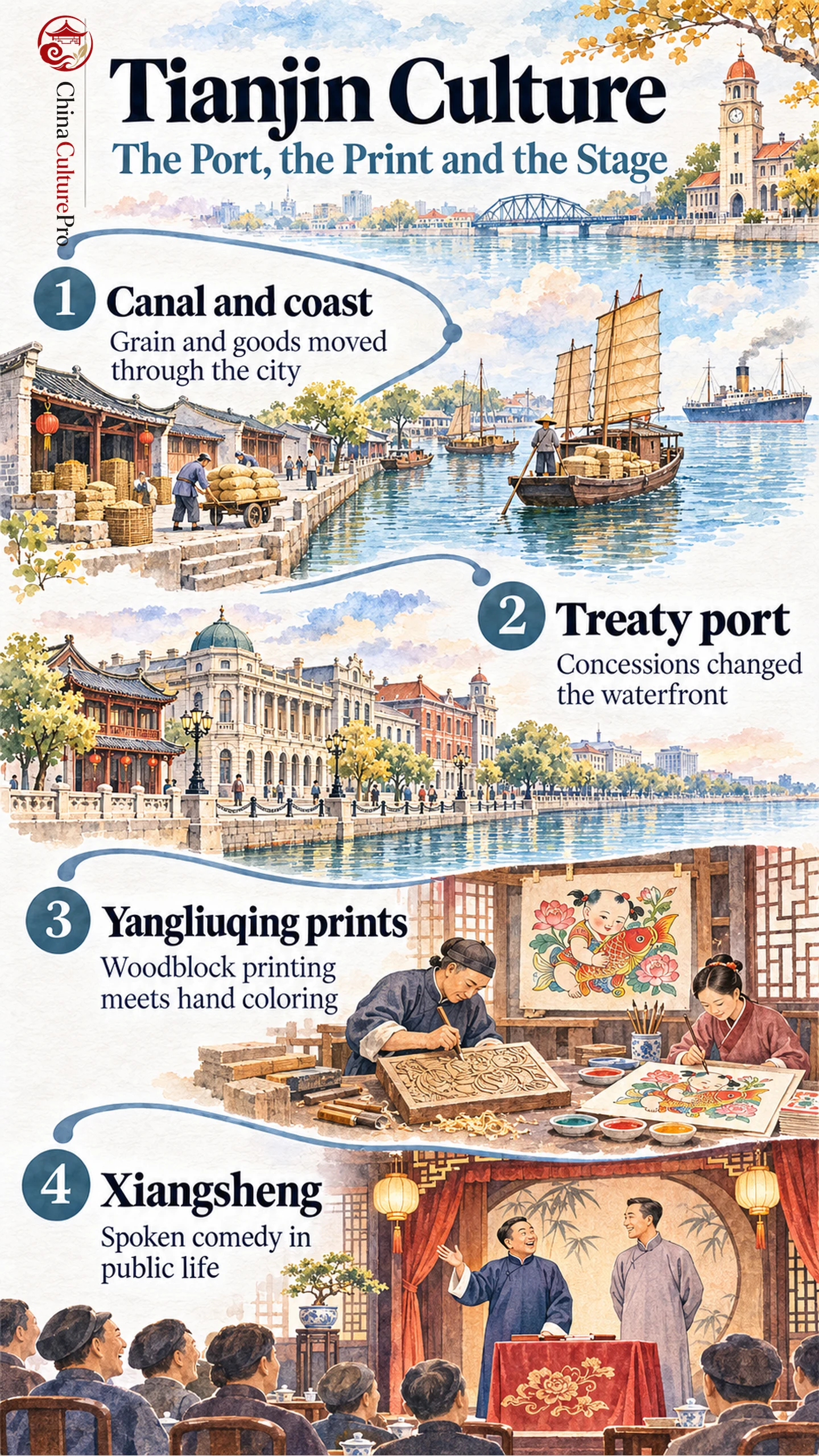
Tianjin’s waterfront tells you who moved goods and where they worked. A New Year print or a theater table can tell you more about what residents displayed at home or shared with an audience.
Four Ways to Read Tianjin Culture
| Point de départ | Ce qu’il faut remarquer | Contexte culturel |
|---|---|---|
| Canal and coast | Routes into and out of the Hai River network | Grain could travel north and change vessels or routes along the way.[1] |
| Treaty-port districts | Streets and plots from separate concession areas | Different governments shaped adjacent parts of the city.[1][2] |
| Yangliuqing New Year prints | Printed lines and areas colored by hand | One local approach to pictures displayed for the New Year.[3][6] |
| Xiangsheng | Comic exchanges and audience timing | Teahouses provided a regular setting for spoken performance.[5] |
From Canal Trade to a Treaty Port
Tianjin’s position made it a transfer point for tax grain shipped from central and southern China toward Beijing. The Grand Canal and the Hai River (海河, Hǎi Hé) connected canal traffic to a wider network. Tianjin’s trading role already mattered when the treaties of 1860 opened the port to wider foreign commerce.[1][2]
Foreign concessions developed their own planning rules and building types alongside areas governed by Chinese authorities. The result was a city of adjacent districts whose streets and public spaces reveal different arrangements of power and commerce. Migrants also built communities there. Tianjin and Harbin, for example, both became homes for people from Russian Jewish communities, within different local histories of migration.[1][2][7]
Two Folk Arts to Look for in Tianjin
Yangliuqing New Year prints developed in a market town now part of Tianjin. The national heritage record links the town’s commercial prosperity to canal trade. The craft combines block printing with brushwork. Printed lines can guide the eye to areas colored by hand, such as faces and clothing.[3][6]
Clay Figure Zhang (泥人张, Nírén Zhāng) names a Tianjin tradition of painted clay sculpture associated with Zhang Mingshan and generations of makers. The modeling gives an object depth, posture and gesture. Color adds details of clothing and expression. Both the prints and the painted clay tradition appeared in the first national intangible heritage list in 2006.[3][4]
Listening to Tianjin’s Teahouse Comedy
Xiangsheng, commonly translated as crosstalk, is a comic performance based on speech, wordplay and timing. A paired routine can gain its rhythm from an interruption, repetition or a change in tone. Tianjin’s teahouses gave performers and audiences a shared place to develop this style. The form has a wider northern Chinese history, and the city is associated with figures such as Ma Sanli.[5]
A teahouse performance shows a different side of the port city’s public culture. Where the trade record identifies routes and goods, spoken comedy uses familiar language and situations to connect performers with the audience.
FAQs About Tianjin Culture
Was Tianjin Already a Port Before 1860?
Tianjin was a major northern commercial center before 1860. That year marks its opening as a treaty port and the start of a new period of concession development.[1][2]
What Makes Yangliuqing Prints Distinctive?
The tradition combines designs transferred from woodblocks with hand-applied color. Both the carved line and the painted details help give the final image its character.[3][6]
Is Xiangsheng the Same as Opera?
Xiangsheng is a spoken comedy form in which language and delivery are central. It has been performed in Tianjin teahouses and other venues.[5]
Sources
[1] Urban History. The Multi-Imperial Dimensions in Treaty-Port Tianjin
[2] Yanchen Sun and colleagues. Urban Construction Regulations of Concessions in Tianjin
[3] China Intangible Cultural Heritage Digital Museum. Yangliuqing Woodblock New Year Prints
[4] China Intangible Cultural Heritage Digital Museum. Clay Figure Zhang in Tianjin
[5] Tianjin Municipal Government. Crosstalk
[6] China Intangible Cultural Heritage Digital Museum. Yangliuqing Prints and How They Record Daily Life
[7] Oxford University Press. The Jewish Communities of Harbin and Tianjin