


Quick Answer: What Defines Guangxi Culture?
Guangxi’s regional culture takes different forms across towns, river valleys and mountain communities. Zhuang communities (壮族, Zhuàngzú) have distinct speech and craft traditions. Dong communities (侗族, Dòngzú) in Sanjiang sustain multipart singing. Yue speech (粤语, Yuèyǔ), often discussed under the umbrella of Cantonese, is present in parts of eastern Guangxi. Ancient rock paintings in the Zuojiang valley tell a separate historical story.[1][2][3][4][5][6]
- Language and craft: The written standard for Zhuang draws on a speech variety from Wuming. Jingxi has a distinct tradition of brocade weaving.[1][2]
- Performance: The Grand Song of the Dong brings several voice parts together. Cantonese opera belongs to a different performance tradition shared across provincial lines.[3][4][5]
- Ancient record: The Huashan rock art preserves Luoyue figures painted on steep cliffs above rivers.[6]
The traditions vary by community and setting. A single language, costume or festival cannot describe the whole region.
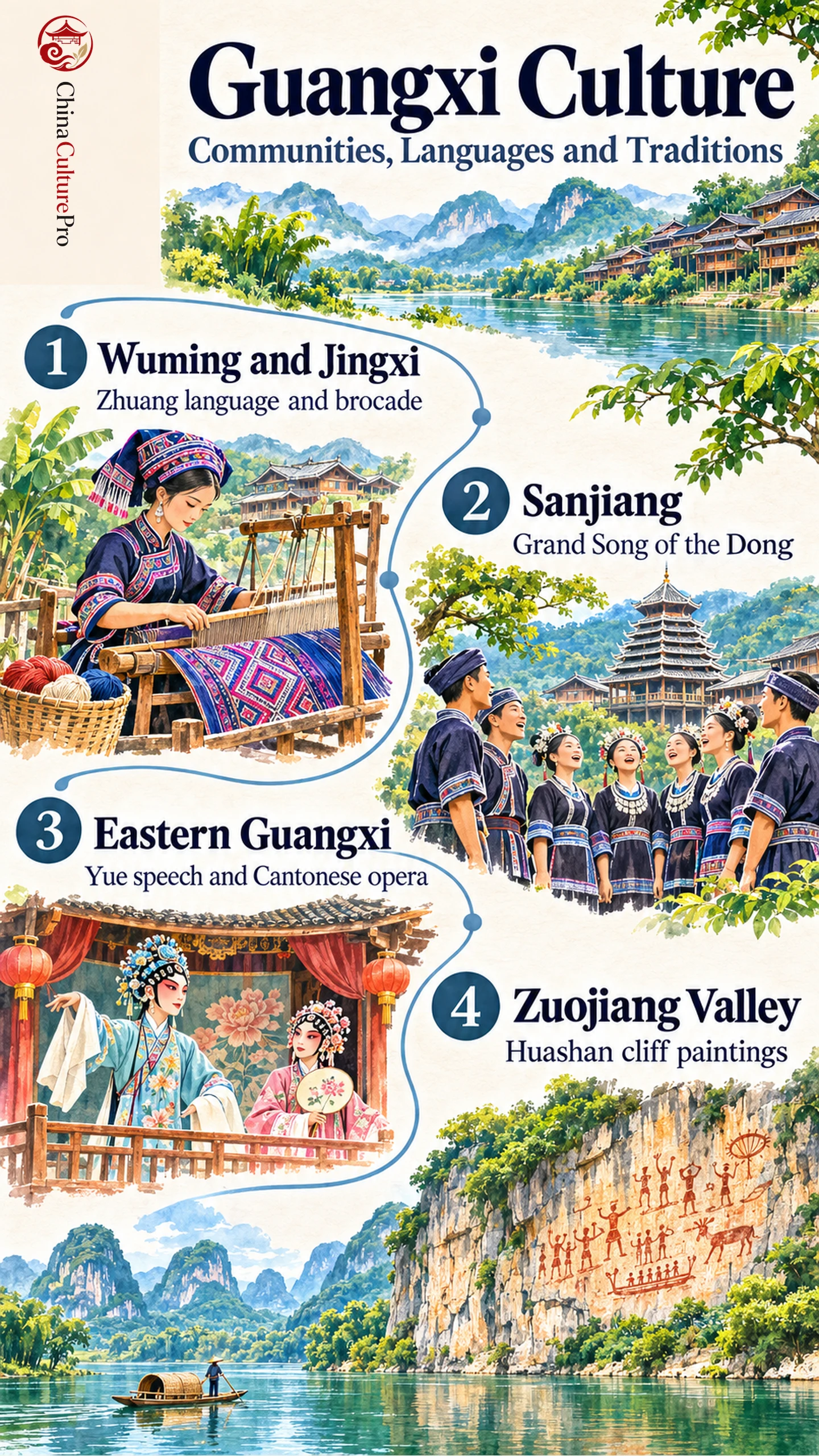
Begin with a voice or an object. A line of song in Sanjiang, a patterned bedcover in Jingxi and a painted figure far above the river each ask a different question about Guangxi.
Four Places to Understand Guangxi Culture
| Lieu | Practice or evidence | Ce que cela montre |
|---|---|---|
| Wuming and Jingxi | Zhuang speech and brocade | A base for written Standard Zhuang and a separate regional textile tradition.[1][2] |
| Sanjiang | Grand Song of the Dong | Several vocal parts performed together without instrumental accompaniment.[3][4] |
| Eastern Guangxi | Yue speech and Cantonese opera | Linguistic and stage traditions with connections across Guangxi and Guangdong.[5][7] |
| Zuojiang River valley | Huashan rock art | Ancient painted figures and ceremonial scenes associated with Luoyue people.[6] |
Zhuang Speech, Singing and Weaving
Standard written Zhuang uses a romanized spelling system based on a northern variety from Shuangqiao in Wuming. Other Zhuang speech varieties are also used in Guangxi. A single standard can be useful for writing while people in different places continue to speak differently. Mandarin is used alongside Zhuang in many settings.[1]
The third day of the third lunar month is known as Sanyuesan (三月三, Sānyuèsān). In parts of Guangxi it provides an occasion for call-and-response singing. The Zhuang March Third festival is one well-known expression of the date. Other communities also observe it, and local song fairs can follow different arrangements.[8][9]
At Jingxi, a documented Zhuang brocade loom was used to weave patterned bedcovers decorated with silk threads laid across the fabric. The tool and textile record a specific local skill alongside the region’s spoken and sung traditions.[2]
Dong Grand Song and the Cantonese Stage
In Sanjiang, groups of singers help sustain the Grand Song of the Dong. Several parts are performed together without instrumental accompaniment. Learning to enter and sustain a part within the group is one way singers pass on the tradition. Sanjiang shares this practice with Dong communities across the border in Guizhou.[3][4]
In eastern Guangxi, Wuzhou has a local Yue speech variety. Cantonese opera is a related regional stage tradition with roots in Guangdong and Guangxi. Its singers perform with instrumental accompaniment, and costumes and painted faces help mark the roles. Guangzhou’s Cantonese stage offers another setting for the same opera tradition.[5][7]
What the Huashan Cliff Paintings Record
UNESCO’s Huashan property includes dozens of sites on cliffs carved by the Zuojiang and Mingjiang rivers. The paintings are associated with the Luoyue and date from roughly the fifth century BCE to the second century CE. Figures and objects in the scenes have been interpreted as evidence of ceremonies and a southern bronze drum tradition. That interpretation describes an ancient record in its landscape.[6]
FAQs About Guangxi Culture
Is Zhuang the same as Cantonese?
Zhuang belongs to the Tai-Kadai language family. Cantonese usually means a variety or group of varieties within Yue Chinese. People in Guangxi may speak or hear more than one language or variety.[1][7]
Do all communities celebrate Sanyuesan the same way?
The date is observed by several communities, and their local customs and song fairs vary. Call-and-response singing is one documented practice.[8][9]
Where can you find Dong Grand Song in Guangxi?
Sanjiang Dong Autonomous County is a documented center. The wider singing tradition is also maintained by Dong communities in neighboring Guizhou.[3][4]
Sources
[1] PLOS ONE. Zhuang-Mandarin Bilingual Children in Rural China
[2] China National Silk Museum. Zhuang Brocade Loom
[3] UNESCO Intangible Cultural Heritage. Grand Song of the Dong Ethnic Group
[4] Academy of Contemporary China and World Studies. Kam Grand Choir
[5] UNESCO Intangible Cultural Heritage. Yueju Opera
[6] UNESCO World Heritage Centre. Zuojiang Huashan Rock Art Cultural Landscape
[7] International Dialects of English Archive. Guangxi 12 Wuzhou Dialect Commentary
[8] China Daily via China Culture. Festival Tunes Into Folk Songs
[9] Ethnomusicology Review. A Tale of Two Song Fairs