
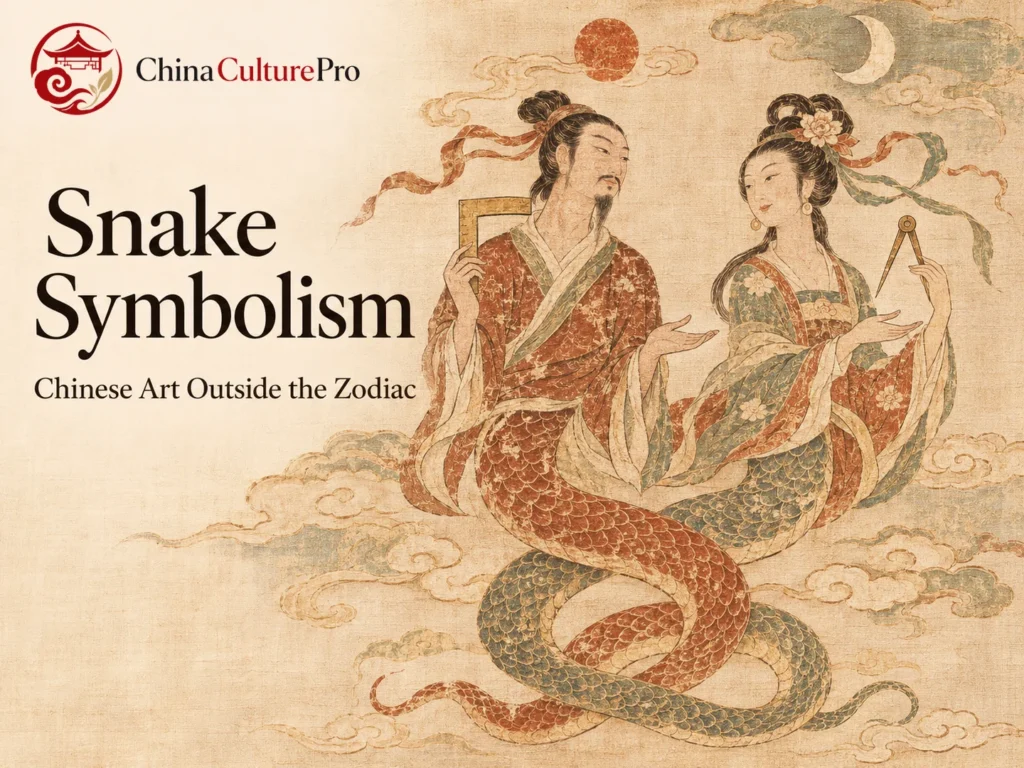

Quick Answer: What Can a Snake Symbolize Outside the Zodiac?
In Chinese art, a snake can be part of a creation deity’s body, one of the creatures in a festival design or a character in a story. The figures and objects around it tell you which role it plays.[1][2][3]
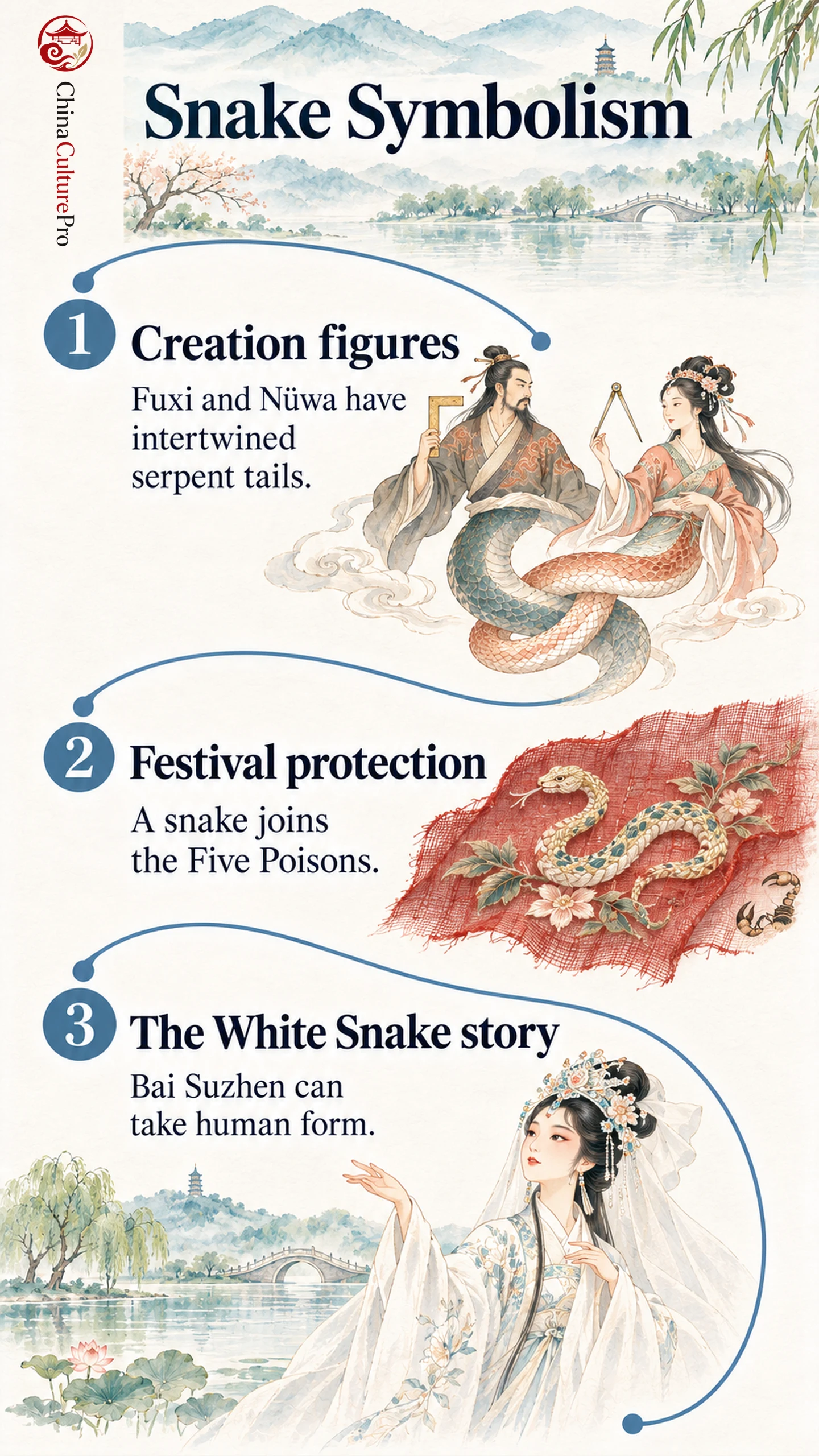
- Creation scene. Fuxi (伏羲, Fúxī) and Nüwa (女媧, Nǚwā) can have human upper bodies and intertwined serpent tails.[1]
- Festival textile. A snake joins other creatures in the Five Poisons.[2]
- Opera. A serpent spirit can take human form and become the central character.[3][4]
Check the setting for tools, festival emblems or recognizable story figures.
A pair of serpent tails twists together beneath two clothed figures in a tomb painting from Turpan. A textile places a much smaller snake beside a tiger. The serpent’s shape is recognizable in both. The people, animals and objects around it change how the image reads.[1][2]
Serpent Bodies in a Creation Scene
A painting from the Astana graves in the National Museum of Korea shows two creation figures with human upper bodies and snake-like lower bodies. Their tails intertwine beneath their robes. The sun, moon and constellations make the scene a small image of the cosmos. The pair also holds a compass and a square, which can evoke a round heaven and a square earth.[1]
The painting came from a burial setting. Small holes along the edges suggest that it may have been attached to the ceiling. That position would have set the painted sky overhead.[1]
The Snake on Dragon Boat Festival Textiles
A Ming red-ground gauze panel places a running tiger among a snake, scorpion, centipede, gecko and toad. The curving body helps distinguish the snake from the jointed tail and pincers of the scorpion. The tiger and the group give the design its festival context.[2]
The Five Poisons motif was used for Duanwu. A surviving set of court accessories combines the animals with gourds and written wishes for good fortune. Here the wish to ward off harm appears on small objects worn at court.[2][5]
The White Snake as an Opera Character
In the Legend of the White Snake (白蛇傳, Báishé Zhuàn), the spirit Bai Suzhen takes human form and marries Xu Xian. The monk Fahai opposes the marriage. Some versions place Bai Suzhen beneath Leifeng Pagoda. A shadow puppet showing her transformation makes the relationship between the woman and serpent visible in one scene.[3][4]
In opera, Bai Suzhen can appear in human costume. The Broken Bridge or the other characters can help identify her before a serpent appears.[3][4]
A coiled serpent also appears in folk paper cuts beside an animal with a very different cultural role. In a snake-and-rabbit design, the pair can express a wish for descendants to prosper. Compare the separate signs of the moon hare, where the pestle and lunar setting identify a different tradition.[6]
FAQs About Snake Symbolism Outside the Zodiac
What can a snake coiled around a rabbit mean?
In one paper-cut tradition, the pairing can evoke a wish for prosperity across generations. The rabbit in that design plays a different role from the one pounding an elixir in a moon scene.[6]
What are the tools held by the two creation figures?
The figures can hold a compass and a bent square. In the Astana painting, these help evoke a traditional image of the round sky and square earth.[1]
Sources
[1] National Museum of Korea. Painting of Fuxi and Nüwa
[2] Palace Museum. Red-ground gauze panel with tiger and Five Poisons
[3] CAFA Art Museum. Legend of the White Snake
[4] Tianhe District Government. Chinese Folk Tale Opera Staged in Tianhe
[5] Palace Museum. Year of the Snake: Online exhibition
[6] University of Kansas Libraries. The Auspicious Serpent Presents Blessings