

Quick Answer: What Is Shanghai Culture?
Shanghai culture developed through local and regional traditions, migration, commerce and international encounters. Haipai (海派, hǎipài), often translated as “Shanghai style,” can describe this urban cultural mixture, while also having more specific uses in the arts. Buildings, language, creative work and everyday design reveal different aspects of the city.[1][2]
- Regional roots: Shanghai’s history connects with the lower Yangtze’s cultural and commercial networks.
- Urban forms: Housing, print, art markets and public institutions shaped cultural exchange.
- Continuing change: Food, clothing and new uses for old buildings show adaptation.
The city’s culture is broader than a skyline, a single historical decade or the idea of simply adopting Western styles.
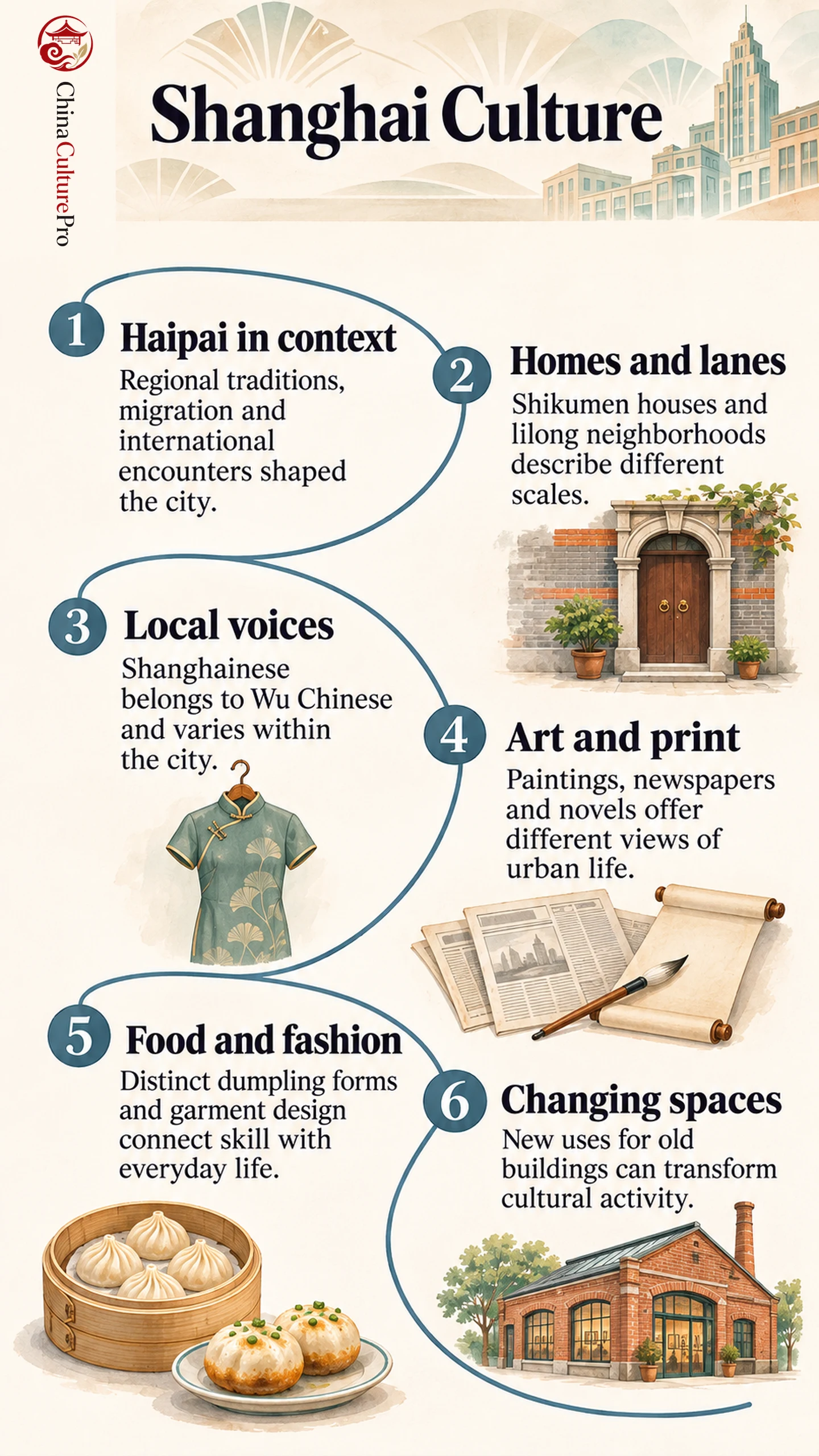
Shanghai’s cultural history can be read in a stone-framed doorway, a newspaper page or the cut of a garment. Comparing these forms reveals how local knowledge, migration and commercial life interacted, while modern institutions continue to change the city’s cultural settings.
Haipai and the City’s Historical Connections
Shanghai had commercial and literary connections before its growth as a modern treaty port. Its ties with Jiangnan (江南, Jiāngnán) connected it to a wider regional world of trade, scholarship and artistic practice. Foreign contact did not create cultural life on previously empty ground.[1]
The opening of the port in 1843 and the development of foreign concessions changed the scale and organization of urban life. Migration and expanding markets shaped housing and cultural production. These encounters also involved colonial power and unequal institutions, rather than only the attractive imagery associated with cosmopolitan life.[2][3]
The word Haipai needs context. A discussion of professional painters uses it more narrowly than a discussion of the city’s food, fashion and commercial culture. It does not identify one uniform style across every art, nor establish a fixed personality for Shanghai residents. The city’s modern cultural history includes different institutions, audiences and social experiences.
Shikumen Houses, Lilong Neighborhoods and Urban Memory
A shikumen (石库门, shíkùmén) house takes its name from its stone-framed gateway. Row-house arrangements brought Chinese domestic spatial ideas into contact with Western architectural features. The doorway is a recognizable element; it does not mean the entire house is built from stone.[3]
Lilong (里弄, lǐlòng) refers to lane neighborhoods: a wider setting of access, housing and shared spaces. A building and its neighborhood belong to different scales of urban life. Changing tenancy and shared kitchens made everyday contact important, while crowded conditions were also part of many residents’ experience.[3]
Architecture can survive with a changed social role. A 2008 study of Xintiandi examined two blocks redeveloped into an entertainment quarter. It argued that the new presentation emphasized a cosmopolitan colonial image while obscuring the history of lower-middle-class tenants. This particular case raises a useful question: whose lives are represented when a historic neighborhood becomes a heritage image?[4]
Shanghainese and a City of Different Voices
Shanghainese (上海话, Shànghǎihuà) belongs within Wu Chinese (吴语, Wúyǔ), with connections to the Taihu region. Speech varies within Shanghai itself, including differences between downtown, Songjiang and Chongming settings. The name does not describe every Wu variety across Jiangsu and Zhejiang.[5]
Migration also brought influences from places such as Ningbo and Suzhou. Local speech is therefore part of a history of contact. As in other multilingual community settings, residence, cultural identification and individual language ability should be distinguished. Mandarin pinyin in this article gives readings of Chinese names, rather than a pronunciation guide to Shanghainese.[5]
Painting, Print and Literary Shanghai
The Shanghai School of Painting (海上画派, Hǎishàng Huàpài) brought professional artists into contact with urban audiences and markets. Painters including Wu Changshuo, Zhao Zhiqian and Xu Gu combined inherited painting traditions with new approaches and popular subjects. Their work shows why artistic change cannot be reduced to replacing Chinese methods with Western ones.[7]
Print provides another kind of evidence. Shenbao (申报, Shēnbào) began publication in 1872; its inaugural issue survives in Shanghai Library’s collection. Newspaper pages connect the city’s history with the production and circulation of printed material. The surviving issue is a dated material record, with a different role from later fictional representations of the city.[8]
Fiction offers a deliberately constructed view. Wang Anyi’s The Song of Everlasting Sorrow (长恨歌, Chánghèngē) follows Wang Qiyao through decades of Shanghai life, from the glamour of the 1940s into the 1980s. Neighborhood spaces and personal aspirations connect with historical change. The novel belongs to modern literature; its characters provide a perspective on city life, rather than a representative survey of residents.[6]
Food, Fashion and Everyday Design
Xiaolongbao (小笼包, xiǎolóngbāo) and shengjianbao (生煎包, shēngjiānbāo) show how familiar foods require precise identification. The former are steamed soup-filled dumplings with thin wrappers. The latter are pan-fried buns with crisp bases; their dough and quantity of broth vary by style. Their different forms matter more than calling both simply “Shanghai dumplings.”[9][10]
These are examples within Shanghai food culture, rather than its entire repertoire. A local food name can remain familiar while different makers adapt texture, filling or presentation.
Qipao (旗袍, qípáo) connects cultural identity with textile, cut and craft. A 2026 exhibition in Hongkou organized designs around seasonal colors and materials. The show ran through October 7 and illustrated how seasonal themes could inform contemporary garment design.[11]
Contemporary Culture and the Reuse of Urban Space
The Power Station of Art was established in 2012 in the former Nanshi Power Plant. Its conversion from industrial infrastructure into a contemporary art institution connects different phases of the city’s material history. It also houses the Shanghai Biennale, placing contemporary artistic practice within the cultural picture.[12]
A reused building, a commercial heritage district and an inhabited lane neighborhood preserve different things. Compare physical fabric, the people using the space and the activities taking place there. This makes cultural change visible without assuming that an old façade guarantees continuity of its former way of life.
FAQs About Shanghai Culture
Does Haipai mean only Western influence?
No. Local and Jiangnan traditions, migration and urban commerce are also central to the term’s cultural context.
Are shikumen houses entirely made of stone?
No. The name refers to the stone-framed gateway, rather than the material of the entire building.
Is Shanghainese the same as Mandarin?
No. Shanghainese belongs to the Wu group and has its own local speech history.
Are xiaolongbao and shengjianbao the same food?
No. Xiaolongbao are steamed soup dumplings; shengjianbao are pan-fried buns with crisp bases.
Does preserving an old façade preserve its former way of life?
No. Building fabric, residents and activities can change independently. An architectural image is only one part of cultural memory.
Sources
[1] Shanghai Normal University, Interdisciplinary Studies of Literature. Shanghai-Style Culture and Jiangnan Culture: Literati Gatherings Before and After the Opening of the Port
[2] Jane Zheng and colleagues. Rediscovering Shanghai Modern: Urban Art, 1912–1948
[3] Guo Changyao, Shanghai Culture and Tourism Portal. Shikumen and Shanghai’s Cultural Heritage
[4] Xuefei Ren. Forward to the Past: Historical Preservation in Globalizing Shanghai
[5] Shanghai Municipal Government. Shanghai Dialects
[6] Wang Anyi, Columbia University Press. The Song of Everlasting Sorrow: A Novel of Shanghai
[7] Macao Museum of Art and the Palace Museum. Shanghai School of Painting: Collections of the Palace Museum
[8] Shanghai Library. Historical Newspapers Exhibition at Xujiahui Library
[9] Shanghai Municipal Government. Xiaolongbao: A Small Dumpling with a Big Story
[10] Shanghai Municipal Government. Pan-Fried Pork Buns
[11] Hongkou District via Shanghai Municipal Government. Qipao Exhibition: Seasonal Color and Craft
[12] Power Station of Art. Power Station of Art: Institutional Profile