


Quick Answer: What Was the Rebellion of the Seven States?
The Rebellion of the Seven States (七国之乱, Qī Guó Zhī Luàn) was an uprising of seven Western Han kingdoms in 154 BCE against Emperor Jing (汉景帝, Hàn Jǐngdì). Liu Bi (刘濞, Liú Bì), the king of Wu, led the coalition after the court moved to take territory from regional rulers. The Han defeated the rebels and later took greater control of the surviving kingdoms’ administration. [1][2][3][4][5]
- Cause: The court began cutting the territories controlled by powerful kings.
- War: Liang resisted Wu and Chu while Han troops cut their supply lines.
- Aftermath: Kings kept their titles, while the court gained greater control over appointments. [1][2][3][4][5]
The main campaign ended within months. The appointment reform recorded in the Book of Han followed in 145 BCE. [2][3][4]
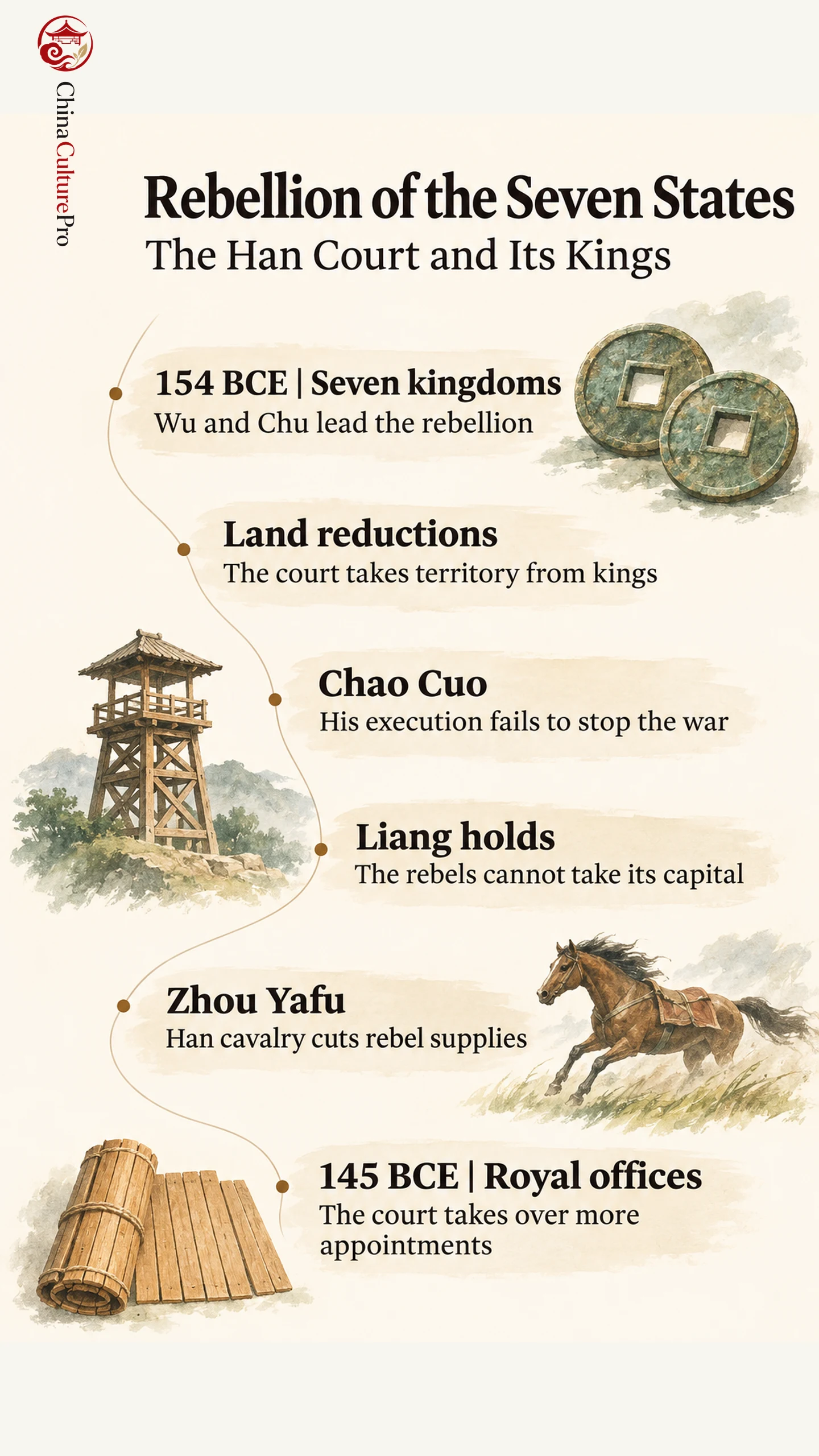
The early Han court had granted royal relatives territories to govern. By 154 BCE it faced a problem of its own making. Several kings could draw on enough land, officials and revenue to resist when the emperor tried to reclaim part of their domains.
Why the Western Han Kings Resisted
The early Han dynasty governed some regions through commanderies directly answerable to the court. Elsewhere it granted kingdoms to relatives and, especially early on, to some allies. A kingdom had its own offices for civil and military affairs. The court retained authority over important appointments, but the kings exercised substantial power locally. [3][4]
Wu was especially well placed to resist. Sima Qian’s biography of Liu Bi describes profits from copper coinage and salt. These resources gave Wu a fiscal base apart from ordinary taxes on households. Losing territory such as Yuzhang, where the biography locates Wu’s copper mines, could mean losing a source of revenue as well. [1][5]
Emperor Jing’s adviser Chao Cuo (晁错, Cháo Cuò) urged him to recover territory from powerful kingdoms. The court used accusations of wrongdoing to justify some reductions. When a notice arrived taking Kuaiji and Yuzhang from Wu, Liu Bi raised troops with allies. The dispute was over who could command the land and revenues the Han had entrusted to the royal houses. [1][4][5]
Which Seven Kingdoms Rebelled?
The seven were Wu, Chu, Zhao, Jiaoxi, Jiaodong, Jinan and Zichuan. Wu and Chu directed the main offensive. Zhao and the four eastern kingdoms also rose. The court sent other commanders against Zhao and into the east, leaving Zhou to deal with Wu and Chu. These names refer to kingdoms within the Western Han, including some with names used for much older states. [1][5]
Liang belonged to the same system of royal kingdoms but sided with the emperor. Its king, Liu Wu, was Emperor Jing’s brother. Liang’s forces stood in the path of the Wu and Chu armies as they moved west. [2][5]
How Zhou Yafu Defeated Wu and Chu
The rebels called for Chao Cuo’s death. Emperor Jing had him executed and sent Yuan Ang to Wu. Liu Bi refused to submit after Chao’s death. Liu Bi’s forces had already mobilized and advanced with Chu against Liang, whose resistance slowed their westward movement. [1][2][5]
The court put Zhou Yafu (周亚夫, Zhōu Yàfū) in charge of the main army against Wu and Chu. According to his biography, he made a fortified camp near Changyi and refused to leave it for a direct rescue of Liang. Instead he sent light cavalry to sever the supply routes behind the rebels. With their supply lines cut, the armies of Wu and Chu needed a quick engagement or a way to retreat. [1][2][5]
The coalition could neither take Liang nor compel Zhou to fight on its terms. As the rebel armies withdrew, Han troops pursued them. Liu Bi fled across the Yangzi to Dantu and sought refuge with Eastern Yue. Sima Qian writes that the Han persuaded Eastern Yue to turn against him and kill him. In the east, several rebel armies besieged Linzi, the capital of Qi, after the king of Qi backed away from the alliance. Their withdrawal when Han forces arrived ended that siege. The campaign in Zhao lasted longer. [1][2][5]
What Changed for the Kings After the War
The court took territory back and reassigned some domains. Kingdoms survived, but the authority of their rulers declined. The Book of Han dates an important further change to 145 BCE. The court took over more appointments and removed several royal offices, including the chief censor and the official who oversaw judicial affairs. [3][4][5]
Sima Qian’s two biographies give different parts of the story. Liu Bi’s account describes the making of the alliance and the course of the rebellion. Zhou Yafu’s describes the commander’s decision to stay in camp. The Book of Han table traces the machinery of government, which helps explain how the court limited the power of later kings after the armies had dispersed. [1][2][3][4]
FAQs About the Rebellion of the Seven States
Was this a war between independent states?
The rebels governed hereditary kingdoms within the Han empire. They could raise forces and control local resources, but their titles came from the Han court. [1][3][4]
How long did the rebellion last?
The main campaign against Wu and Chu lasted about three months in 154 BCE according to Zhou Yafu’s biography. Operations against the other kingdoms followed their own schedules. [1][2][5]
Did Emperor Jing abolish all the kingdoms?
No. Some territories were confiscated or reassigned, but kings and kingdoms remained. The imperial court took over appointments that had been left to the kings and eliminated some of the kingdoms’ higher offices. [3][4][5]
Sources
[1] Sima Qian. Records of the Grand Historian, chapter 106: The King of Wu
[2] Sima Qian. Records of the Grand Historian, chapter 57: The House of Zhou Bo
[3] Ban Gu and other compilers. Book of Han, chapter 19: Table of Officials
[4] Michael Loewe. The Men Who Governed Han China
[5] Chinese Academy of Social Sciences history series. A General History of China: Reducing the Fiefs and Suppressing the Rebellion of the Seven Kingdoms