

Quick Answer: Why Does the Speaker Smile Instead of Replying?
In Question and Answer in the Mountains (山中問答, Shānzhōng Wèndá), Li Bai (李白, Lǐ Bái) presents a speaker content with mountain life. Rather than explaining that choice directly to his questioner, the speaker smiles; the poem’s remaining landscape supplies an imaginative answer. It is a seven-character quatrain (七言絕句, qīyán juéjù), with four lines and 28 characters.[1]
- The question: Why remain in the hills?
- The response: A smile accompanies a mind already at ease.
- The scene: Peach blossoms and flowing water suggest a realm different from the everyday human world.
The contrast does not prove that the speaker has become immortal or identify the exact location of his residence.
Someone asks for a reason; the mountain dweller offers a smile. The poem then gives its reader something the questioner does not receive as an argument: peach blossoms moving with a stream and the suggestion of a life apart from ordinary concerns.
The Complete Poem and an English Sense Translation
This original English rendering follows the received reading 何意, “why” or “with what intention,” rather than the recorded variant 何事. It retains the affirmative “another realm” in the last line.[1]
| Chinese line | English sense translation |
|---|---|
| 問余何意棲碧山, | You ask why I dwell among the green mountains (碧山, bì shān); |
| 笑而不答心自閒。 | I smile without replying, my mind at ease of itself. |
| 桃花流水窅然去, | Peach blossoms pass with the flowing water into quiet distance; |
| 別有天地非人間。 | here is a realm apart, different from the everyday human world. |
The third line follows blossom and water into distance. It does not explicitly describe the speaker boarding a boat or traveling downstream.
The Question, the Smile and the Quiet Mind
The opening question assumes that living here calls for an explanation. A reader might expect a list of advantages or a defense of withdrawal. Instead, the second line changes the terms of the exchange: the speaker’s contentment is already present.[1]
His smile is not explicitly described as mockery, and the questioner is not identified as a hostile official. Reading those details into the scene would make the encounter more confrontational than the wording requires.
The phrase about the mind being at ease also matters. Silence alone could suggest embarrassment or unwillingness; paired with inward leisure, it becomes an expression of satisfaction. The speaker need not win a debate to inhabit the landscape comfortably.
Peach Blossoms, Flowing Water and Another World
The third line gives the poem movement without haste. Blossoms drift beyond the immediate view, allowing the setting to open into a space the reader cannot fully see. The final “another heaven and earth” (別有天地, bié yǒu tiāndì) names a distinct realm or experience. The Ministry of Education’s idiom dictionary explains the expression through this poem as an inviting landscape and, more broadly, a different sphere.[2]
Peach blossom, water and separation from the ordinary world also invite comparison with Source aux fleurs de pêcher (桃花源, Táohuā Yuán), by Tao Yuanming (陶淵明, Táo Yuānmíng). That earlier narrative reaches a hidden community through a peach grove and a stream passage.[3]
The shared motifs make a useful literary echo. Li’s four lines do not retell the fisherman’s whole journey, however, or announce that his speaker has found the identical settlement. The connection enriches the scene without turning it into a map.
A Landscape That Answers without an Argument
The title’s promise of an answer is fulfilled through the poem rather than through a quoted reply. The reader sees why this life might be attractive, while the person inside the encounter receives only the smile.[1]
This distinction helps keep the poem’s lightness. A long philosophical explanation would replace the experience it offers. The contrast between the familiar world and a realm apart can support ideas of withdrawal and freedom, but the verse does not set out the doctrines of a named religious school.
As in much Chinese nature poetry, the landscape’s movement and distance give substance to the speaker’s contentment.
How to Read the Unspoken Answer
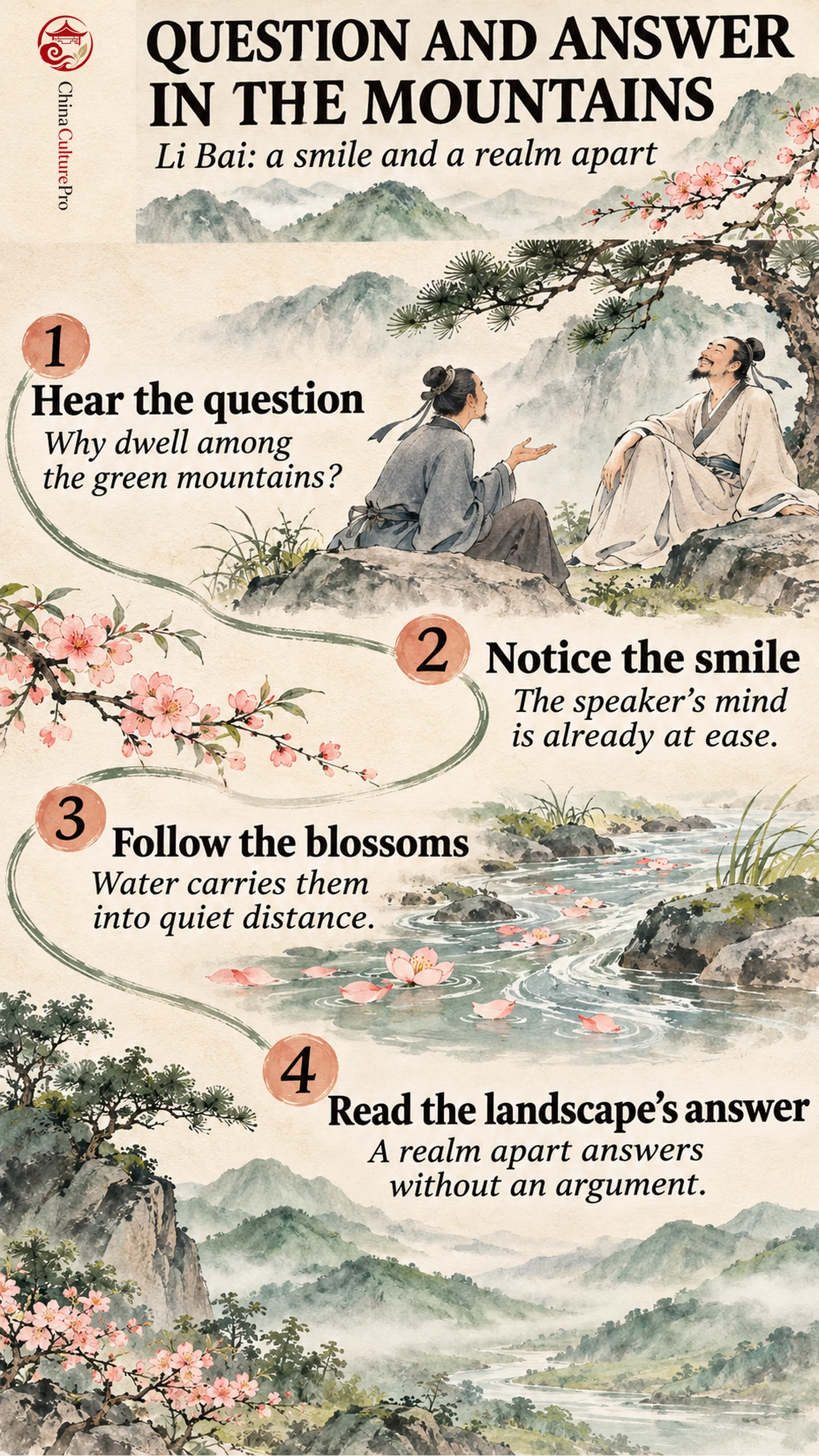
- Hear the demand for a reason: Read the opening as a question about the speaker’s choice of dwelling.
- Stay with the smile: Notice the accompanying ease before interpreting the silence as rejection.
- Follow the water: Let the moving blossoms extend the scene beyond what can immediately be seen.
- Return to the question: Consider how the final landscape answers the speaker’s choice through experience.
FAQs About Question and Answer in the Mountains
Does the last line deny the existence of heaven and earth?
No. It affirms a different realm and contrasts it with the ordinary human world. Reading it as “neither heaven nor earth exists” reverses the construction.
Do the blossoms prove the speaker is immortal?
They can evoke a world apart and invite a comparison with the earlier hidden-village story. The poem does not state that the speaker has attained immortality.
Can the poem identify an exact mountain residence?
The green mountain setting alone cannot establish a specific modern site or a dated itinerary. Such identifications require evidence beyond these four lines.
Sources
[1] Li Bai. Question and Answer in the Mountains, Complete Tang Poems, volume 178
[2] Ministry of Education, Taiwan. Dictionary of Chinese Idioms: Another Heaven and Earth
[3] Tao Yuanming. Account and Poem of Peach Blossom Spring