

Quick Answer: What Is Liu Yong’s Yulin Ling About?
Yulin Ling (雨霖铃, Yǔlín Líng) is the tune title of a ci (词, cí) lyric by Liu Yong (柳永, Liǔ Yǒng). The poem begins with an autumn farewell and follows the speaker into the morning and months he imagines after leaving.[1][2]
- Farewell: The boat is ready, but the pair are reluctant to let go.
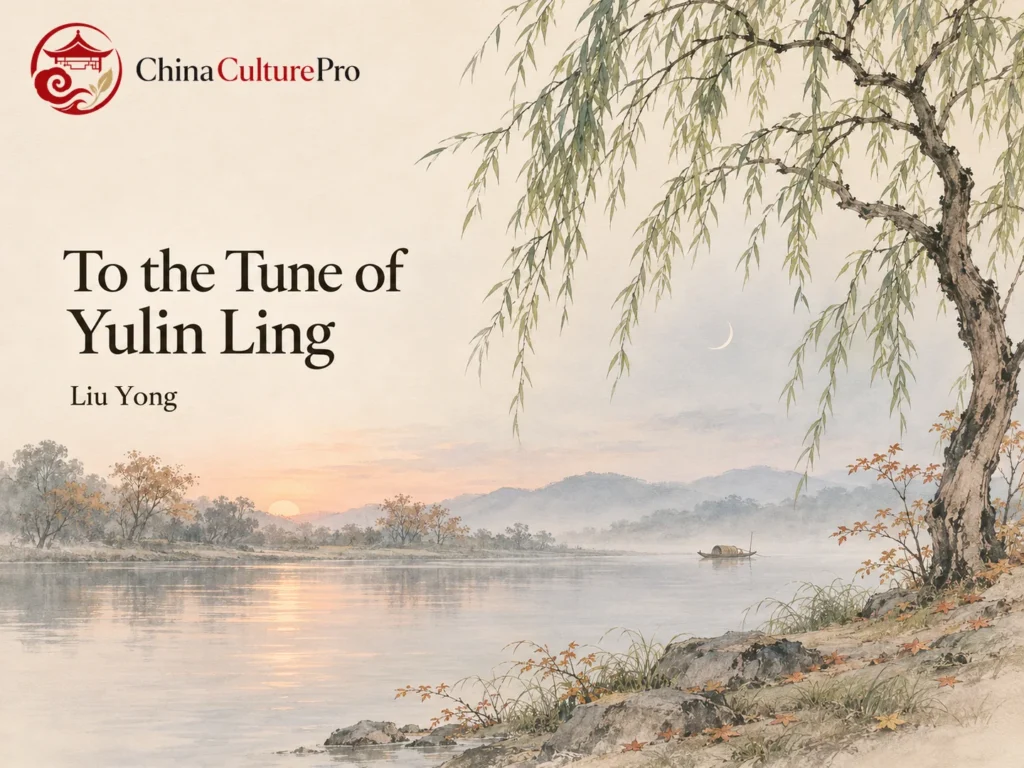
- Morning: The speaker pictures a willow bank, dawn wind and a fading moon.
- Absence: He wonders who will hear what he feels once the other person is gone.[1]
The lyric moves from two people unable to speak to one person with no one to speak to.[1]

Rain has just stopped at dusk when the boat calls for departure. By the time the famous willow bank appears, the speaker is already imagining the morning after. A reading of both stanzas shows why those quiet images matter. They describe the first place he can picture waking up alone.
Yulin Ling in Chinese and English
This ci belongs to the longer lyric tradition known as manci (慢词, màncí). Its tune gives the phrases different lengths and room for the scene to move from a farewell to a projected future. The English below follows the base text, using 沉 for the variant writing 沈 in the mist phrase.[1][2]
| Stanza | Chinois | Sens en français |
|---|---|---|
| Premier | 寒蝉凄切。对长亭晚,骤雨初歇。 | Cold-weather cicadas cry sharply. Evening at the roadside pavilion, a sudden shower just ended. |
| Premier | 都门帐饮无绪,留恋处、兰舟催发。 | At a farewell drink by the capital gate, I have no heart for the wine. We linger, but the boat presses to leave. |
| Premier | 执手相看泪眼,竟无语凝噎。 | We clasp hands and look into tearful eyes. In the end we choke back every word. |
| Premier | 念去去、千里烟波,暮霭沉沉楚天阔。 | I think of going on and on across a thousand li of misty water. Evening haze thickens beneath the wide sky of Chu. |
| Deuxième | 多情自古伤离别。更那堪、冷落清秋节。 | Those who feel deeply have always grieved at parting. How much harder in the chill and desolation of autumn. |
| Deuxième | 今宵酒醒何处,杨柳岸、晓风残月。 | Where will I sober up after tonight’s wine? A bank of willows, the dawn wind, a fading moon. |
| Deuxième | 此去经年,应是良辰、好景虚设。 | Away for a year and more, fine hours and lovely scenes will be there to no purpose. |
| Deuxième | 便纵有、千种风情,更与何人说。 | Even if I have a thousand tender feelings, to whom can I speak of them? |
How the First Stanza Makes the Boat Leave
Cicadas and the shower belong to the immediate scene. The end of the rain coincides with the moment of departure. The farewell drink should offer a last moment together, but the speaker takes no pleasure in it. The boat is already pressing for departure.[1]
The lovers’ clasped hands answer a pressure that speech cannot meet. After the pause in which neither can talk, the lyric expands to “a thousand li” of water. The line moves from the small distance between two faces to the distance the speaker expects the boat to carry him.[1]
The Willow Bank, Dawn Wind and Fading Moon
The speaker asks where he will wake after drinking. The next phrases give three things he can picture or feel. There are willows on the shore, a wind at dawn and what remains visible of the moon. The images have the brevity of an answer, yet they supply no town and no companion.[1]
The moon can be a point of contact in other lyrics about separation. In Su Shi’s Water Tune Prelude, people far apart may still share its light. Liu’s imagined dawn uses the moon to mark how much of the first night has already passed. The speaker is waking into the distance he imagined at dusk.[1]
Why the Lyric Ends with a Question
The last two phrases extend the next morning into many future occasions. The speaker expects to see good scenery and find it empty of purpose. The world has things to offer, but there is no one in reach to whom he wants to tell what they mean. The last question makes that lack of a listener the endpoint of the journey.[1]
The opening and ending give silence different causes. At the pavilion, feeling stops both people from speaking. At the end, the feeling may be just as strong, but the other person is absent. Li Qingzhao’s Drunken Flower Shade also lets autumn setting give shape to solitude. The longer pattern often used by Liu Yong gives this lyric room to move from a shared farewell to an imagined year away.[1][2]
FAQs About Liu Yong’s Yulin Ling
Is Yulin Ling the title or the tune?
Yulin Ling is the tune title. “The cold cicadas cry sharply,” the opening words of the lyric, identifies this particular text in a collection.[1][2]
Does the lyric identify whom Liu Yong was leaving?
The lyric gives no personal name for the other person. It is written from a traveller’s point of view, which does not establish that the event happened to the author as described.[1][3]
Sources
[1] Liu Yong. Yulin Ling: Autumn Parting
[2] Renditions, Chinese University of Hong Kong. Liu Yong
[3] Stephen Owen. Liu Yong and Dancing Renzong