

Quick Answer: What Is On Sichuan Silk?
On Sichuan Silk (蜀素帖, Shǔsù Tiè) is a 1088 handscroll by Mi Fu (米芾, Mǐ Fú), written in running script (行书, xíngshū) on fine twilled silk. Its principal section measures 27.8 × 270.8 cm and belongs to the National Palace Museum, Taipei. The title names the writing material’s Sichuan origin. Mi’s varying stroke weight, tilted characters and lively spacing create movement within a framework of straight black ruling.[1][2]

Start by comparing one ruled column with the characters inside it. The contrast between a stable framework and a changing hand is the clearest route into the scroll.
The 1088 Handscroll at a Glance
| Champ | Identification |
|---|---|
| Calligrapher | Mi Fu |
| Date of writing | Autumn 1088 |
| Période | Northern Song dynasty |
| Support | Ink on twilled silk |
| Format | Handscroll |
| Script | Running script |
| Principal section | 27.8 cm high × 270.8 cm long |
| Literary contents | Eight poems in different forms |
| Collection | National Palace Museum, Taipei |
| Museum object number | 故書000071 |
The 270.8 cm length describes the main section, rather than all the mounted papers and later additions. The catalogue records those other components separately.[3]
The guide to Mi Fu introduces the calligrapher, poet and collector. The Song dynasty provides the broader historical setting.
The Silk and Its Ruling Came before the Writing
An inscription records that the precious silk was made in Dongchuan, associated with present-day Zitong in Sichuan, in 1044. The material was therefore decades older than Mi’s 1088 writing.[1][2]
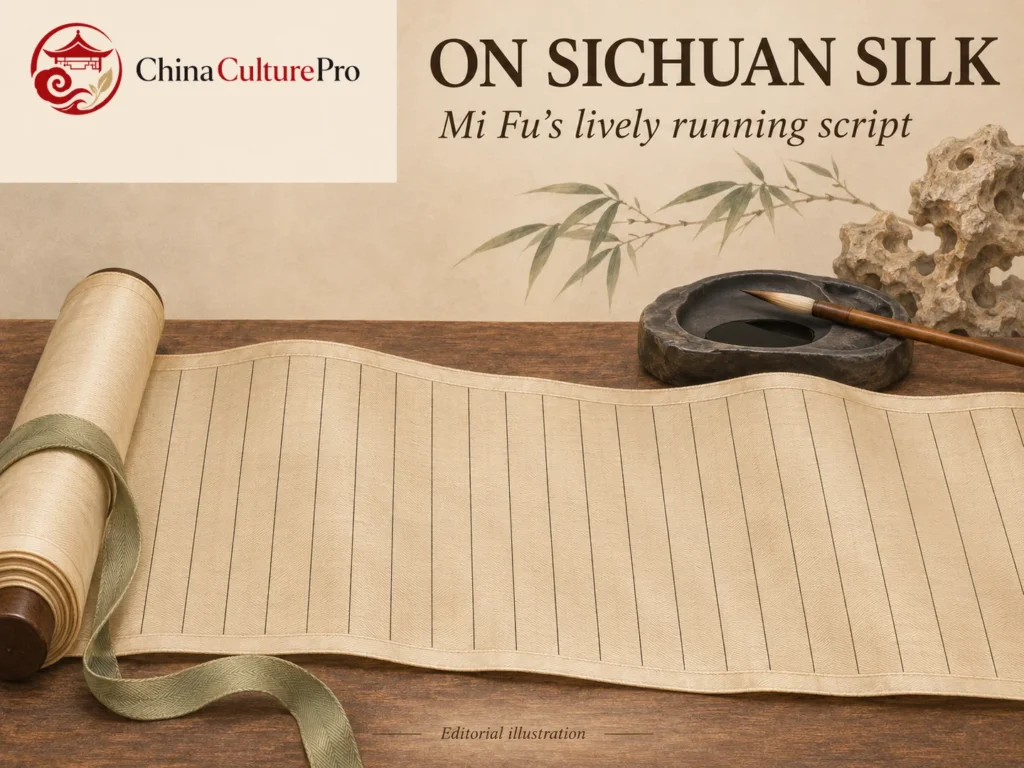
Its black ruling, known as wusilan (乌丝栏, wūsīlán), establishes a regular structure for the calligraphy. The museum’s detailed account distinguishes woven upper and lower lines from vertical lines drawn in ink. The support was prepared specifically for writing.[1]
Look at a line of ruling before looking at a stroke. Its regularity gives you a reference against which to judge changes of angle, width and placement in the characters. What initially looks like a restriction makes the movement of the writing more visible.
The material also changes what the title means. “Sichuan” identifies the silk’s origin; the work’s literary and social circumstances belong to Mi’s travels elsewhere. The guide to ling silk damask (绫, líng) introduces the patterned textile category recorded for the support. The history of Chinese silk gives its broader material context.
Eight Poems Belong to a Journey and Its Friendships
In autumn 1088, Mi accepted a request from Lin Xi (林希, Lín Xī), an official associated with Huzhou in Zhejiang, to write on the treasured silk. He filled it with eight poems in several literary forms.[2][3]
The sequence includes archaic-style poems, travel scenes around Wujiang, verses connected with entering Huzhou, a Double Ninth Festival (重阳节, Chóngyáng Jié) gathering, a response to Lin and a farewell. It gathers different occasions into one sustained work of calligraphy.[3]
That variety matters when viewing the scroll. You can follow the writing as a continuous visual movement while also noticing the breaks between literary pieces. A fresh heading or changed passage gives the eye another point from which to examine rhythm and spacing.
The poems’ subjects connect the object with travel, sociability and the exchange of verse. The Double Ninth Festival guide introduces one of those occasions without turning the whole scroll into a festival illustration.
Mi’s final inscription dates his writing to the twenty-third day of the ninth lunar month in 1088. That date belongs to the calligraphy, while the earlier inscription supplies the material’s separate history.[3]
Slant, Weight and Spacing Create Movement
Mi’s characters repeatedly change their balance. Some lean noticeably, while others seem to recover a more upright stance. Heavy strokes alternate with lighter ones, and changes in size give adjacent forms different kinds of emphasis.[1][2]
Choose a tilted character and compare its central direction with a vertical rule beside it. Then look at the next character. The contrast can make a short sequence feel like an exchange of leaning, turning and recovery.
Next, compare a fuller stroke with a narrow connection or pointed ending. A change in thickness suggests a different action of the brush. It can also alter how much visual weight a character carries within its column.
Spacing supplies a further layer. A tightly gathered group of marks feels different from an open interval, even when both sit within the same ruled framework. Compare the spaces inside characters with those between them.
These small observations are more useful than treating the work as uniformly rapid. Its liveliness comes from changing relationships that remain controlled. The guides to Chinese calligraphy styles and calligraphy brushes support those comparisons of form and tool.
Later Readers Saw Full Commitment in the Brush
The work accumulated comments and seals as it passed through later collections. One memorable response came from Dong Qichang (董其昌, Dǒng Qíchāng), who likened the writing to a lion using its full strength to seize an elephant.[3]
The comparison is a later reader’s interpretation of the calligraphy. It directs attention to commitment and force, even though the individual characters are relatively small.
Try reading the metaphor against a detail. Find a compact form in which the strokes remain sharply differentiated. The effect depends on decisive handling at a small scale, rather than simply making a large mark.
The guide to painting inscriptions and seals helps distinguish a work’s original writing from its later record of appreciation. Keeping those layers separate lets you follow Mi’s hand first, then return to the voices that helped shape its reputation.
How to Compare the Ruling with Mi Fu’s Hand
- Find a clear vertical rule. Use it as a reference for the changing angles of nearby characters.
- Compare two neighboring forms. Look at differences in height, tilt and the amount of open space inside them.
- Follow a change in stroke weight. Move from a broad mark to a fine connection or pointed ending, then consider its effect on the character’s balance.
- Read the object in layers. Separate the poems and Mi’s dated ending from earlier material records and later collectors’ comments.
The guide to reading Chinese calligraphy develops this close-looking approach.
FAQs About On Sichuan Silk by Mi Fu
Did Mi Fu write the work in Sichuan?
The title refers to the silk’s origin. The 1088 writing is associated with Lin Xi’s invitation and Mi’s Huzhou journey in Zhejiang.[2][3]
Does the scroll contain one long poem?
No. It contains eight poems in different forms, bringing several subjects and social occasions into one handscroll.[3]
Are the straight black lines part of Mi Fu’s character strokes?
They are the prepared ruling of the silk support. Mi’s characters vary in angle and weight within that framework.[1]
Sources
[1] National Palace Museum. On Sichuan Silk: the silk’s date, ruling and Mi Fu’s brushwork
[2] National Palace Museum. An Assembly for the Ages: On Sichuan Silk, material and commission
[3] National Palace Museum. On Sichuan Silk: object 912, dimensions, eight poems, dated inscription and later colophons