

Quick Answer: What Is Su Shi’s Ode to the Red Cliff?
Former Ode on the Red Cliff (前赤壁赋, Qián Chìbì Fù) is an ink-on-paper handscroll by Su Shi (苏轼, Sū Shì), written in 1083 after he composed the text in 1082. Preserved at the National Palace Museum in Taipei, its main calligraphic section measures 23.9 × 258 cm. The work combines Su’s literary reflection on a river outing with his carefully controlled handwriting. Its first 36 characters were restored in the Ming dynasty.[1][2]
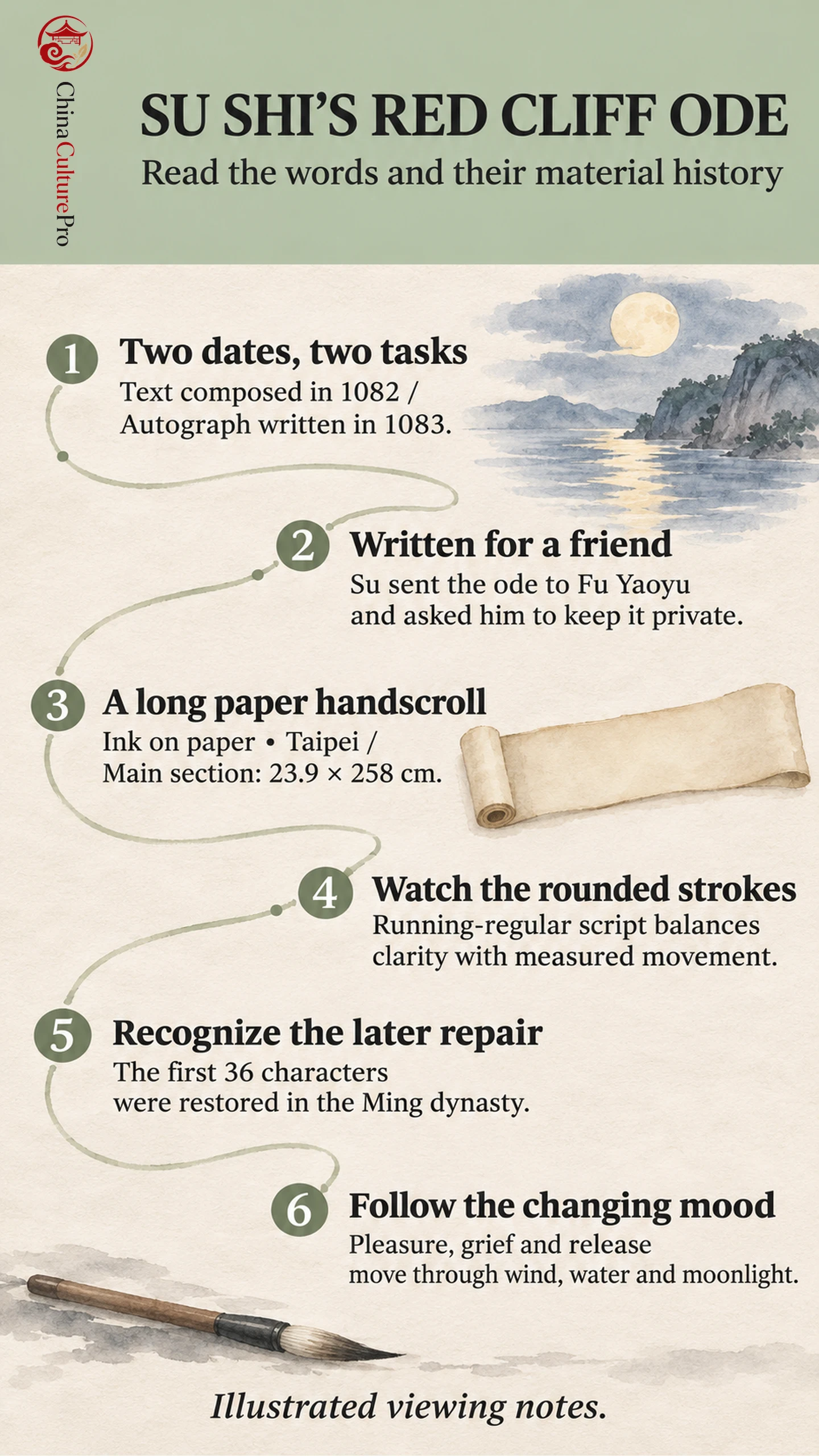
Follow the text’s changing argument, then look at the pace, weight and spacing of the marks that carry it.
The Handscroll at a Glance
| Champ | Identification |
|---|---|
| Calligrapher and author | Su Shi |
| Text composed | 1082 |
| Surviving autograph written | 1083 |
| Période | Northern Song dynasty |
| Medium and format | Ink on paper, handscroll |
| Script | Running-regular script (行楷, xíngkǎi) |
| Main calligraphic section | 23.9 cm high × 258 cm long |
| Collection | National Palace Museum, Taipei |
| Museum object number | 故書000068 |
The main section is 23.9 cm high and 258 cm long. Later comments appear on additional mounted paper.[1][5]
For the writer’s wider career, see Su Shi. His place within Song-dynasty culture helps explain why a literary composition and an individual hand could be valued together.
A Text from 1082, a Handscroll from 1083
Su composed the first ode after an outing at Huangzhou, in present-day Huanggang, Hubei. Its opening situates the journey on the sixteenth day of the seventh lunar month in 1082. A later outing that year produced Latter Ode on the Red Cliff (后赤壁赋, Hòu Chìbì Fù). These are two separate literary works.[2][3]
The surviving calligraphy was written the following year for Fu Yaoyu (傅尧俞, Fù Yáoyú), whose courtesy name was Qinzhi (钦之, Qīnzhī). Su’s concluding note says that he had composed the ode the previous year and was now writing it out in response to his friend’s request.[1][2]
This is therefore an autograph fair copy, rather than the first draft of the essay. The distinction matters when looking at its deliberate, composed writing.
The note also makes the object unusually personal. Following the political difficulties that had brought him to Huangzhou, Su urged his friend to keep the work private. He mentioned the second ode but said that a tired brush would have to leave its transcription for another letter.[2]
The Ode Moves from Pleasure through Grief to Release
The text belongs to the rhapsody tradition, known as fu (赋, fù) in Chinese and also described as poetic prose. Its scenic description, song and dialogue allow the mood to change as the boat journey unfolds.[3]
At first, wind, water and moonlight create expansive pleasure. A guest’s flute then turns the atmosphere toward sadness. Recalling the vanished power of historical heroes, the guest laments the brevity of individual life beside the enduring river.[3]
Su’s answer turns to water and the moon. Both can be understood through change and through continuity. He then directs attention to the freely shared wind and moonlight. The conversation ends with renewed drinking and the travelers sleeping in the boat until dawn.[3]
The movement gives a reader something specific to follow across the scroll: an opening scene, a troubled question and a response that widens the field of thought. The calm impression of the handwriting becomes more interesting when set beside this emotional journey.
Su’s Red Cliff Memories is a separate lyric on a related subject. Recognizing the different titles and literary forms prevents several famous Red Cliff works from collapsing into one poem.
Rounded Brushwork Gives the Words a Measured Pace
The museum classifies the writing as running-regular script (行楷, xíngkǎi). Characters remain relatively clear and self-contained while retaining the mobility of running script. Su’s forms have full, substantial strokes.[4][5]
Look first at a short group of characters rather than trying to absorb the entire 2.58-meter section. Compare a dense cluster of strokes with the open paper around it. Then notice how a rounded turn changes into a firmer edge or a narrower stroke.
The writing feels controlled without becoming mechanically uniform. Differences in width, angle and internal spacing give each character its own balance. That makes the intervals between characters as useful to examine as the ink itself.
The museum’s account emphasizes steady movement and a serene overall appearance. Its recent discussion also draws attention to the precision and fullness of the brushwork.[4][5]
For a wider comparison of script families, use the guide to Chinese calligraphy styles. Here, the useful question is how a mobile hand maintains clarity over a long literary text.
The Opening Includes a Later Ming Restoration
The beginning suffered damage, and the first 36 characters were supplied later. The museum’s catalogue connects the replacement with Wen Zhengming (文徵明, Wén Zhēngmíng), while its research note specifies that his son Wen Peng (文彭, Wén Péng) wrote the replacement on his behalf.[1]
This distinction changes how the scroll should be read. The visible opening is a Ming contribution to the preservation of a Song work. A continuous printed transcription can conceal that material break.
Look for the difference between the restored opening and the surviving Su Shi section before considering the later seals and comments. Those additions document the work’s transmission and appreciation across generations.
Wen’s Ode to the Red Cliff and Zhao Mengfu’s Odes to the Red Cliff are separate calligraphic treatments. They offer a useful next comparison: the same literary subject could produce a different visual experience in another writer’s hand.
How to Read the Scroll in Layers
- Orient the sequence. Begin at the right and follow the vertical columns toward the left. Use an enlarged detail rather than a distant panoramic image.
- Identify the opening repair. Separate the later replacement from the surviving autograph before judging the handwriting as a whole.
- Compare a few characters. Look at stroke fullness, internal spaces and the intervals between forms. Then follow the same qualities through a longer passage.
- Find the final personal note. Notice the shift from the literary work to Su’s message to his friend, then distinguish the later collectors’ material.
The broader guide to reading Chinese calligraphy offers a method for comparing form and rhythm even when you cannot read every character.
FAQs About Ode to the Red Cliff by Su Shi
Is this Su Shi’s original handwriting?
Yes, the scroll preserves Su’s own transcription of the first ode. Its damaged opening includes a later Ming replacement, so the visible text is not entirely in his hand.[1][4]
Does this scroll contain both Red Cliff odes?
No. It transcribes the Former Ode. Su’s concluding note mentions the Latter Ode and postpones writing it out for his friend.[1]
Was Su Shi describing the actual Red Cliff battlefield?
His outing was at Red Nose Cliff outside Huangzhou. The essay evokes the earlier battle through literary remembrance; the site of his boat journey should not simply be equated with the historical battlefield.[2][3]
Sources
[1] National Palace Museum. Former Ode on the Red Cliff: catalogue, transcription, dimensions and research notes
[2] National Palace Museum. Former Ode on the Red Cliff: composition and the copy for Fu Yaoyu
[3] Su Shi. Former Ode on the Red Cliff: classical Chinese text, via Wikisource
[4] National Palace Museum. The Expressive Significance of Brush and Ink: Former Ode to the Red Cliff
[5] He Yanquan, National Palace Museum. Former Ode on the Red Cliff, National Palace Museum Monthly 500, page 45