


Quick Answer: What Was the New Life Movement?
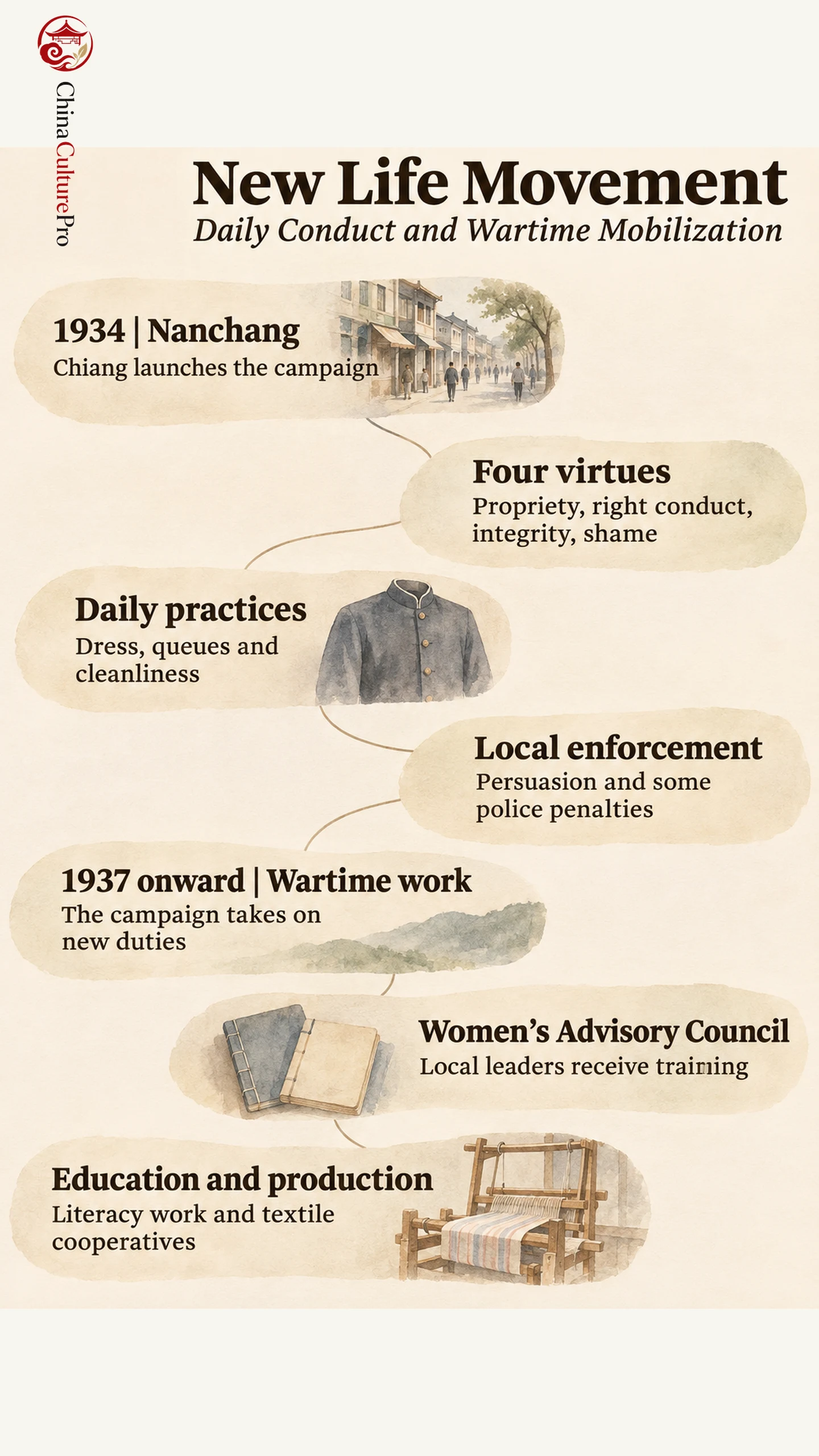
The New Life Movement (新生活运动, Xīn Shēnghuó Yùndòng) was a Nationalist campaign to change daily behavior in Republican China. Chiang Kai-shek (蒋介石, Jiǎng Jièshí) launched it in Nanchang on February 19, 1934. It linked moral conduct and hygiene to national strength. Its organizations later took on tasks connected with the war against Japan. [1][2][3][5][6]
- Message: The campaign asked people to practice four virtues in ordinary life.
- Local practice: Government agents promoted rules about dress, cleanliness and public behavior.
- Wartime work: Women’s organizations trained local workers and supported production and education. [2][3][4][5][6]
The directives were promoted nationally. The people and resources available to carry them out varied by locality. [3][4]
Buttoning a coat properly or standing in line might seem far removed from national defense. The Nationalist campaign treated habits like these as preparation for a more disciplined society.
Why the Campaign Began in Nanchang
In the early 1930s the Nationalist government faced Japanese expansion in northeastern China, Communist opposition and uneven authority in the provinces. Chiang launched the movement from Nanchang in Jiangxi, a base for the government’s military campaigns against the Communists. Its leaders argued that changing conduct could strengthen the state as well as the individual. [1][2][3]
The program drew on the language of Confucian moral cultivation, but applied it to the goals of a modern government. In his 1934 speech, Chiang tied orderliness, frugality and responsibility to readiness for national defense. His speech presented self-discipline as a condition for military preparedness. It also called for changes in production and spending. [1][2][3][4]
Historian Federica Ferlanti traces the program in Jiangxi through associations and local officials. Its organizers tried to extend the government’s reach into communities where it had only limited means of carrying out policy. A campaign could recruit people through associations while leaving much of the work to existing local offices. [3]
How Four Virtues Became Rules for Daily Life
Chiang identified four virtues. Lǐ (礼) meant propriety, yì (义) meant right conduct, lián (廉) meant integrity, and chǐ (耻) meant a sense of shame. He used them to discuss how people should eat, dress, maintain their homes and behave with others. [2]
The campaign translated these principles into instructions that could be taught and observed. They included lining up in crowded places, buttoning clothing fully and keeping personal and public spaces clean. Street behavior was easy for police to observe, while keeping rooms or courtyards clean involved conditions at home. Both became matters for the campaign. [2][3][4]
The speech distinguishes outward conduct from the judgment that precedes it. Chiang used propriety for the form an action took and right conduct for doing what one judged proper. He gave integrity and shame a role in deciding how to act in the first place. That was his own explanation of how the four terms belonged together. [2]
How Local Officials Put the Rules Into Practice
Officials debated how far the government should go. Wang Jingwei argued for persuasion in matters of morality, and Chiang accepted persuasion as an approach. The movement was still incorporated into government work. In April 1935 the Shanghai Public Security Bureau set up a branch to train officers, who were expected to follow the directives themselves and instruct the public. [4]
Shanghai assigned some officers to teams whose first task was persuasion. In cases covered by existing police regulations, officers could penalize repeated violations. Students also taught reading and public conduct in some cities, but they had no police authority. Wennan Liu’s study of local records shows how practices varied with the personnel and resources available. Shanghai police branches reported shortages of street sweepers and poor roads and sanitation facilities, conditions that reminders or penalties could do little to change. [3][4]
What Changed During the War Against Japan
After full-scale war with Japan began in 1937, the movement’s work expanded into wartime organization. Soong Mei-ling (宋美龄, Sòng Měilíng) promoted women’s participation through the Women’s Advisory Council (妇女指导委员会, Fùnǚ Zhǐdǎo Wěiyuánhuì). Its networks linked central organizers to provincial and rural communities. Programs included training local leaders, literacy instruction and production work. [5][6][7]
In Ji’an, Jiangxi, an office opened in 1938 and used household visits to identify women who could be trained to work in nearby rural areas. In Sichuan, the council and government bodies developed textile factories and cooperatives. Some provided work for refugees and offered literacy instruction as well as producing goods. The Hoover Institution’s catalogue identifies surviving publications from provincial women’s committees. Such records can help trace what local organizers did with the program announced in national speeches. [5][6][7]
Ferlanti identifies the Baisha textile factory, opened in Sichuan in January 1939, as one of these projects. It made cotton goods such as cloth and towels. The production sites gave organizers a place to reach workers with literacy classes, although plans to replicate the model were not carried out everywhere. [6]
FAQs About the New Life Movement
Was the New Life Movement a public health campaign?
Public health was one part of a wider program. The movement also addressed dress and manners, while wartime organizations took on literacy work and production. [2][3][4][6]
Were all the New Life rules laws?
Many were campaign directives promoted by education or persuasion. Some could be enforced by police under existing regulations, depending on the conduct involved and local practice. [4]
What role did Soong Mei-ling play?
Soong Mei-ling helped direct women’s mobilization through the Women’s Advisory Council. Its provincial and local organizers trained women for leadership and worked with communities on wartime production and education. [5][6][7]
Sources
[1] Arif Dirlik. The Ideological Foundations of the New Life Movement: A Study in Counterrevolution
[2] Chiang Kai-shek, reproduced by Columbia University’s Asia for Educators. Essentials of the New Life Movement, 1934
[3] Federica Ferlanti. The New Life Movement in Jiangxi Province, 1934–1938
[4] Wennan Liu. Redefining the Moral and Legal Roles of the State in Everyday Life
[5] Xiaoping Sun. New Life Meets Real Life: Chinese Women in Nation Building and State Making, 1934–1949
[6] Federica Ferlanti. Women’s Activism and Mobilization in Wartime China
[7] Hoover Institution Library and Archives. Kuomintang Microfilming Project Hits Million-Page Mark